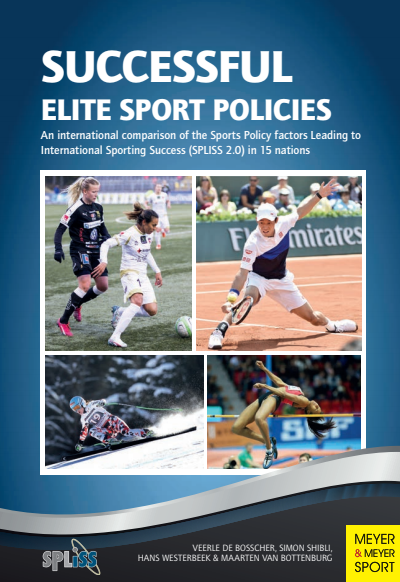
Successful Elite Sport Policies
An international comparison of the Sports Policy factors Leading to International Sporting Success (SPLISS 2.0) in 15 nations- Authors:
- , , ,
- Publisher:
- 01.09.2015
Summary
How can nations improve their chances of winning medals in international sport? This book deals with the strategic policy planning process that underpins the development of successful national elite sport development systems. Drawing on various international competitiveness studies, it examines how nations develop and implement policies that are based on the critical success factors that may lead to competitive advantage in world sport. An international group of researchers joined forces to develop theories, methods and a model on the Sports Policy factors Leading to International Sporting Success (SPLISS). The book presents the results of the large-scale international SPLISS-project. In this project the research team identified, compared and contrasted elite sport policies and strategies in place for the Olympic Games and other events in 15 distinct nations. With input from 58 researchers and 33 policy makers worldwide and the views of over 3,000 elite athletes, 1,300 high performance coaches and 240 performance directors, this work is the largest benchmarking study of national elite sport policies ever conducted. The nations taking part in SPLISS are: • Americas: Brazil and Canada • Asia: Japan and South Korea • Europe: Belgium (Flanders & Wallonia), Denmark, Estonia, Finland, France, the Netherlands, Northern Ireland, Portugal, Spain, Switzerland • Oceania: Australia
Keywords
Search publication
Bibliographic data
- Publication year
- 2015
- Publication date
- 01.09.2015
- ISBN-Print
- 978-1-78255-744-9
- ISBN-Online
- 978-1-78255-744-9
- Publisher
- Meyer & Meyer Verlag, Aachen
- Language
- English
- Pages
- 400
- Product type
- Book Titles
Table of contents
- Titelei/Inhaltsverzeichnis No access Pages II - 14
- 1 Introduction No access Pages 15 - 36
- 2 Theoretical underpinnings of the SPLISS model No access Pages 37 - 58
- 3 Methodologies and samples No access Pages 59 - 86
- 4 Outputs–Measuring the success of elite sport policy No access Pages 87 - 108
- 5 Pillar 1: Financial support No access Pages 109 - 132
- 6 Pillar 2: Governance, organisation and structure of (elite) sport policies: An integrated approach to policy development No access Pages 133 - 180
- 7 Pillar 3: Sport participation No access Pages 181 - 196
- 8 Pillar 4: Talent identification and development No access Pages 197 - 232
- 9 Pillar 5: Athletic career and post-career support No access Pages 233 - 260
- 10 Pillar 6: Training facilities No access Pages 261 - 278
- 11 Pillar 7: Coach provision and coach development No access Pages 279 - 310
- 12 Pillar 8: National and international competition/events No access Pages 311 - 328
- 13 Pillar 9: Sport science support, scientific research and innovation in elite sport No access Pages 329 - 350
- 14 Conclusions: Successful elite sport policies No access Pages 351 - 400