, to see if you have full access to this publication.
Monograph No access
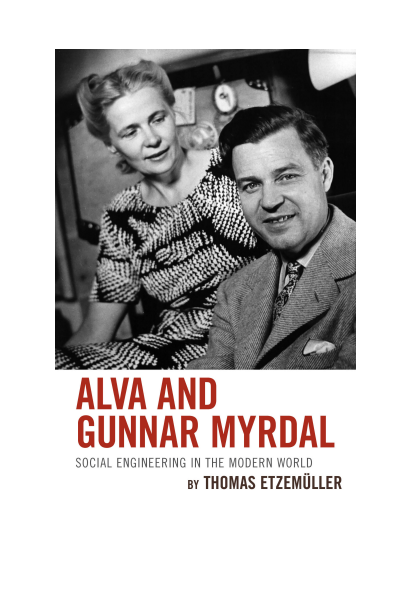
Alva and Gunnar Myrdal
Social Engineering in the Modern World
Authors:
Publisher:
2014
Summary
As two of the leading social scientists of the twentieth century, Alva and Gunnar Myrdal tried to establish a harmonious, “organic” Gemeinschaft [community] in order to fight an assumed disintegration of modern society. By means of functionalist architecture and by educating “sensible” citizens, disciplining bodies, and reorganizing social relationships they attempted to intervene in the lives of ordinary men. The paradox of this task was to modernize society in order to defend it against an “ambivalent modernity.” This combination of Weltanschauung [world view], social science, and technical devices became known as social engineering.
The Myrdals started in the early 1930s with Sweden, and then chose the world as their working field. In 1938, Gunnar Myrdal was asked to solve the “negro problem” in the United States, and, in the 1970s, Alva Myrdal campaigned for the world's super powers to abolish all of their nuclear weapons. The Myrdals successfully established their own "modern American" marriage as a media image and role model for reform. Far from perfect, their marriage was disrupted by numerous conflicts, mirrored in thousands of private letters. This marital conflict propelled their urge for social reform by exposing the need for the elimination of irrational conflicts from everyday life. A just society, according to the Myrdals, would merge social expertise with everyday life, and ordinary men with the intellectually elite.
Thomas Etzemüller's study of these two figures brings to light the roots of modern social engineering, providing insight for today's sociologists, historians, and political scholars.
Keywords
Search publication
Bibliographic data
Edition
1/2014
Copyright Year
2014
ISBN-Print
978-0-7391-8874-3
ISBN-Online
978-0-7391-8875-0
Publisher
Lexington, Lanham
Language
English
Pages
366
Product Type
Monograph
Table of contents
ChapterPages
Contents No access
List of Illustrations No access
Preface No access
Acknowledgments No access
Abbreviations No access
Chapter One: Introduction No access Pages 1 - 18
Chapter Two: Orchestrated Lives No access Pages 19 - 36
Chapter Three: Exploratory Steps No access Pages 37 - 64
Chapter Four: The Project of Modernity No access Pages 65 - 106
Chapter Five: The Power of Cold Reason No access Pages 107 - 140
Chapter Six: Rebuilding Society No access Pages 141 - 184
Chapter Seven: Project Child No access Pages 185 - 206
Chapter Eight: An Exemplary Life? No access Pages 207 - 250
Chapter Nine: America No access Pages 251 - 284
Chapter Ten: World Citizens No access Pages 285 - 320
Chapter Eleven: Conclusion No access Pages 321 - 330