, to see if you have full access to this publication.
Monograph No access
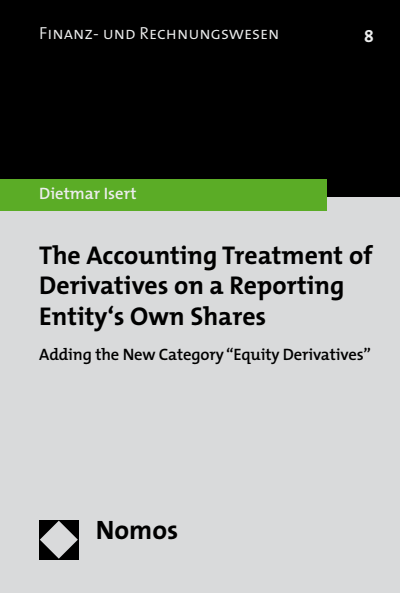
The Accounting Treatment of Derivatives on a Reporting Entity's Own Shares
Adding the New Category "Equity Derivatives"- Authors:
- Series:
- Finanz- und Rechnungswesen, Volume 8
- Publisher:
- 2009
Summary
Die Bilanzierung von Finanzierungsinstrumenten und von Derivaten auf eigene Aktien wird seit Jahren zwischen dem IASB und dem FASB kontrovers diskutiert. Um die Vorteilhaftigkeit unterschiedlicher Bilanzierungsprinzipien hinsichtlich der Abbildung von Derivaten auf eigene Aktien bewerten zu können, ist eine Reihe von Beurteilungskriterien aufgestellt worden. Dabei werden die Vor- und Nachteile der von den Standardsettern veröffentlichten Ansätze und eine neu entwickelte Methode systematisch dargestellt. Mit zahlreichen Beispielen wie etwa Warrants, Aktienrückkaufvereinbarungen und langfristig vereinbarte Kapitalerhöhungen wird die finanzwirtschaftliche Perspektive betont.
Search publication
Bibliographic data
- Edition
- 1/2009
- Copyright Year
- 2009
- ISBN-Print
- 978-3-8329-4504-6
- ISBN-Online
- 978-3-8452-1723-9
- Publisher
- Nomos, Baden-Baden
- Series
- Finanz- und Rechnungswesen
- Volume
- 8
- Language
- English
- Pages
- 231
- Product Type
- Monograph
Table of contents
ChapterPages
- Titelei/Inhaltsverzeichnis No access Pages 2 - 13Authors:
- List of Exhibits No access Pages 14 - 14Authors:
- List of Abbreviations No access Pages 15 - 16Authors:
- Problem formulation No access Pages 17 - 23Authors:
- General accounting research approaches No access Pages 24 - 25Authors:
- Developments in the accounting standards of the IASB and FASB regarding financing instruments and derivatives on an entity’s own shares No access Pages 25 - 27Authors:
- The perception of the market regarding debt and equity (accounting) considerations No access Pages 27 - 30Authors:
- Recognizing or disclosing accounting information No access Pages 30 - 31Authors:
- Balance sheet presentation of financing instruments and derivatives on an entity’s own shares No access Pages 31 - 37Authors:
- Overview No access Pages 38 - 41Authors:
- First criterion: displaying relevant information in the body of the financial statements No access Pages 41 - 44Authors:
- Second criterion: providing reliable information for users of the financial statements No access Pages 44 - 47Authors:
- Third criterion: liquidity and solvency concerns No access Pages 47 - 48Authors:
- Fourth criterion: comparability of the financial statements over time and between different entities No access Pages 48 - 50Authors:
- Fifth criterion: consistent recognition requirements and a consistent measurement basis for derivatives on an entity’s own shares No access Pages 50 - 52Authors:
- Sixth criterion: correspondence between the accounting treatment of one and several contracts No access Pages 52 - 55Authors:
- Seventh criterion: reclassification of the components of derivatives on an entity’s own shares No access Pages 55 - 57Authors:
- Definition and economic analysis of derivatives on an entity’s own shares No access Pages 58 - 62Authors:
- Authors:
- Introduction No accessAuthors:
- Accounting principle 1: classification as financial asset/financial liability derivatives No accessAuthors:
- Accounting principle 2: classification as ‘equity derivatives’ No accessAuthors:
- Accounting principle 3: classification as equity No accessAuthors:
- Accounting principle 4: classification as non-derivative financial assets or as non-derivative financial liabilities No accessAuthors:
- Summary of the four accounting principles regarding derivatives on an entity’s own shares No accessAuthors:
- The economic unit theory and the parent company theory No access Pages 74 - 75Authors:
- The reassessed expected outcomes approach – a variation of accounting principles regarding derivatives on an entity’s own shares No access Pages 75 - 77Authors:
- General annotations regarding the fact patters presented about derivatives on an entity’s own shares No access Pages 77 - 79Authors:
- Fact pattern No access Pages 79 - 80Authors:
- Authors:
- Possible accounting principles No accessAuthors:
- Classification of the short forward contract as a financial asset/financial liability derivative No accessAuthors:
- Classification of the short forward contract as an ‘equity derivative’ No accessAuthors:
- Classification of the short forward contract as equity No accessAuthors:
- Classification of the forward price as a non-derivative financial asset No accessAuthors:
- Fact pattern No access Pages 87 - 88Authors:
- Authors:
- Possible accounting principles No accessAuthors:
- Classification of the long forward contract as a financial asset/financial liability derivative No accessAuthors:
- Classification of the long forward contract as an ‘equity derivative’ No accessAuthors:
- Classification of the long forward contract as equity No accessAuthors:
- Classification of the forward price as a non-derivative financial liability No accessAuthors:
- Fact pattern No access Pages 95 - 96Authors:
- Authors:
- Possible accounting principles No accessAuthors:
- Classification of the short call option contract as a financial liability derivative No accessAuthors:
- Classification of the short call option contract as an ‘equity derivative’ No accessAuthors:
- Classification of the short call option contract as equity No accessAuthors:
- Classification of the exercise price of the short call option as a non-derivative financial asset No accessAuthors:
- Additional considerations if the short call option is out of the money at maturity No access Pages 102 - 103Authors:
- Fact pattern No access Pages 103 - 104Authors:
- Authors:
- Possible accounting principles No accessAuthors:
- Classification of the long call option contract as a financial asset derivative No accessAuthors:
- Classification of the long call option contract as an ‘equity derivative’ No accessAuthors:
- Classification of the long call option contract as equity No accessAuthors:
- Classification of the exercise price of the long call option as a non-derivative financial liability No accessAuthors:
- Additional considerations if the long call option is out of the money at maturity No access Pages 110 - 111Authors:
- Fact pattern No access Pages 111 - 112Authors:
- Authors:
- Possible accounting principles No accessAuthors:
- Classification of the long put option contract as a financial asset derivative No accessAuthors:
- Classification of the long put option contract as an ‘equity derivative’ No accessAuthors:
- Classification of the long put option contract as equity No accessAuthors:
- Classification of the exercise price of the long put option as a non-derivative financial asset No accessAuthors:
- Additional considerations if the long put option is out of the money at maturity No access Pages 118 - 119Authors:
- Fact pattern No access Pages 119 - 120Authors:
- Authors:
- Possible accounting principles No accessAuthors:
- Classification of the short put option contract as a financial liability derivative No accessAuthors:
- Classification of the short put option contract as an ‘equity derivative’ No accessAuthors:
- Classification of the short put option contract as equity No accessAuthors:
- Classification of the exercise price of the short put option as a non-derivative financial liability No accessAuthors:
- Additional considerations if the short put option is out of the money at maturity No access Pages 126 - 127Authors:
- Overview No access Pages 127 - 128Authors:
- Applying the assessment criteria to the first accounting principle ‘financial asset and financial liability derivatives’ No access Pages 128 - 134Authors:
- Applying the assessment criteria to the second accounting principle ‘equity derivatives’ No access Pages 134 - 139Authors:
- Applying the assessment criteria to the third accounting principle ‘equity’ No access Pages 139 - 140Authors:
- Applying the assessment criteria to the fourth accounting principle ‘non-derivative financial assets and non-derivative financial liabilities’ No access Pages 140 - 143Authors:
- Applying the assessment criteria to the accounting principles of the reassessed expected outcomes approach No access Pages 143 - 145Authors:
- Evaluating the advantages and disadvantages of the accounting principles regarding derivatives on an entity’s own shares No access Pages 145 - 155Authors:
- Introduction No access Pages 155 - 159Authors:
- US-GAAP SFAS 150 and EITF Issue No. 00-19 No access Pages 159 - 161Authors:
- IFRS statement IAS 32 No access Pages 161 - 163Authors:
- Current approaches of the FASB No access Pages 163 - 164Authors:
- Summary and conclusions regarding the application of different accounting principles to diverse derivatives on own shares No access Pages 164 - 167Authors:
- Overview No access Pages 168 - 171Authors:
- Deep in the money short call option contracts on an entity’s own shares No access Pages 171 - 181Authors:
- Deep in the money long call option contracts on an entity’s own shares No access Pages 181 - 188Authors:
- Deep in the money short put option contracts on an entity’s own shares No access Pages 188 - 197Authors:
- Deep in the money long put option contracts on an entity’s own shares No access Pages 197 - 205Authors:
- Evaluating the advantages and disadvantages of the accounting principles regarding deep in the money options on an entity’s own shares No access Pages 205 - 208Authors:
- Reclassification of (not) deep in the money options on an entity’s own shares No access Pages 208 - 216Authors:
- Summary of findings No access Pages 217 - 223Authors:
- Literature No access Pages 224 - 231Authors: