, to see if you have full access to this publication.
Monograph No access
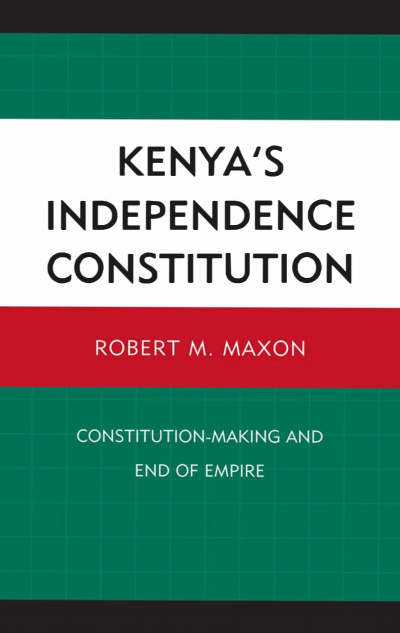
Kenya's Independence Constitution
Constitution-Making and End of Empire
Authors:
Publisher:
2011
Summary
Kenya's Independence Constitution: Constitution-Making and End of Empire, by Robert M. Maxon, is a narrative of the evolution of the constitution that was put into effect as Kenya's history as a colonial possession came to an end. It details the attempts of the colony's political elite and the British Colonial Office to find a constitutional means to move Kenya to the status of independent state. As this process moved forward, political ethnicity assumed central significance. This produced an environment in which demands for a federal constitution, popularly termed majimbo, came to dominate constitutional discourse. Deep disagreement among Kenya's political elite over this issue marked the remainder of the colonial period. That elite, now represented by the Kenya African National Union (KANU) and the Kenya African Democratic Union (KADU), advocated different constitutional paths to independence. KADU's demands for a majimbo constitution dominated discourse during 1962 and early 1963, but deep disagreement characterized the constitutional negotiations. This resulted in a constitution for self-government (introduced on June 1, 1963) that was regional in character but fell short of a federal system. Almost as soon as it came into existence, this constitution faced pressure for substantial change from KANU, the party that won the 1963 general election. As a result, the British government was forced to make alterations in what became the independence constitution. The latter proved a prelude to the destruction of majimbo a year later. Kenya's Independence Constitution provides the first in-depth description of the final stage of colonial Kenya's constitutional evolution. The book not only provides a detailed account of the process of constitution-making, including definitive treatments of the final two constitutional conferences of 1962 and 1963. Utilizing British and Kenya cabinet papers and secret intelligence reports never featured in earlier accounts, the narrative also destroys many of the myths that have long been associated with Kenya's decolonization, such as the alleged favoritism for federalism and support given by the colonial state and Colonial Office to KADU and the reasons for KANU's hostility to the self government constitution. It makes a particularly significant contribution by illuminating the genesis of KADU's majimbo policy and emphasizing the African agency involved. The book is most timely as the Kenya political elite struggles to find a new constitutional order to replace that which had its roots in the independence constitution.
Keywords
Search publication
Bibliographic data
Edition
1/2011
Copyright Year
2011
ISBN-Print
978-1-61147-052-9
ISBN-Online
978-1-61147-053-6
Publisher
Lexington, Lanham
Language
English
Pages
360
Product Type
Monograph
Table of contents
ChapterPages
Contents No access
Preface No access
List of Abbreviations No access
1. Background to Constitution-Making and Decolonization No access Pages 15 - 29
2. Pressures for a New Constitution: Kenya, 1960–61 No access Pages 30 - 53
3. Majimbo Takes Center Stage No access Pages 54 - 76
4. The Battle for Majimbo: Lancaster House II No access Pages 77 - 112
5. Making the Constitution, April–December 1962 No access Pages 113 - 151
6. Completing the Constitution, December 1962–April 1963 No access Pages 152 - 175
7. The 1963 Election and Setting a Date for Independence No access Pages 176 - 200
8. Change the Constitution Part 1, April–September 1963 No access Pages 201 - 220
9. Change the Constitution Part 2: Lancaster House III and Kenya's Independence Constitution, September–December 1963 No access Pages 221 - 266
10. Constitution-Making: Uhuru na Majimbo No access Pages 267 - 276