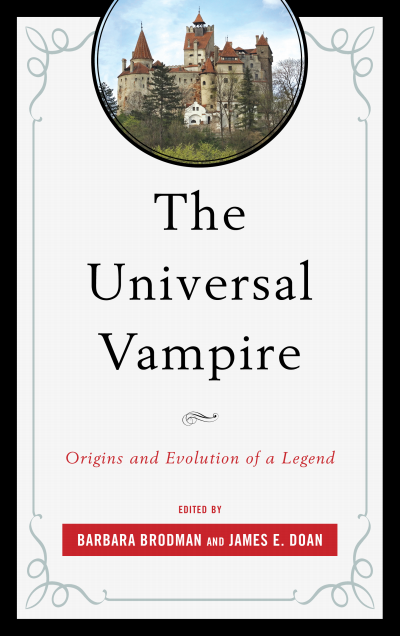
The Universal Vampire
Origins and Evolution of a Legend- Editors:
- |
- Publisher:
- 2013
Summary
Since the publication of John Polidori’s The Vampyre (1819), the vampire has been a mainstay of Western culture, appearing consistently in literature, art, music (notably opera), film, television, graphic novels and popular culture in general. Even before its entrance into the realm of arts and letters in the early nineteenth century, the vampire was a feared creature of Eastern European folklore and legend, rising from the grave at night to consume its living loved ones and neighbors, often converting them at the same time into fellow vampires.
A major question exists within vampire scholarship: to what extent is this creature a product of European cultural forms, or is the vampire indeed a universal, perhaps even archetypal figure? In this collection of sixteen original essays, the contributors shed light on this question. One essay traces the origins of the legend to the early medieval Norse draugr, an “undead” creature who reflects the underpinnings of Dracula, the latter first appearing as a vampire in Anglo-Irish Bram Stoker’s 1897 novel, Dracula.
In addition to these investigations of the Western mythic, literary and historic traditions, other essays in this volume move outside Europe to explore vampire figures in Native American and Mesoamerican myth and ritual, as well as the existence of similar vampiric traditions in Japanese, Russian and Latin American art, theatre, literature, film, and other cultural productions.
The female vampire looms large, beginning with the Sumerian goddess Lilith, including the nineteenth-century Carmilla, and moving to vampiresses in twentieth-century film, literature, and television series. Scientific explanations for vampires and werewolves constitute another section of the book, including eighteenth-century accounts of unearthing, decapitation and cremation of suspected vampires in Eastern Europe. The vampire’s beauty, attainment of immortality and eternal youth are all suggested as reasons for its continued success in contemporary popular culture.
Keywords
Search publication
Bibliographic data
- Edition
- 1/2013
- Copyright Year
- 2013
- ISBN-Print
- 978-1-61147-580-7
- ISBN-Online
- 978-1-61147-581-4
- Publisher
- Lexington, Lanham
- Language
- English
- Pages
- 250
- Product Type
- Edited Book
Table of contents
- Contents No access
- Acknowledgments No access
- Introduction No access
- Chapter 1. “Draugula”: The Draugr in Old Norse-Icelandic Saga Literature and His Relationship to the Post-Medieval Vampire Myth No access
- Chapter 2. Dracula Anticipated: The “Undead” in Anglo-Irish Literature No access
- Chapter 3. Retracing the Shambling Steps of the Undead: The Blended Folkloric Elements of Vampirism in Bram Stoker’s Dracula No access
- Chapter 4. Dracula’s Kitchen: A Glossary of Transylvanian Cuisine, Language, and Ethnography No access
- Chapter 5. Biomedical Origins of Vampirism No access
- Chapter 6. Evidence for the Undead: The Role of Medical Investigation in the 18th-Century Vampire Epidemic No access
- Chapter 7. Undead Feedback: Adaptations and Echoes of Johann Flückinger’s Report, Visum et Repertum (1732), until the Millennium No access
- Chapter 8. Women with Bite: Tracing Vampire Women from Lilith to Twilight No access
- Chapter 9. Vampiresse: Embodiment of Sensuality and Erotic Horror in Carl Th. Dreyer’s Vampyr and Mario Bava’s The Mask of Satan No access
- Chapter 10. The Vampire in Native American and Mesoamerican Lore No access
- Chapter 11. Vampiric Viragoes: Villainizing and Sexualizing Arthurian Women in Dracula vs. King Arthur (2005) No access
- Chapter 12. “If I Wasn’t a Girl, Would You Like Me Anyway?” Le Fanu’s Carmilla and Alfredson’s Let the Right One In No access
- Chapter 13. A Cultural Dynasty of Beautiful Vampires: Japan’s Acceptance, Modifications, and Adaptations of Vampires No access
- Chapter 14. From Russia with Blood: Imagining the Vampire in Contemporary Russian Popular Culture No access
- Chapter 15. Dracula Comes to Mexico: Carlos Fuentes’s Vlad, Echoes of Origins, and the Return of Colonialism No access
- Chapter 16. Sublime Horror: Transparency, Melodrama, and the Mise-en-Scène of Two Mexican Vampire Films No access
- Selected Bibliography No access Pages 239 - 240
- Index No access Pages 241 - 244
- About the Editors No access Pages 245 - 250