, to see if you have full access to this publication.
Edited Book No access
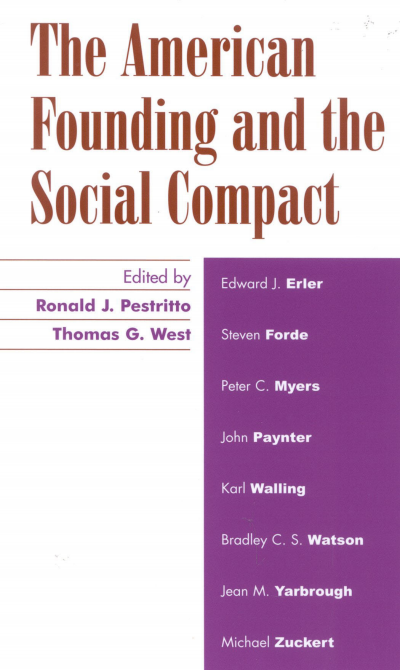
The American Founding and the Social Compact
Editors:
|
Publisher:
2003
Summary
Unlike many other books about the American founding, this new work by two of the most prominent scholars of American political history emphasizes the coherence and intelligibility of the social compact theory. Social compact theory, the idea that government must be based on an agreement between those who govern and those who consent to be governed, was one of the Founders' few unifying philosophical positions, and it transcended the partisan politics of that era. Contributors to this volume present a comprehensive overview of the social compact theory, discussing its European philosophical origins, the development of the theory into the basis of the fledgling government, and the attitudes of some of the founders toward the theory and its traditional proponents. The authors argue forcefully and convincingly that the political ideas of the American Founders cannot be properly understood without understanding social compact theory and the exalted place it held in the construction of the American system of government.
Search publication
Bibliographic data
Edition
1/2003
Copyright Year
2003
ISBN-Print
978-0-7391-0664-8
ISBN-Online
978-0-585-47937-8
Publisher
Lexington, Lanham
Language
English
Pages
283
Product Type
Edited Book
Table of contents
ChapterPages
Contents No access
Preface No access
1 Locke on the Social Compact: An Overview Peter C. Myers No access Pages 1 - 36
2 Social Compact, Common Law, and the American Amalgam: The Contribution of William Blackstone Michael Zuckert No access Pages 37 - 74
3 Hume, Historical Inheritance, and the Problem of Founding Bradley C. S. Watson No access Pages 75 - 94
4 The Political Theory of the Declaration of Independence Thomas G. West No access Pages 95 - 146
5 Thomas Jefferson and the Social Compact Jean M. Yarbrough No access Pages 147 - 162
6 From Subjects to Citizens: The Social Compact Origins of American Citizenship Edward J. Erler No access Pages 163 - 198
7 Alexander Hamilton and the Grand Strategy of the American Social Compact Karl Walling No access Pages 199 - 230
8 John Adams' "Hobbism" John Paynter No access Pages 231 - 254
9 Benjamin Franklin and the Theory of Social Compact Steven Forde No access Pages 255 - 276