, to see if you have full access to this publication.
Monograph No access
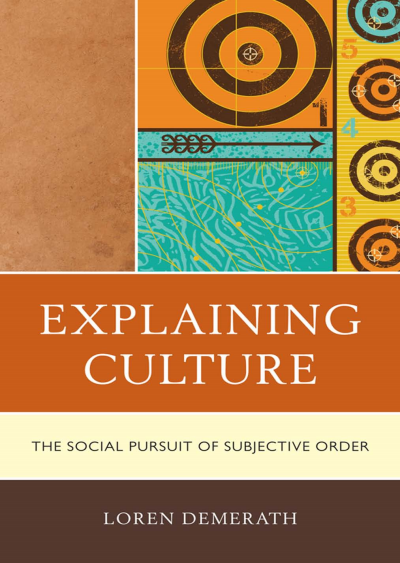
Explaining Culture
The Social Pursuit of Subjective Order
Authors:
Publisher:
2012
Summary
This book is about our appreciation for order and meaningfulness. It offers a new theory of that feeling inspired by Durkheim and Marx, then derives other theories to answer a range of questions: why we like to make ourselves orderly (in Chapter Three’s theory of identity and commitment), why create shared orders of meaning (in Chapter Four’s theory of culture); how we create those orders collaboratively through conversation (Chapter Five), and also through narrative, symbolic, and ritualistic formats (Chapter Six), and how orders of meaning are created in response to social structural position (Chapter Seven). In the end, this book shows how our sense of order both integrates and segregates us into productive associations with one another.
And so, Explaining Culture is able to explain two patterns common to all growth: expansion and centralization. We see how our desire for novelty disperses us for resources, and that for familiarity draws us together to create meaningful order from them. Indeed, this book may offer a new approach to answering one of the most basic questions in both social and natural science: the question of how organic systems like society are created and maintained.
Explaining Culture is an important new step in answering our most basic questions about culture, social interaction, and the emergence of order. The unique contribution of this work is in identifying the determinants of meaningfulness, and the ways we make the world meaningful by ordering it. Our valuing of order is rarely mentioned in sociology, but this book shows how it is the key influence in how we order ourselves and each other.
Keywords
Search publication
Bibliographic data
Edition
1/2012
Copyright Year
2012
ISBN-Print
978-0-7391-1638-8
ISBN-Online
978-0-7391-7542-2
Publisher
Lexington, Lanham
Language
English
Pages
153
Product Type
Monograph
Table of contents
ChapterPages
Contents No access
Preface No access
Chapter 1 Alienation and Anomia as a Basis for Theorizing Culture No access Pages 1 - 16
Chapter 2 Knowledge-Based Affect and the Pleasures of Order No access Pages 17 - 30
Chapter 3 Putting Ourselves in Order: An Epistemological Identity Theory No access Pages 31 - 44
Chapter 4 The Social Pursuit of Meaningfulness: An Epistemological Theory of Culture No access Pages 45 - 68
Chapter 5 The Pursuit of Meaningfulness through Epistemological Conversation No access Pages 69 - 84
Chapter 6 Conditions for Community and Culture No access Pages 85 - 102
Chapter 7 Network Position, Knowledge-Based Affect, and Cultural Manipulation No access Pages 103 - 118