, to see if you have full access to this publication.
Monograph No access
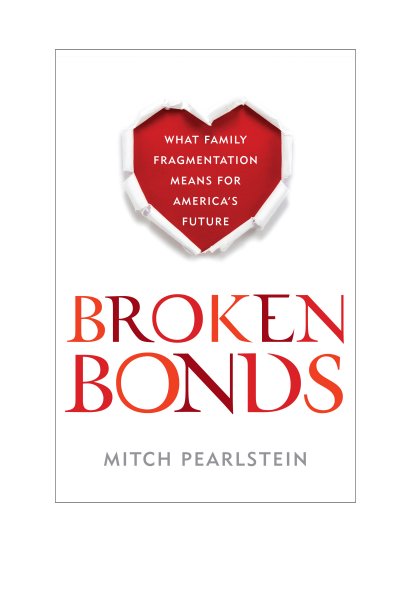
Broken Bonds
What Family Fragmentation Means for America’s Future
Authors:
Publisher:
2014
Summary
The United States has the highest family fragmentation rates in the industrial world. Nonmarital birth rates for the nation as a whole are 40%, with proportions dramatically higher in many communities as defined by race, ethnicity, or geography. Divorce rates, while moderating in recent decades, are still estimated at about 40% for first marriages and 50% for second ones. Together, this fragmentation impacts millions of children as well as adults, leading to educational, economic, and other losses that in turn lead to lower social mobility and deepening class divisions.
In Broken Bonds, Mitch Pearlstein explores the declining state of the American family and what its disintegration means for our future. Based on candid interviews with forty leading family experts across the political spectrum - from Stephanie Coontz, to Heather Mac Donald - Pearlstein ruminates on the political, social, and spiritual fallout of this trend. In honest and frank conversations, Pearlstein and his interviewees fearlessly diagnose the problems that many have been too timid to explore and suggest ways to reverse these trends that threaten our social fabric.
Search publication
Bibliographic data
Edition
1/2014
Copyright Year
2014
ISBN-Print
978-1-4422-3663-9
ISBN-Online
978-1-4422-3664-6
Publisher
Rowman & Littlefield, Lanham
Language
English
Pages
145
Product Type
Monograph
Table of contents
ChapterPages
Contents No access
Acknowledgments No access
Introduction No access
Chapter One: How Big of a Problem? No access Pages 1 - 16
Chapter Two: Why Are Family Fragmentation Rates So High? No access Pages 17 - 34
Chapter Three: How Well Do We Know and Feel for Each Other? No access Pages 35 - 50
Chapter Four: Stuck in Place? No access Pages 51 - 64
Chapter Five: How Will We Govern? No access Pages 65 - 80
Chapter Six: What Will America Look Like and Be? No access Pages 81 - 100
Chapter Seven: What to Do? No access Pages 101 - 124
Chapter Eight: Conclusion No access Pages 125 - 132