, to see if you have full access to this publication.
Monograph No access
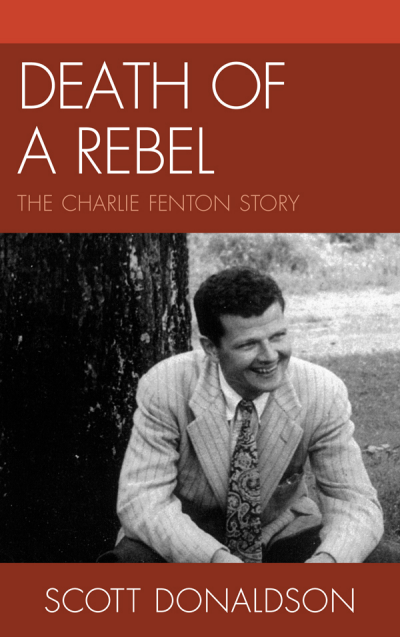
Death of a Rebel
The Charlie Fenton Story
Authors:
Publisher:
2011
Summary
Death of a Rebel tells the story of Charles Andrews Fenton (1919-1960), a charismatic
teacher, scholar, and writer who took his own life by jumping from the top of the Washington Duke Hotel in Durham, North Carolina. At the time he was apparently at the peak of his career. He had written excellent books on Hemingway and Stephen Vincent Benét, had three other books in press, and was working on a new version of his novel about World War II (a 1945 account won the Doubleday Twentieth Century Fox award). He had earned Guggenheim and ACLS grants. Students flocked to his courses. He was widely regarded as the most popular professor at Duke.
Charlie Fenton’s story is a compelling one, and takes on further meaning in the context of the times. An individualist during the notoriously conformist 1950s, he swam against the current, defying authority and openly inviting controversy. This jaunty refusal to accept received wisdom made him an appealing figure to many of his students and colleagues. But it was a dangerous stance that did not sit well with his superiors, and it cost him when his fortunes took a turn for the worse in the spring and summer of 1960.
Love and war had a lot to do with his suicide as well. Charlie Fenton, who had come down to Duke from Yale two years earlier with a promotion to full professor, fell in love with one of his graduate students. His wife, outraged, left and took their son Andy with her. The scandal left him alone and a social pariah around campus. Then he suffered one of his bouts of depression. Usually these periods were triggered by trauma, most of it derived from his service as a tail gunner with the RAF bomber command in the summer and fall of 1942. In the past he’d always been able to shake free of his despondency. This time he was overcome by psychological pain deriving from loss: of wife and family, of public admiration, of companionship, and worst of all, of self-regard.
The book recounts Fenton’s last days in vivid detail. In writing it, Donaldson had the assistance of family members, of his devoted students, and even – at a painful distance – of the woman he fell in love with fifty years ago. They all share an abiding sense of what might have been, and a deep regret that he could not go on to inspire the uncounted students who would never get to know and admire and learn from him.
Search publication
Bibliographic data
Edition
1/2011
Copyright Year
2011
ISBN-Print
978-1-61147-493-0
ISBN-Online
978-1-61147-494-7
Publisher
Lexington, Lanham
Language
English
Pages
188
Product Type
Monograph
Table of contents
ChapterPages
Contents No access
Acknowledgments No access
Introduction No access Pages 1 - 4
Chapter 01. First Sighting No access Pages 5 - 10
Chapter 02. Bomber Boy No access Pages 11 - 32
Chapter 03. The Young Academic No access Pages 33 - 52
Chapter 04. Hemingway vs. Fenton No access Pages 53 - 74
Chapter 05. Carving a Career No access Pages 75 - 92
Chapter 06. A Different Planet No access Pages 93 - 118
Chapter 07. Sailing through Air No access Pages 119 - 144
Chapter 08. What Might Have Been No access Pages 145 - 166
Notes on Sources No access Pages 167 - 174
A Charles A. Fenton Bibliography No access Pages 175 - 178