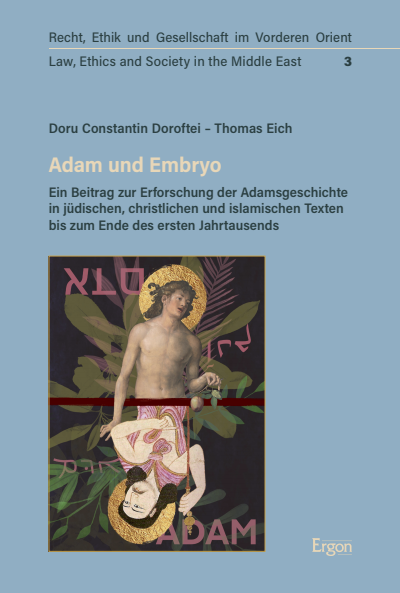
Adam und Embryo
Ein Beitrag zur Erforschung der Adamsgeschichte in jüdischen, christlichen und islamischen Texten bis zum Ende des ersten Jahrtausends- Authors:
- |
- Series:
- Recht, Ethik und Gesellschaft im Vorderen Orient | Law, Ethics and Society in the Middle East, Volume 3
- Publisher:
- 2023
Summary
This book critically analyzes the notion that there are passages in the 7th-century text of the Qur’an that reflect medical ideas of the time about the origin of human beings through pregnancy. It turns out that the Qur’an draws on a rich heritage of motifs, on the one hand baptismal theological motifs that had developed by the 7th century and on the other hand Jewish-Christian polemical debates about the nature of Jesus. The unquestionable embryological passages of the Qur’an text are to be located in this polemic, in which an image known from Jewish-Palestinian texts of the 6th century is central: the growth of every embryo occurs in the same way as God created the first human being. The image of "Adam and Embryo" accompanied the early Islamic intellectual history for several centuries before it gradually fell into oblivion.
Keywords
Search publication
Bibliographic data
- Copyright year
- 2023
- ISBN-Print
- 978-3-98740-064-3
- ISBN-Online
- 978-3-98740-065-0
- Publisher
- Ergon, Baden-Baden
- Series
- Recht, Ethik und Gesellschaft im Vorderen Orient | Law, Ethics and Society in the Middle East
- Volume
- 3
- Language
- German
- Pages
- 340
- Product type
- Book Titles
Table of contents
- Titelei/InhaltsverzeichnisPages 1 - 12 Download chapter (PDF)
- EinleitungPages 13 - 18 Download chapter (PDF)
- 1.1 Gedichtete Summa Embryologiae um das 6. Jahrhundert n.Chr.?
- 1.2 Adam als Broterstlingsopfer der Welt
- Exkurs: rabbinische Bibelexegese
- 1.3 Das Kneten des Körpers Adams in der rabbinischen Literatur
- 1.4.1 Die Erstlingsopfer in der hebräischen Bibel und in der metabiblischen Literatur
- a) Röm 11,16
- b) 1.Kor 15,20–23
- a) Irenäus
- b) Tertullian
- 1.4.3 Die Erstlingsopfer in rabbinischer Auslegung
- a) Gen 1,26–28 und Gen 2,6–7
- b) Psalm 139
- c) Ijob 10
- 1.5.2 Nachbiblische Anthropologien
- 1.5.3 Die rabbinische Sicht auf den von Gott erschaffenen Adam
- 1.6 Schlussfolgerung
- 2.1 Das Motiv von Staub und Wasser in der Adamsgeschichte
- 2.2 Das Motiv des Wassers
- 2.3 Die Thematik der Erschaffung der Seelen
- 3.1.1 Das größere Bild
- 3.1.2 Der Krieg zwischen Sasaniden und Byzanz 602 bis 628
- 3.2.1 Die Arbeit von Lehmann / Pedersen
- 3.2.2 Die Forschung seit den 1960er Jahren
- 3.3.1 Das Konzept des „generellen Präsens“
- 3.3.2 Die Problematik Suren-chronologischer Ansätze
- 3.3.3 Konzepte redaktioneller Überarbeitung und die Handschriftenforschung
- Einschränkende Vorbemerkung
- Zusammenfassung der Methodik
- 4.1 Ṭīn und Ṣalṣāl – Erschaffung Adams und Bezug zur Schatzhöhle
- 4.2.1 Turāb in Q 3:59 und Q 30:20
- 4.2.2. Turāb und nuṭfa in Q 18:37 und Q 35:11
- Exkurs: Die Verbenfolge ḫalaqa fa-sawwā
- 4.3.1 Q 25:54 (al-māʾ)
- 4.3.2 Q 32:7-9 (māʾ mahīn)
- 4.3.3.1 Q 23:12-13 (nuṭfa fī qarār makīn)
- 4.3.4 Q 86:5-10 (māʾ dāfiq)
- 4.4.1 Q 76:1-3 – Prüfung al-Insāns
- 4.4.2 Q 16:4 und Q 36:77 – al-Insāns Gegnerschaft
- 4.4.3 Q 80:17-23 – Verfluchung von al-Insān
- 4.4.4 Q 53:44-47 „Aus einem Tropfen, wenn er ausgestoßen wird“
- 4.5.1 Q 96:2 (ʿalaq)
- 4.5.2 Q 75:36-40 (nuṭfa und ʿalaqa)
- 4.5.3 Q 22:5 und Q 40:67 (turāb – nuṭfa – ʿalaqa – [muḍġa])
- 4.5.4 Q 23:12-14 (nuṭfa – ʿalaqa – muḍġa – ʿaẓm – laḥm)
- 4.6 Zusammenschau und Implikationen
- 5.1 Verwendungen ohne direkten Bezug zu vorgeburtlichem Leben
- 5.2.1 Überlieferungen zu ʿidda, umm walad-Status und Schwangerschaftsabbrüchen
- 5.2.2 Überlieferungen über den coitus interruptus (ʿazl)
- 5.3 Zusammenfassung
- 6.1.1 Die Ergänzung von nuṭfa
- 6.1.2 Das Element der Beseelung
- 6.2 Selten überlieferte Variationen des Ibn Masʿūd-ḥadīṯ
- Q 3:6 und Q 22:5
- Q 76:2
- 6.4 Zusammenfassung
- 7.1 „Im Bauch seiner Mutter“
- 7.2 Beseelung
- 7.3 Die Grabeserde
- 7.4 Zusammenfassung
- 8 Gesamtschau und Ausblick
- BibliographiePages 301 - 328 Download chapter (PDF)
- Appendix A: Findet sich im Korantext nicht doch die Idee der Individualbeseelung?Pages 329 - 334 Download chapter (PDF)
- Appendix B: Der Koran und die Infantizid-Debatte: zum Begriff mawʾūda in Q 81:8Pages 335 - 340 Download chapter (PDF)