, to see if you have full access to this publication.
Monograph No access
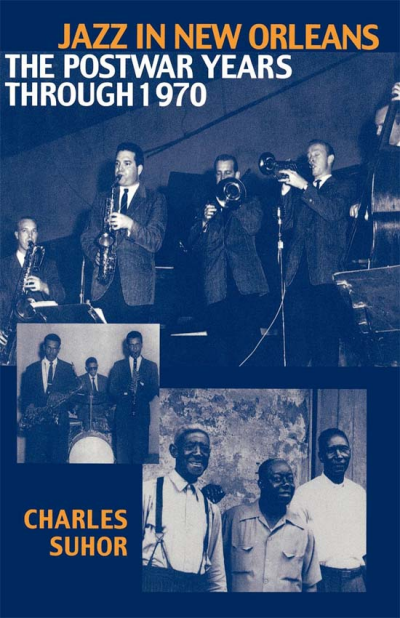
Jazz in New Orleans
The Postwar Years Through 1970
Authors:
Publisher:
2001
Summary
Jazz in New Orleans provides accurate information about, and an insightful interpretation of, jazz in New Orleans from the end of World War II through 1970. Suhor, relying on his experiences as a listener, a working jazz drummer, and writer in New Orleans during this period, has done a great service to lovers of New Orleans music by filling in some gaping holes in postwar jazz history and cutting through many of the myths and misconceptions that have taken hold over the years. Skillfully combining his personal experiences and historical research, the author writes with both authority and immediacy.
The text, rich in previously unpublished anecdotes and New Orleans lore, is divided into three sections, each with an overview essay followed by pertinent articles Suhor wrote for national and local journals—including Down Beat and New Orleans Magazine. Section One, "Jazz and the Establishment," focuses on cultural and institutional settings in which jazz was first battered, then nurtured. It deals with the reluctance of power brokers and the custodians of culture in New Orleans to accept jazz as art until the music proved itself elsewhere and was easily recognizable as a marketable commodity. Section Two, "Traditional and Dixieland Jazz," highlights the music and the musicians who were central to early jazz styles in New Orleans between 1947 and 1953. Section Three, "An Invisible Generation," will help dispel the stubborn myth that almost no one was playing be-bop or other modern jazz styles in New Orleans before the current generation of young artists appeared in the 1980s.
Search publication
Bibliographic data
Edition
1/2001
Copyright Year
2001
ISBN-Print
978-0-8108-3907-6
ISBN-Online
978-1-4616-6002-6
Publisher
Rowman & Littlefield, Lanham
Language
English
Pages
329
Product Type
Monograph
Table of contents
ChapterPages
Table of Contents No access
Timeline Charts No access
Foreword No access
Preface No access
Acknowledgments No access
1. Discovering Myths, Reclaiming the Past No access
Section I. Jazz and the Establishment: From Flouting to Flaunting No access Pages 17 - 48
2. Jazz and the New Orleans Press No access
3. The New Orleans Jazz Club: From Ragtime to Riches No access
4. Hello, Central, Give Me Doctor Jazz: Edmond Souchon No access
5. The Jazz Museum No access
6. The Jazz Archive at Tulane No access
7. The Stage Band Movement at Loyola-Or, How to Start a Revolution While Really Trying not to No access
8. Jazzfest 1968: Review No access
9. Jazzfest 1969: Preview No access
10. Jazzfest 1969: Review No access
11. New Orleans Farewell: Louis Armstrong No access
Section II. "Revivals" Beaucoup: Traditional, Dixieland, and Revivalist Jazz No access Pages 101 - 158
12. The Dukes of Dixieland: A Jazz Odyssey No access
13. Pete Fountain No access
14. Al Hirt in Perspective No access
15. Armand Hug: The Making of a Legend No access
16. Raymond Burke and Art Hodes in Concert: Review No access
17. Preservation Hall: New Orleans Rebirth No access
18. The Last Rites of a Jazzman: George Lewis No access
19. A Festival for a Funeral? No access
20. New Orleans Jazz—With a Foreign Accent No access
Section III. An Invisible Generation: Early Modern Jazz Artists No access Pages 192 - 249
21. New Jazz in the Cradle, Part I No access
22. New Jazz in the Cradle, Part II No access
23. The Problems of Modern Jazz in New Orleans No access
24. Jazz Off Bourbon Street No access
25. Buddy Prima Trio: Review No access
26. Modern Jazz Pioneers in New Orleans: A Symposium No access
Appendix 1. The Jazz Scene: Four Cross Sections No access Pages 291 - 304
Appendix 2. Early Modern Jazz Musicians in New Orleans, 1945-1960 No access Pages 305 - 308