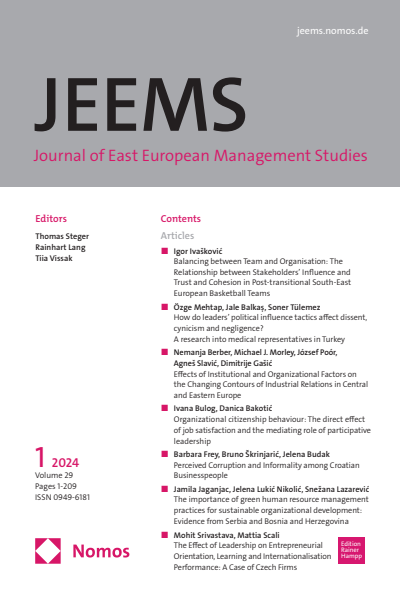
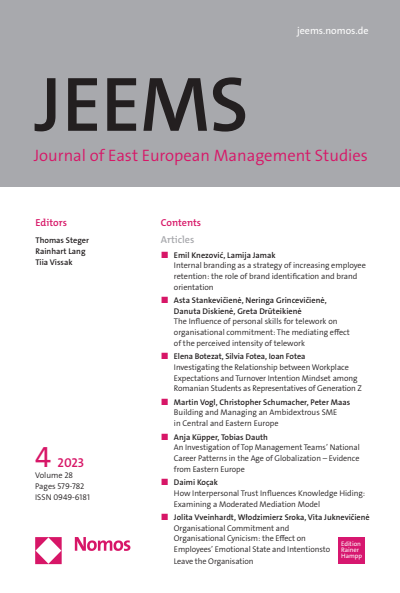
The Journal of East European Management Studies aims to promote dialogue and cooperation among scholars seeking to examine,explore and explain the behaviour and practices of management within the transforming societies of Central and Eastern Europe.The theoretical interests of the journal areorganisational and management change,Central and East European societies (including those on the fringes of Europe) undergoing processes of transition or transformation, andscientific issues of business, management and organisation that arise in such contexts.The JEEMS aims to attract social scientific contributions from scholars of any nation and region, but particularly wishes to encourageauthors from those countries directly experiencing transformational change. Its potential readership is international, comprising academicsand practitioners with an involvement or interest in the management of change in transforming societies in Central and Eastern Europe.
Any kind of innovative activity is driven by the urge for utmost success, continuous improvement or mere survival. The same holds true for management innovation, arguably the most advanced innovation type in the world of business. Although...
The purpose of this study is to broaden our understanding of the post-entry effects of psychic distance by asking what markets - psychically close or distant - became over time the most strategically significant for European SMEs. Specifically, we...
This study explores the impact of perceived top management involvement and knowledge sharing on perceived project performance. Relationships are examined from a sample of CEOs, directors and project managers from one large international bank in...
Despite the efforts of companies to invest into CSR reporting and to communicate information to various stakeholders these efforts in Serbia are still at a very low level compared with the developed countries. In this study content analysis is...
The aim of the study is to determine the preferred leadership and followership styles, as well as the statistical significance of differences between those preferences among individuals employed in both state and privately owned companies in Serbia...
Social networks are an important variable which explain career issues such as career satisfaction, success, development and employment. However, research is often conducted separately from different theoretical perspective, i.e. social capital,...
The main objective of this paper is to determine the factors of influence on growth aspired entrepreneurial ventures in order to determine characteristics of these entrepreneurs in the SEE region. We draw upon data from the Global Entrepreneurship...