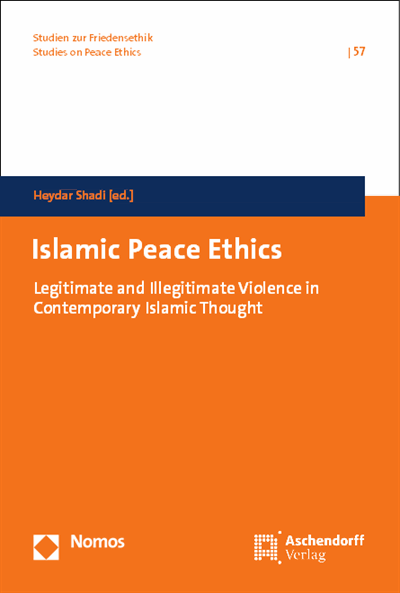
Islamic Peace Ethics
Legitimate and Illegitimate Violence in Contemporary Islamic Thought- Editors:
- Series:
- Studien zur Friedensethik, Volume 57
- Publisher:
- 2017
Summary
Das Buch widmet sich den Argumenten zeitgenössischer muslimischer Denker zum Thema Krieg und Frieden und behandelt die konfessionelle, geografische und ideologische Diversität islamischer Friedensethik. Ein Teil der Beiträge wurde verfasst von unterschiedlichen Gruppierungen und Gelehrten, die sowohl die sunnitischen als auch die schiitischen Zweige des Islams repräsentieren, und es gibt Beiträge zu den unterschiedlichen Einstellungen gegenüber Gewalt, ausgehend von Pazifismus und Traditionalismus hin zu Fundamentalismus und Dschihadismus. Die Beiträger sind Wissenschaftler aus verschiedenen Ländern, u.a. Indonesien, Pakistan, dem Iran, der Türkei, Deutschland, dem Vereinigten Königreich, den USA und Belgien. Die Kapitel des Buches behandeln das Thema aus unterschiedlichen disziplinären Perspektiven wie Theologie, Philosophie, Religions-, Kultur- und Politikwissenschaft. Das Buch ist in drei Teile gegliedert: a) Methodik und Theorie islamischer Friedensethik, b) Jus ad bellum und c) Jus in bello.
Mit Beiträgen von:
Dirk Ansorge, Abdessamad Belhaj, Seyed Hassan Eslami, Oliver Leaman, Simona E. Merati, Najia Mukhtar, Charles M. Ramsey, Sybille Reinke de Buitrago, Yahya Sabbaghchi, Heydar Shadi, Bianka Speidl und Asfa Widiyanto.
Search publication
Bibliographic data
- Edition
- 1/2017
- Copyright Year
- 2017
- ISBN-Print
- 978-3-8487-4050-5
- ISBN-Online
- 978-3-8452-8349-4
- Publisher
- Nomos, Baden-Baden
- Series
- Studien zur Friedensethik
- Volume
- 57
- Language
- English
- Pages
- 264
- Product Type
- Edited Book
Table of contents
- Titelei/InhaltsverzeichnisPages 1 - 8 Download chapter (PDF)
- I. Methodologies and Theories of Islamic Peace Ethics
- II. Jus ad bellum
- III. Jus in bello
- Authors:Download chapter (PDF)
- 1. IntroductionAuthors:
- 2. What does ‘peace’ mean in ‘Islamic peace ethics’? Peace ethics or fiqh al-jihad (law of war)? An inter-cultural and translation challengeAuthors:
- 3. What does ‘ethics’ mean in Islamic peace ethics? An over-juridification of Islamic normative system?Authors:
- 4. What does ‘Islam’ mean in Islamic peace ethics? Islamic/ Islamicate. An over-Islamization of Muslims?Authors:
- Authors:
- 5.1. Research on ‘Islamic peace ethics’ as epistemological violence from the centre?Authors:
- 6. Philosophical foundations of the questionAuthors:
- Authors:Download chapter (PDF)
- IntroductionAuthors:
- 1. A challenging exampleAuthors:
- 2. Religion and ‘essentialism’Authors:
- 3. Religion, human rights, and human reasonAuthors:
- 4. Religion, violence, and peaceAuthors:
- 5. ConclusionAuthors:
- Authors:Download chapter (PDF)
- 1. IntroductionAuthors:
- 2. Universality versus Plurality of NormsAuthors:
- 3. The Impact of Discursive ConstructionsAuthors:
- 4. ConclusionAuthors:
- Authors:Download chapter (PDF)
- 1. Justifying violence and IslamAuthors:
- 2. The rules of warAuthors:
- 3. The importance of considering the consequencesAuthors:
- 4. Different kinds of jihadAuthors:
- 5. Back to absolute principlesAuthors:
- 6. Principles and how to apply themAuthors:
- Further ReadingAuthors:
- Authors:Download chapter (PDF)
- 1. IntroductionAuthors:
- 2. The intricate interplay between religion and violenceAuthors:
- 3. The notion of authorityAuthors:
- 4. Islamism and ‘Indonesian Islam’Authors:
- 5. ‘Commanding good and forbidding evil’ in Islamic scholarshipAuthors:
- Authors:
- 6.1 The Islamic Defenders Front and its theological tendencyAuthors:
- 6.2 The Islamic Defenders Front and the mission of ‘commanding good and forbidding evil’Authors:
- Authors:
- 7.1 Habib Rizieq Syihab and religious authorityAuthors:
- 7.2 Ma‘ruf, munkar, and the conditions of performing ‘commanding good and forbidding evil’Authors:
- 7.3 Violence and freedom of conscienceAuthors:
- 7.4 Epistemological foundation of the ‘commanding good and forbidding evil’Authors:
- 7.5 Anthropological and constitutional logic of ‘commanding good and forbidding evil’Authors:
- 7.6 Constitutional and cultural circumstances of the ‘commanding good and forbidding wrong’Authors:
- 7.7 Axiological basis of the ‘commanding good and forbidding evil’Authors:
- Concluding remarksAuthors:
- Authors:Download chapter (PDF)
- 1. Introduction: Socio-political context, problem spaces and discursive actorsAuthors:
- Authors:
- 2.1 GhamidiAuthors:
- 2.2 Tahir-ul-QadriAuthors:
- Authors:
- 3.1 Citizenship as inclusion of religious difference … with exceptionsAuthors:
- 3.2 Citizenship as exclusion – the rebel citizenAuthors:
- 4. ConclusionAuthors:
- Authors:Download chapter (PDF)
- 1. IntroductionAuthors:
- 2. Pakistan: a ‘hard country’ in contextAuthors:
- Authors:
- 3.1 IslahiAuthors:
- 3.2 DeobandiAuthors:
- 4. AnalysisAuthors:
- Authors:Download chapter (PDF)
- 1. IntroductionAuthors:
- 2. Russian traditional IslamAuthors:
- 3. Muslims as supporters of the secular state: official Islamic institutionsAuthors:
- 4. Islam as an element of Russian political system.Authors:
- 5. Islam as revolutionary forceAuthors:
- 6. A Russian interpretation of jihadAuthors:
- 7. ConclusionAuthors:
- Authors:Download chapter (PDF)
- 1. Universality of IslamAuthors:
- 2. Divine promise for Islam prevailingAuthors:
- 3. The Qur’anic evidences for offensive jihadAuthors:
- Authors:
- 4.1 A methodological considerationAuthors:
- Authors:
- 4.2.1 Compulsion is not justified in a religionAuthors:
- 4.2.2 The Prophet’s duty is only to communicateAuthors:
- 4.2.3 Emphasis on applying reason and proscribing of ignorant followingAuthors:
- 4.2.4 Human dignityAuthors:
- 4.2.5 Authenticity of peaceAuthors:
- 4.3 Literal study of jihad and qital (fighting)Authors:
- 4.4 Applying theoretical principles to the interpretation of jihad and qitalAuthors:
- 4.5 Verbal study of the jihad and qital versesAuthors:
- Authors:Download chapter (PDF)
- The Structure of the ArgumentAuthors:
- The Internal Logic of the ArgumentAuthors:
- Authors:
- 1. Argument from scriptureAuthors:
- 2. Argument from necessityAuthors:
- 3. Argument from virtueAuthors:
- 4. Argument from instrumentalityAuthors:
- 5. Rhetorical questionsAuthors:
- 6. RepetitionAuthors:
- Authors:
- 7.1 The account of Karbala’ in Fadlallah’s narrative of powerAuthors:
- 7.2 The role of the Mahdi in Fadlallah’s narrative of powerAuthors:
- 7.3 Salvation history in Fadlallah’s narrative of powerAuthors:
- 8. Antinomy (tibaq)Authors:
- 9. Metaphors of battle(field)Authors:
- Concluding remarksAuthors:
- Authors:Download chapter (PDF)
- IntroductionAuthors:
- 1. Jawdat Sa‘id: A profile of peaceAuthors:
- 2. Knowledge as a foundation of peace: insights into Saʿid’s epistemologyAuthors:
- Authors:
- 3.1 The doctrine of the first Son of AdamAuthors:
- 3.2 Jihad and khurujAuthors:
- 3.3 Misconceptions about peace in IslamAuthors:
- 3.4 Does peace go by the book or by reality?Authors:
- 3.5 PeacebuildingAuthors:
- 3.6 World peaceAuthors:
- 4. LimitsAuthors:
- ConclusionAuthors:
- Authors:Download chapter (PDF)
- The boundaries and interpretationsAuthors:
- Authors:
- 1. When lying in war is permissible, because God, or Shari‘ah, has allowed it.Authors:
- 2. Lying in war is permissible, because it is necessaryAuthors:
- 3. Lying in war is not permissible, but trickery isAuthors:
- 4. Lying in war is basically prohibited, and there is no room for lying in the warAuthors:
- ConclusionAuthors:
- Short biographies of the authorsPages 257 - 262 Download chapter (PDF)
- The Institute of Theology and Peace (ithf)Pages 263 - 264 Download chapter (PDF)