, to see if you have full access to this publication.
Monograph No access
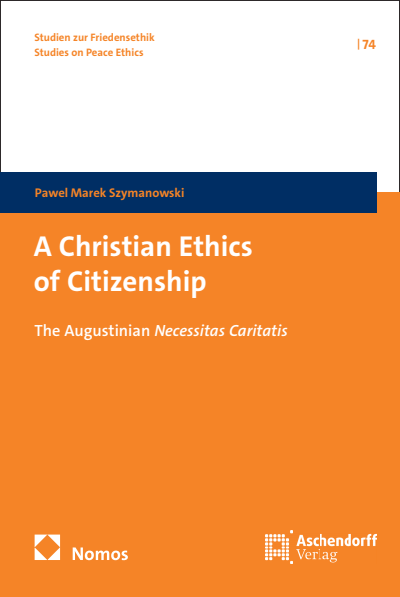
A Christian Ethics of Citizenship
The Augustinian Necessitas Caritatis- Authors:
- Series:
- Studien zur Friedensethik, Volume 74
- Publisher:
- 2025
Summary
What does it mean to be a good Christian citizen today? This book examines Augustine‘s ethics of citizenship through an analysis of his theological writings, letters, and sermons. Introducing the Augustinian
Necessitas Caritatis (Duty of Love), it identifies the non-negotiable elements of Christian civic identity and clarifies the responsibilities of believers in pluralistic societies. With a focus on Christian European identity, it also discusses the critical role of Augustinian citizens in shaping the future of a truly pluralistic Europe. Written by Pawel Marek Szymanowski, this study was researched at the Accademia Alfonsiana in Rome.
Keywords
Search publication
Bibliographic data
- Edition
- 1/2025
- Copyright Year
- 2025
- ISBN-Print
- 978-3-7560-1949-6
- ISBN-Online
- 978-3-7489-5132-2
- Publisher
- Nomos, Baden-Baden
- Series
- Studien zur Friedensethik
- Volume
- 74
- Language
- English
- Pages
- 322
- Product Type
- Monograph
Table of contents
ChapterPages
- Acknowledgments No access
- List of Abbreviations No access
- Aim of the Study No access
- Specific Contributions No access
- Structure of the Study No access
- General Method No access
- 1.1.1. Greek Polis: Ruling and Being Ruled No access
- 1.1.2. Roman Republic: Civis Romanus Sum No access
- 1.1.3. The Roman Empire: Citizens as Subjects No access
- 1.1.4. Excursus: Augustine’s View on the Universalization of Citizenship No access
- 1.2. Citizens/Subjects and Their Identities: Patria and Dual Citizenship No access
- 1.3.1.1. Salus Populi in the Late Republic No access
- 1.3.1.2. Salus Publica Redefined by Imperial Ideology No access
- 1.3.2.1. Seeking Internal Freedom: Securitas as Peace of Mind No access
- 1.3.2.2. State-Ensured Safety: Securitas as the Peace of the Empire No access
- 1.3.3.3. Excursus: St. Paul’s «Peace and Security» (1Thess 5,2-3) No access
- 1.4.1. Aristotle: Between Human and Civic Virtue No access
- 1.4.2. Virtus Romana: Between Arete and Andreia No access
- 1.4.3. Virtus as Manliness: The Heart of Romanness No access
- 1.4.4. Virtus as Ethical Human Excellence No access
- 1.4.5. Virtutes Romanae: Cardinal Virtues No access
- 1.4.6. Virtutes of the Citizens and Subjects No access
- 1.5.1. Diogenes’ Kosmopolites: Living Following Nature No access
- 1.5.2. Zeno’s Kosmopolites: Perfect Community Inhabited by the Sages No access
- 1.5.3. Roman Stoics’ Cosmopolis: Universal Brotherhood of All Human Minds No access
- 1.5.4.1. Philo’s Kosmopolites: Living in Harmony with the Divine Law No access
- 1.5.4.2. Ambrose’s Kosmopolites: Living According to the Highest Part of Human Nature No access
- Conclusion No access
- 2.1.1. The Evolution of the Concepts of Bios Theoretikos and Bios Politikos No access
- 2.1.2. Theology of Two Vitae: Augustine’s Active and Contemplative Virtues No access
- 2.1.3. Spatial Dimensions of the Contemplative and Active Lives: Christianization of Otium and Negotium No access
- 2.2.2. Unlocking Augustine’s Cities: (Fundamental Moral) Theology No access
- 2.3.1. Augustine’s Cives and Their Capacity to Love and Be Loved No access
- 2.3.2. Augustine’s Civitates and Their Development No access
- 2.3.3. Intersecting Civitates: Boundary Setting of Theological Cities and Human Societies No access
- 2.4.1. From Civic Politics to Civic Theology: Understanding the Heavenly Regime No access
- 2.4.2. Perfect Citizens of the City of God: Their Eternity, Truth, and Love No access
- 2.4.3.1. The Status of Semi-citizenship: Biblical Truth No access
- 2.4.3.2. The Status of Semi-Citizenship: Human Self-Understanding No access
- 2.5.1. Restored Civic Status: From Earthly Citizens to Pilgrims No access
- 2.5.2. The Pilgrims’ Hope, Faith, and Love No access
- 2.5.3. Defining the Nature of Pilgrims’ Action No access
- Conclusion No access
- 3.1.1. Searching Securitas in the Sanctuary of Mind: Augustine and Nebridius No access
- 3.1.2. Discovering Theological Salus: Augustine to Nebridius No access
- 3.1.3. Clothing Securitas in Utiles Curae: Augustine and Celestine No access
- 3.1.4. Difficult Learning to Serve ad Salutem Aliorum: Augustine and bishop Valerius No access
- 3.1.5. Excursus: Bishop Valerius’ Discovery about Salus/Tria No access
- 3.2.1. Rising Above Physical Health: Spiritual Salus Shared with Angels No access
- 3.2.2. Transcending Temporal Wellbeing: Eternal Salus Bestowed upon the Good No access
- 3.3.1. Defining Civitas: The Bond of Shared Love No access
- 3.3.2. Purpose of Civitas and Cives: Sharing the Same Source No access
- 3.4.1. Nectarius’ Amor Patriae: Seeking Salus in Wealth + Health No access
- 3.4.2. Augustine’s Caritas Patriae: Seeking Salus in Necessaria + Happiness of Living Rightly No access
- 3.5.1. Praecepta Caritatis: Exploring the Foundation of Salus Civitatis with a Roman Opponent No access
- 3.5.2. Christian Praecepta Concordiae: Restoring Reipublicae Salus with a Christian Friend No access
- 3.6.1. Theological Virtues as Vera Pietas: The Heart of the Active Life No access
- 3.6.2.1. The Theologian Disputes with Julian: The Source and End of All Virtues No access
- 3.6.2.2. The Bishop to Macedonius: The Process of Transforming Civic Virtues into Genuine Ones No access
- Conclusion No access
- 4.1.1. The Dual Nature of Christian Civic Ethics: Between Theological Principles and Civic Secular Ethos No access
- 4.1.2. Theological Principles: Defining Constans Ratio No access
- 4.1.3. Civic Ethos and National Identities: Exploring the Mutabilis Component No access
- 4.1.4. Becoming a Christian Citizen: From Theological Principles to Civic Engagement No access
- 4.2.1. The EU One-Sided Citizenship: Rights without Duties No access
- 4.2.2.1. G. Weigel’s Two Europes: Between the Cube and the Cathedral No access
- 4.2.2.2. J. Derrida’s One Europe: The Other as the Foundation of Self No access
- 4.2.2.3. European Distinctiveness: Discovering Uniqueness in Ethical Challenges No access
- 4.3.1. Creating a Christian Society and Counterculture: The Benedict Option No access
- 4.3.2.1. Exploring Necessitas and Options: Christian Approaches to Europe No access
- 4.3.2.2. Redefining European Salus: The Augustinian Citizens’ Pursuit No access
- 4.3.2.3. Redefining European Patriotism: Love of Others as Civic Duty No access
- 4.3.2.4. Redefining European Foreignness: Augustinian Citizens as Others No access
- 4.7.1. Damasus I: Transforming Christian Foreigners into Roman Patriots No access
- 4.7.2. Orosius: Challenging Historical Roman Identity No access
- 4.7.3. Damasus, Orosius and Augustine: The Difference that Christianity Makes No access
- Conclusion No access
- Augustine’s Relevance Today: Defining Challenges in Citizenship Ethics No access
- Beyond Civic Theoria and Praxis: Framing Roman and Augustine’s Necessitas No access
- Theology of Heavenly Citizenship: Exploring the Essence of Christian Morality No access
- Augustine’s Ethics of Citizenship: Defining the Objects of Christian Active Life No access
- The Interplay Between Theological Principles and Civic Ethos: Framing Christian Ethics of Citizenship No access
- Christian Ethics of European Citizenship: Discussing the Augustinian Necessitas Caritatis in Practice No access
- Augustine’s Ethics of Writing and Developing: Exploring Future Perspectives No access
- General Bibliography No access Pages 305 - 322