, to see if you have full access to this publication.
Edited Book No access
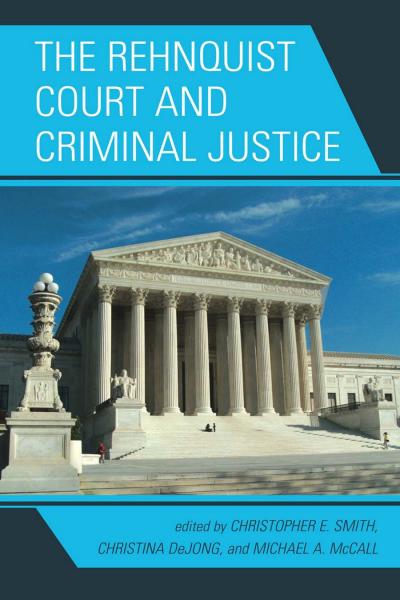
The Rehnquist Court and Criminal Justice
Editors:
| |
Publisher:
2011
Summary
This book examines the criminal justice decisions of the Rehnquist Court era through analyses of individual justices' contributions to the development of law and policy. The Rehnquist Court era (1986-2005) produced a period of opportunity for the U.S. Supreme Court's judicial conservatives to reshape constitutional law concerning rights in the criminal justice process. It was an era in which the Court produced many hotly-debated decisions concerning such issues as capital punishment, search and seizure, police interrogations, and prisoners' rights. The Court's most conservative justice, William H. Rehnquist, ascended to the key leadership position of Chief Justice and he was joined on the Court by two new appointees, Antonin Scalia and Clarence Thomas, who were equally supportive of both greater authority for police and limited definitions of constitutional rights for suspects, defendants, and criminal offenders. The Rehnquist Court era decisions refined and narrowed many of the rights-expanding decisions of the Warren Court era (1953-1969). However, the Supreme Court did not ultimately eliminate the Warren era's foundational rights concepts in criminal justice, such as the exclusionary rule and Miranda warnings. As the leading liberal voices of the Warren era, William Brennan and Thurgood Marshall, retired early in the Rehnquist era, the Court experienced continued advocacy of broad conceptions for many rights through the increased assertiveness of Republican appointees Harry Blackmun, John Paul Stevens, and David Souter as well as the arrival of new Democratic appointees Ruth Bader Ginsburg and Stephen Breyer. In many important cases, the justices advocating the preservation of constitutional protections could prevail, even on a generally conservative Court, by persuading one or more of President Ronald Reagan's appointees to support a particular right for suspects and defendants. Sandra Day O'Connor and Anthony Kennedy, in particular, shaped outcomes within a divided Court as they determined which of the Court’s wings with which they would align in a particular case. The contributors to this volume identify and highlight the unique perspectives and influential decisions of individual justices as the means for understanding the Rehnquist Court’s imprint on criminal justice.
Search publication
Bibliographic data
Edition
1/2011
Copyright Year
2011
ISBN-Print
978-0-7391-4080-2
ISBN-Online
978-0-7391-4082-6
Publisher
Lexington, Lanham
Language
English
Pages
316
Product Type
Edited Book
Table of contents
ChapterPages
Contents No access
Preface No access
1 Introduction: The Rehnquist Court No access Pages 1 - 16
2 William Brennan and Thurgood Marshall: The Mediator & the Absolutist No access Pages 17 - 42
3 Byron White: The Overlooked, Moderate Swing Voter No access Pages 43 - 60
4 Harry A. Blackmun: Counterweight to a Conservative Court No access Pages 61 - 86
5 William H. Rehnquist: Leadership & Influence from the Conservative Wing No access Pages 87 - 122
6 John Paul Stevens: A Liberal Leader & His Roles on the Court No access Pages 123 - 142
7 Sandra Day O'Connor: Influence from the Middle of the Court No access Pages 143 - 168