, to see if you have full access to this publication.
Monograph No access
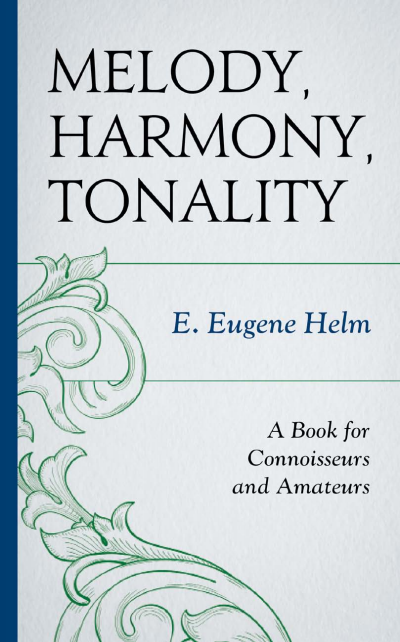
Melody, Harmony, Tonality
A Book for Connoisseurs and Amateurs
Authors:
Publisher:
2012
Summary
Where did the major scale come from? Why does most traditional non-Western music not share Western principles of harmony? What does the inner structure of a canon have to do with religious belief? Why, in historical terms, is J.S. Bach’s music regarded as a perfect combination of melody and harmony? Why do clocks in church towers strike dominant-tonic-dominant-tonic? What do cathedrals have to do with monochords? How can the harmonic series be demonstrated with a rope tied to a doorknob, and how can it be heard by standing next to an electric fan? Why are the free ocean waves in Debussy’s La Mer, the turbulent river waves in Smetana’s Moldau, and the fountain ripples in Ravel’s Jeux d’Eau pushed at times into four-bar phrases? Why is the metric system inherently unsuitable for organizing music and poetry? In what way does Plato’s Timaeus resemble the prelude to Wagner’s Das Rheingold? Just how does Beethoven’s work perfectly illustrate fully functional tonality, and why were long-range works based on this type of tonality impossible before the introduction of equal temperament? In this new century, what promising materials are available to composers in the wake of harmonic experimentation and, some would argue, exhaustion?
The answers to these seemingly complicated questions are not the sole province of music professors or orchestra conductors. In fact, as E. Eugene Helm demonstrates, they can just as easily be explained to amateurs, and their answers are important if we are to understand how Western music works. The full range of Western music is explored through 21 concise chapters on such topics as melody, harmony, counterpoint, texture, melody types, improvisation, music notation, free imitation, canon and fugue, vibration and its relation to harmony, tonality, and the place of music in architecture and astronomy. Intended for amateurs and professionals, concert-goers and conductors, Helm offers in down-to-earth language an explanation of the foundations of our Western music heritage, deepening our understanding and the listening experience of it for all.
Search publication
Bibliographic data
Edition
1/2012
Copyright Year
2012
ISBN-Print
978-0-8108-8639-1
ISBN-Online
978-0-8108-8640-7
Publisher
Rowman & Littlefield, Lanham
Language
English
Pages
200
Product Type
Monograph
Table of contents
ChapterPages
Contents No access
Preface No access
Chapter 1 Melody Is Pure but Not So Simple No access Pages 1 - 4
Chapter 2 Harmony, Unlike Melody, Is Pure Only in Theory No access Pages 5 - 6
Chapter 3 Our Usual Musical Menu Is Melody with Subsidiary Accompaniment No access Pages 7 - 10
Chapter 4 Counterpoint Is a Harmonious Marriage of Independent Melodies No access Pages 11 - 14
Chapter 5 Texture No access Pages 15 - 16
Chapter 6 Special Mixtures of Texture No access Pages 17 - 24
Chapter 7 East Is East Is Melody; West Is West Is Harmony No access Pages 25 - 30
Chapter 8 The Universal Patterns of Melody: Melody Types No access Pages 31 - 40
Chapter 9 Of the Earth, Earthy: Folk Music and its Role in Composition No access Pages 41 - 54
Chapter 10 Improvisation Forever No access Pages 55 - 60
Chapter 11 Melody and Harmony in Notation No access Pages 61 - 68
Chapter 12 Canon, Free Imitation, Fugue: A Path to Musical Meaning No access Pages 69 - 94
Chapter 13 Free Imitation: Canon with a Grain of Salt No access Pages 95 - 100
Chapter 14 Fugue: The Whole Contrapuntal Bag of Tricks No access Pages 101 - 110
Chapter 15 Harmony, the Governing Principle No access Pages 111 - 134
Chapter 16 Music in Architecture No access Pages 135 - 140
Chapter 17 Music in Astronomy No access Pages 141 - 142
Chapter 18 Vibration, the New Paradigm No access Pages 143 - 154
Chapter 19 The Harmonic Series No access Pages 155 - 168
Chapter 20 Mapping the New Tonal Territory No access Pages 169 - 176
Chapter 21 Tonality Is Still Here No access Pages 177 - 186