, to see if you have full access to this publication.
Monograph No access
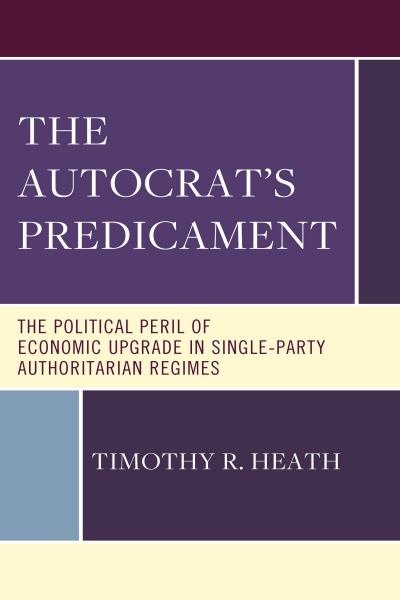
The Autocrat's Predicament
The Political Peril of Economic Upgrade in Single-Party Authoritarian Regimes
Authors:
Publisher:
2023
Summary
In their quest for national revival, China’s leaders under Xi Jinping have sought to improve the economy’s performance. The disappointing economic record of authoritarian regimes provides ample grounds for doubt, yet not all have failed. Why have some succeeded where most did not? The theory of the “enabling condition” highlights the central role that politics plays in the pursuit of economic advancement. The theory explains that a political situation characterized by a strong central leadership, weak elite opposition, and a united public offers favorable prospects for enacting concentrated growth policies. This arrangement enables the central leadership to enlist the public in convincing elites to implement policies that they might otherwise resist. Focusing on the experience of single party, authoritarian regimes, The Autocrat’s Predicament: The Political Peril of Economic Upgrade in Single Party, Authoritarian Regimes examines episodes in the histories of the People’s Republic of China, Taiwan, and the Soviet Union. It concludes that China’s unfavorable political situation could be potentially unfriendly for its ambitions to build an efficient, highly productive economy.
Keywords
Search publication
Bibliographic data
Edition
1/2023
Copyright Year
2023
ISBN-Print
978-1-6669-4739-7
ISBN-Online
978-1-6669-4740-3
Publisher
Lexington, Lanham
Language
English
Pages
224
Product Type
Monograph
Table of contents
ChapterPages
Contents No access
Acknowledgments No access
Introduction No access Pages 1 - 16
Chapter 1: The Theory of the Enabling Condition No access Pages 17 - 40
Chapter 2: China 1991–1997: Deng Xiaoping’s Triumph and a Toxic Political Legacy No access Pages 41 - 66
Chapter 3: China 2004–2010: Hu Jintao: Professionalization Fails to Convert Opposing Elites No access Pages 67 - 100
Chapter 4: China 2013–2020: A Fragmented Public Impair Undermines Xi’s Strategy to Dominate Elites No access Pages 101 - 128
Chapter 5: Taiwan 1973–1979: Success Amid a Looming Threat of an Elite-Led Popular Mobilization No access Pages 129 - 144
Chapter 6: Soviet Union 1985–1990: Weak Central Leadership, Strong Elite Opposition Dooms Perestroika No access Pages 145 - 168
Chapter 7: Comparative Analysis No access Pages 169 - 186