, to see if you have full access to this publication.
Monograph No access
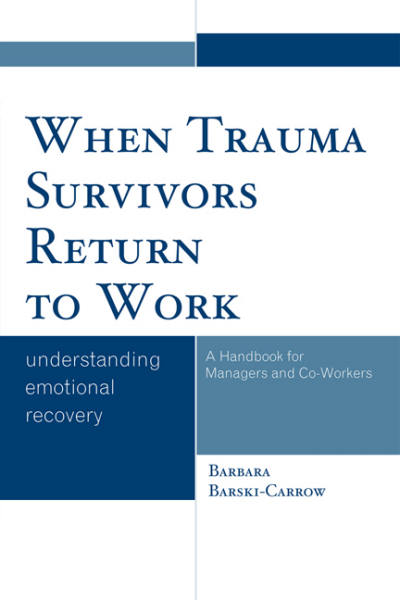
When Trauma Survivors Return to Work
Understanding Emotional Recovery
Authors:
Publisher:
2010
Summary
When Trauma Survivors Return To Work explains how managers and co-workers can help foster the process of emotional recovery for employees who have been traumatized and are returning to work. No other source clearly and positively teaches managers and co-workers how to treat fellow workers returning to the workplace after experiencing a rape, a burglary, an armed assault, a violent accident, or witnessing a brutal crime. No one explains what to say to those who have just been told they have a terminal illness, or how to treat an employee whose close family member has committed suicide. It is not helpful for co-workers to deny such traumatic events or remain silent, which is what often happens, or for managers to avoid directly communicating with the traumatized employee. Is there something that managers and co-workers can do to be truly helpful to such sensitively wounded people? The answer is yes. In this illuminating educational approach, Dr. Barski-Carrow shows how managers and co-workers can learn simple ways to make the workplace a better environment for emotional healing.
Search publication
Bibliographic data
Edition
1/2010
Copyright Year
2010
ISBN-Print
978-0-7618-5030-4
ISBN-Online
978-0-7618-5031-1
Publisher
Hamilton Books, Lanham
Language
English
Pages
170
Product Type
Monograph
Table of contents
ChapterPages
Contents No access
Acknowledgments No access
Introduction No access
Chapter 1. Why I Wrote This Book No access
Chapter 2. What Is a Traumatic Life Experience (TLE)? No access
Chapter 3. What Is It Like to Be a Returning TLE Employee? No access
Chapter 4. What Can Managers Do? No access
Chapter 5. What Do You Tell Co-Workers? No access
Chapter 6.What Does Psychology Tell Us about Trauma? No access
Chapter 7. What Can an Employee Assistance Program Do? No access
Chapter 8. What Is a Study Circle? No access
Chapter 9. How Does an Organization Set Up a Study Circle? No access
Chapter 10. Putting Out a Welcome Mat: The First Study Circle No access
Chapter 11. Lending a Listening Ear: The Second Study Circle No access
Chapter 12. Offering a Helping Hand: The Third Study Circle No access
Chapter 13. When an Entire Group Is Traumatized, How Do Managers and Employees Cope? No access
Chapter 14. How Does an Employee’s Trauma Affect His Children? No access
Chapter 15. How Can You Help Yourself after a Traumatic Life Experience? No access
Chapter 16. What Challenges Face a Facilitator? No access
Appendix. Study Circle Handouts No access Pages 163 - 164