Book Titles Open Access Full access
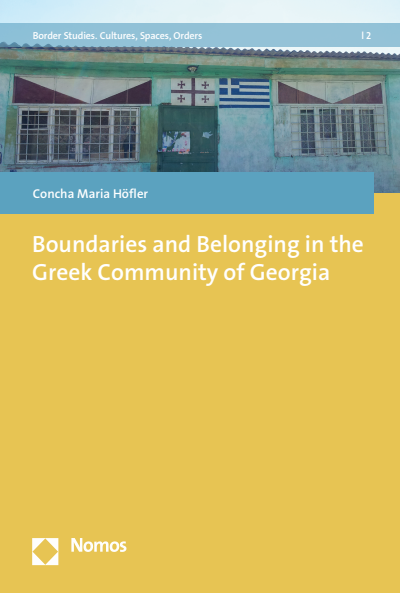
Boundaries and Belonging in the Greek Community of Georgia
- Authors:
- Series:
- Border Studies. Cultures, Spaces, Orders, Volume 2
- Publisher:
- 2020
Search publication
Bibliographic data
- Copyright year
- 2020
- ISBN-Print
- 978-3-8487-4832-7
- ISBN-Online
- 978-3-8452-9050-8
- Publisher
- Nomos, Baden-Baden
- Series
- Border Studies. Cultures, Spaces, Orders
- Volume
- 2
- Language
- English
- Pages
- 313
- Product type
- Book Titles
Table of contents
ChapterPages
- Titelei/InhaltsverzeichnisPages 1 - 18 Download chapter (PDF)
- Introducing the Greek community of Georgia: A note on naming
- Research on Georgia’s Greek community
- Research questions
- Outline of the book
- Migrating from the Ottoman to the Russian Empire
- The Soviet Union: Processes of homogenization and particularization
- Georgian transformations
- Emigration to Greece
- Imagination: Categories and groupness
- Community and belonging
- Actors, processes, and context
- Qualities of boundaries
- (Un)making boundaries
- Categorization
- Doing things with categories: Positioning the self and others
- Context
- The semi-structured interview
- Who to speak to?
- Constructing and entering the field
- From interview data to written analysis
- Competence and everyday language use
- The “Choice” between language and religion
- Speaking about the respective other heritage variety
- Speaking about Pontic Greek
- Urum as a “Problematic” heritage variety
- Preliminary summary
- Competence in SMG and evaluating its importance
- Tracing belonging through competence
- “We are born Greeks”: Tracing belonging through ancestry and religion
- Competence “Desirable” – uncertain evaluations
- Preliminary summary
- Competence and everyday language use
- Speaking about Russian
- Comparing Russian and Georgian
- Speaking about Georgian
- Discussion
- How to avoid talking about the end of the Soviet Union
- “Georgia for Georgians”: The dissolution of the “Family of Nations”
- “Staying behind”: Coming to terms with emigrating family members
- Discussion
- Being categorized as “Different” in Greece
- Relating “Nation” and “Citizenship”
- Contesting the category “Greek”
- Preliminary summary
- Ts’alk’a: Struggling to belong
- Belonging to Georgia and blurring boundaries
- Irreducible differences? “Religion” and “Ancestry”
- Discussion Pages 277 - 288 Download chapter (PDF)
- Conclusion Pages 289 - 290 Download chapter (PDF)
- Appendix A: Sociolinguistic metadata Pages 291 - 294 Download chapter (PDF)
- Bibliography Pages 295 - 313 Download chapter (PDF)