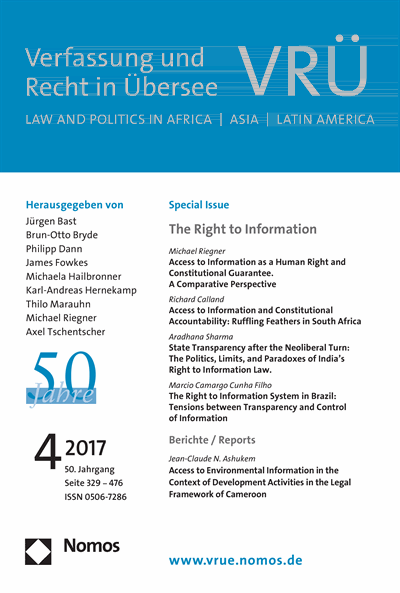
"Law and Politics in Africa, Asia and Latin America" analyses legal and constitutional developments in all states or regions outside of Europe as well as their regional and international integration. Founded in 1968 and inspired by decolonization and the idea of a cooperative new beginning, the Journal also promotes a special interest in contributions on 'Law and development'. The journal aims to provide a forum for a variety of perspectives on these fields of interest, be they focused on one country or comparative, theoretical or methodological in nature. Next to extensive articles, the journal publishes shorter reports about current events or conferences as well as book reviews. As a special service, each issue of "Law and Politics in Africa, Asia and Latin America" contains an international bibliography of relevant publications from around the world. This is compiled in cooperation with the Leibniz-Institute for Global and Regional Studies in Hamburg (GIGA). "Law and Politics" addresses authors and readers on all continents and aims to serve as a forum of mutual exchange. The journal is open for contributions from legal and social sciences as well as for analyses from practitioners. The journal is published quarterly and welcomes contributions in German, English, Spanish and French. Website: www.vrue.nomos.de
Since the 1990s, there has been a “global explosion of freedom of information” as new constitutions have enshrined the right to information, legislators have enacted access to information acts, and courts have enforced and expanded individual...
Recent corruption scandals pivoting around South Africa’s President Jacob Zuma have knocked much of the gloss off of the country’s rosy constitutional face. But it’s democracy is proving to be resilient in the face of severe challenges to...
In 2005, the Indian government passed the Right to Information or RTI Act, which is hailed for inaugurating an era of open, accountable and truly postcolonial democracy. This article focuses on how the RTI law is being both implemented and subverted...
Right to Information (RTI) laws are commonly seen as key elements of participatory democracies because they allow citizens to hold public officials accountable for their actions. Nevertheless, these laws can be ambiguous since, while creating...
This article focuses on an examination of the substantive content of section 7 of Law No 96/12 of 5th August 1996 on Environmental Management in Cameroon (Law No 96/12) and argues that the incompleteness of section 7 has made it difficult for people...