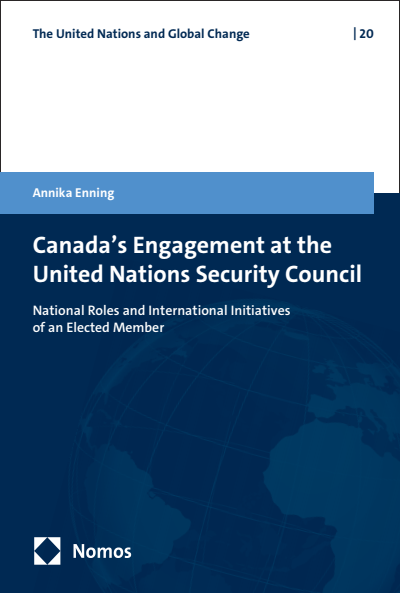
Canada's Engagement at the United Nations Security Council
National Roles and International Initiatives of an Elected Member- Authors:
- Series:
- The United Nations and Global Change, Volume 20
- Publisher:
- 2025
Summary
This book sheds light on the hitherto neglected role of the elected members of the UN Security Council and asks which roles Canada has played at the Security Council. Adopting an innovative approach, it combines role theory and interpretative process tracing. By means of a qualitative text analysis of speeches, governmental documents and interviews with diplomats, the author reveals key leitmotifs, arguments and the self-presentation patterns of recent Canadian terms of office in the Council and election campaigns for it, illustrating (electoral) strategies and means of influence for elected members using Canada as an example. Specifically, Canada has acted as a multilateralist, reformer, peacekeeper, mediator, benefactor, promoter of human rights and activist leader.
Keywords
Search publication
Bibliographic data
- Copyright year
- 2025
- ISBN-Print
- 978-3-7560-2368-4
- ISBN-Online
- 978-3-7489-5049-3
- Publisher
- Nomos, Baden-Baden
- Series
- The United Nations and Global Change
- Volume
- 20
- Language
- English
- Pages
- 327
- Product type
- Book Titles
Table of contents
- Titelei/Inhaltsverzeichnis No access Pages 1 - 18
- 1.1 Context and Significance No access
- 1.2 State of Research No access
- 1.3 Research Question and Case Selection No access
- 1.4 Theory, Methods, and Material No access
- 1.5 Structure No access
- 2.1.1 Roles in Foreign Policy Analysis No access
- 2.1.2 The Negotiation of Expectations between Ego and Alter No access
- 2.1.3 The Making and Taking of Roles in the Role Location Process No access
- 2.2.1 Interpretive Process Tracing No access
- 2.2.2 Role Location as a Minimalist Causal Mechanism No access
- 2.2.3 Case Selection and Material No access
- 2.3.1 Qualitative Content Analysis No access
- 2.3.2 Collecting the Material No access
- 2.3.3 Analyzing the Material No access
- 2.4 Benefits and Constraints No access
- 3.1.1 Counting on Multilateralism No access
- 3.1.2 Employing Middlepowermanship No access
- 3.1.3 Contributing to Peacekeeping No access
- 3.1.4 Advancing Compromise through Mediation No access
- 3.1.5 Promoting Values No access
- 3.1.6 Protecting National Interests No access
- 3.2.1 From Skepticism to Pragmatic Optimism at the Council No access
- 3.2.2 Focusing on Disarmament, Peacekeeping, and Development No access
- 3.2.3 Towards Constructive Engagement at the Council No access
- 3.2.4 Counting on Multilateralism to Engage as a Medium-Sized Power No access
- 3.2.5 Promoting Reform and Introducing Human Security to the Council No access
- 3.2.6 Promoting Human Security and Fighting Terrorism Multilaterally No access
- 3.2.7 From Trade and Human Rights to Reengaging with Peacekeeping No access
- 4.1 Analytical Framework No access
- 4.2.1 Election Procedure and Campaigning No access
- 4.2.2 E10 Influence Despite P5 Institutional Dominance No access
- 5.1 The 1970s at the Council: Cyprus, Middle East, and Southern Africa No access
- 5.2 The Canadian Campaign No access
- 5.3.1 Mediating in the Cyprus Peace Process No access
- 5.3.2 Mediating in the Middle East Peace Process No access
- 5.3.3 Mediating to Oppose Apartheid and Support Namibian Independence No access
- 5.4 Conclusion No access
- 6.1 The 1980s at the Council: Middle East, Kuwait, and Namibia No access
- 6.2 The Canadian Campaign No access
- 6.3.1 Mediating and Promoting Human Rights in the Middle East No access
- 6.3.2 Defending Multilateralism after the Invasion of Kuwait No access
- 6.3.3 Mediating a Final Push for Namibian Independence No access
- 6.4 Conclusion No access
- 7.1 The 1990s at the Council: Sanctions, Human Rights, and Regional Conflicts No access
- 7.2 The Canadian Campaign No access
- 7.3.1 Leading on Effective Sanctions Implementation in Angola No access
- 7.3.2 Institutionalizing the Protection of Civilians in Armed Conflict No access
- 7.3.3 Resolving Regional Conflict after the End of the Cold War No access
- 7.4 Conclusion No access
- 8.1 Campaigning as a Mediator and Peacekeeper in 2010 No access
- 8.2 Campaigning as a Multilateralist and Peacekeeper in 2020 No access
- 8.3 Conclusion No access
- 9.1 Summary of the Argument No access
- 9.2 Results No access
- 9.3 Further Research Avenues and Outlook No access
- Archival Sources No access Pages 291 - 304
- Interviews No access Pages 305 - 306
- Bibliography No access Pages 307 - 326
- Appendix: Interview Schedule No access Pages 327 - 327