, to see if you have full access to this publication.
Monograph No access
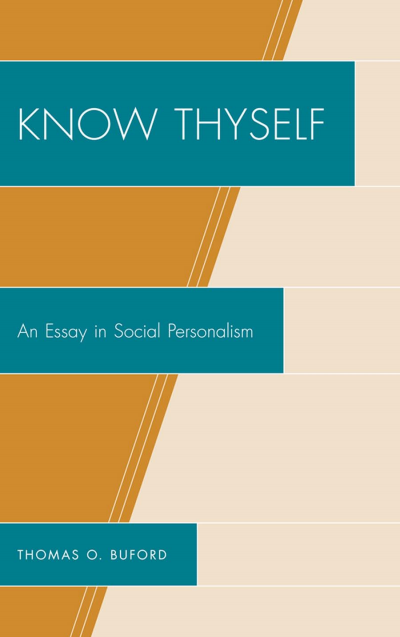
Know Thyself
An Essay on Social Personalism
Authors:
Publisher:
2011
Summary
Know Thyself: An Essay in Social Personalism proposes that social Personalism can best provide for self-knowledge. In the West, self-knowledge has been sought within the framework of two dominant intellectual traditions, order and the emerging self. On the one hand, ancient and medieval philosophers living in an orderly hierarchical society, governed by honor and shame, and bolstered by the metaphysics of being and rationalism, believed persons gain self-knowledge through uniting with the ground of their being; once united they would understand what they are, what they are to be, and what they are to do. On the other hand, Renaissance and modern thinkers such as Pico della Mirandola, Copernicus, Descartes, Locke, and Kant shattered the great achievement of the high middle ages and bequeathed to posterity an emerging self in a splintered world. Continuing their search for self-knowledge, the moderns found themselves faced with the dualism of the emerging self of the Renaissance and the natural world as understood by modern scientists. New problems spun out of this dualism, including the mind-body problem; the other minds problem; free will and determinism; the nature and possibility of social relationships; values, moral norms and their relationship to the natural and social worlds; and the relationships between science and religion. Finding self-knowledge among these splinters without a guiding orientation has proven difficult. Even though luminaries such as Spinoza, Berkeley, and Hegel attempted to bring order to the sundered elements, their attempts proved unsatisfactory. We contend that neither order nor the emerging self can adequately provide for self-knowledge. Since those culturally embodied “master narratives” lead us to an impasse, we turn to social Personalism.
Self-knowledge developed in this book shows how persons in relation to the Personal learn who they are, what they are to become, and what they must do to achieve that goal. It also shows that the achievement of self-knowledge is supported by a natural, social, and cultural environment rooted in trust. In this humane and timely discussion, Thomas O. Buford offers a personalist understanding of self-knowledge that avoids the impersonalisms that erode the dignity of persons and their moral life which characterize modern life.