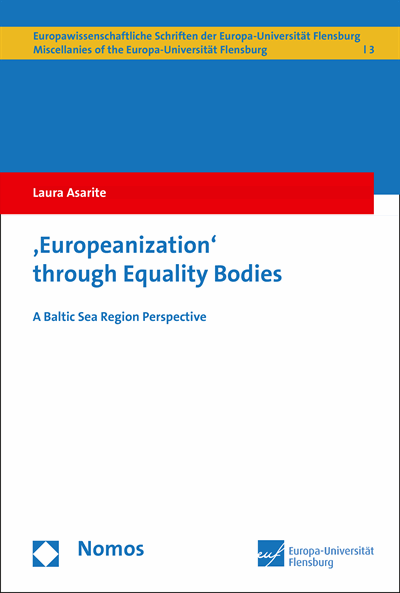
Europeanization through Equality Bodies
A Baltic Sea Region Perspective- Authors:
- Series:
- Europawissenschaftliche Schriften der Europa-Universität Flensburg | Miscellanies of the Europa-Universität Flensburg, Volume 3
- Publisher:
- 2015
Summary
Die Arbeit ist eine interdisziplinäre Studie über die Rolle der nationalen Gleichbehandlungsstellen (GBS) und des Europäischen Netzes der GBS in Europa. Sie gibt Aufschluss über den Zusammenhang zwischen der Vernetzung der GBS und der Europäisierung im Bereich der Förderung der Gleichstellung. Die Entwicklung eines gemeinsamen Ansatzes zur Förderung der Gleichstellung in der EU ist auf zwei Arten möglich – durch Rechtsharmonisierung und Europäisierung. Mit Hilfe der Untersuchung der Ostseeregion kann gezeigt werden, dass die nationalen GBS und deren Vernetzung zur Europäisierung in der Gleichstellungsförderung führen können. Die Forschungsarbeit trägt dazu bei, eine bedeutende Lücke in der wissenschaftlichen Debatte über die GBS zu schließen und treibt die Debatte über Politiknetzwerke in der EU voran. Darüber hinaus wird belegt, dass der einzigartige Charakter der GBS und deren Vernetzung einen erheblichen Beitrag zu der Entwicklung fragmentierter, nationaler Ansätze hin zu einem gemeinsamen europäischen Konzept für die Gleichstellungsförderung liefern.
Search publication
Bibliographic data
- Edition
- 1/2015
- Copyright Year
- 2015
- ISBN-Print
- 978-3-8487-2148-1
- ISBN-Online
- 978-3-8452-6247-5
- Publisher
- Nomos, Baden-Baden
- Series
- Europawissenschaftliche Schriften der Europa-Universität Flensburg | Miscellanies of the Europa-Universität Flensburg
- Volume
- 3
- Language
- English
- Pages
- 246
- Product Type
- Monograph
Table of contents
- Titelei/Inhaltsverzeichnis No access Pages 1 - 12
- List of abbreviations No access Pages 13 - 14
- Problem definition No access
- Setting the scene: the current view towards equality policy network No access
- Policy networks in general No access
- Objectives of research No access
- Grounded Theory No access
- Policy network analysis No access
- Structure of the work No access
- Introduction No access
- 1.1. The concept of integration in the European context No access
- 1.2.1. The concept of harmonisation No access
- 1.2.2. The reasoning of harmonisation No access
- 1.2.3. The process of harmonisation No access
- 1.3.1. What is Europeanization? No access
- 1.3.2. Different models of Europeanization No access
- Concluding remarks: From harmonisation to Europeanization and back No access
- Introduction No access
- 2.1.1. Beginnings of the EU equality legislation (1950-1996) No access
- 2.1.2. Article 13 and equality Directives – a leap further (1997-2006) No access
- 2.1.3. The Lisbon Treaties and the way forward (2007 and onwards) No access
- 2.1.4. Other initiatives of the EU No access
- Concluding remarks No access
- 2.2. EU equality legislation and its implications No access
- 2.3. Equality legislation in the EU – an overview No access
- 2.4.1. Information gathering on equality harmonisation across Member States No access
- 2.4.2. The reflection of EU equality legislation in the Member States No access
- 2.4.3. A step further from legal harmonisation No access
- Concluding remarks No access
- Introduction No access
- 3.1. Equality bodies in the EU law No access
- 3.2. Equality bodies in the International law No access
- 3.3.1. Composition of body No access
- 3.3.2. Finances of the equality bodies No access
- 3.3.3. Role of external actors in the work of equality bodies No access
- 3.3.4. Equality bodies across Europe – divided or united? No access
- 3.4.1. Assistance No access
- 3.4.2. Conduct of surveys No access
- 3.4.3. Impact on the development of laws No access
- 3.4.4. Promote equality No access
- 3.5.1. Independence No access
- 3.5.2. Effectiveness No access
- 3.5.3. Strategies for effectiveness No access
- 3.6.1. Potential No access
- 3.6.2. Challenges of using the potential of the equality bodies No access
- 3.7.1. Denmark No access
- 3.7.2. Sweden No access
- 3.7.3. Finland No access
- 3.7.4. Estonia No access
- 3.7.5. Latvia No access
- 3.7.6. Lithuania No access
- 3.7.7. Poland No access
- 3.7.8. Germany No access
- 3.7.9. Overview No access
- Concluding remarks No access
- Introduction No access
- 4.1.1. Bilateral cooperation No access
- 4.1.2.1. Nordic forum for equality bodies No access
- 4.1.2.2. Baltic forum for equality bodies No access
- 4.1.3.1. The functioning of the Network of equality bodies No access
- 4.1.3.2. The actions of Equinet No access
- 4.1.3.3. Historical overview of activities No access
- 4.1.3.3. What opportunities networking provides for the equality bodies No access
- 4.2. Similarity - From networking to Europeanization and a step further? No access
- Concluding remarks No access
- Conclusion No access Pages 226 - 232
- Bibliography No access Pages 233 - 246
Bibliography (235 entries)
No match found. Try another term.
- Bibliography Open Google Scholar DOI: 10.5771/9783845262475
- AGE: AGE Factsheet on Equinet: the European network of equality bodies, checked on 3/19/2014. Open Google Scholar DOI: 10.5771/9783845262475
- Allen, robin (2007): Article 13 EC, evolution and current contexts. In Helen Meenan (Ed.): Equality law in an enlarged European Union. Understanding the Article 13 Directives, pp. 38–72. Open Google Scholar DOI: 10.5771/9783845262475
- Ammer, Margit; Crowley, Niall; Liegl, Barbara; Holzleithner, Elisabeth; Wladasch, Katrin; Yesilkagit, Kutsal (Eds.) (2010): Study on Equality Bodies set up under Dir¬ect¬ives 2000/43/EC, 2004/113/EC and 2006/54/EC: Ludwig Boltzmann Institut für Menschenrechte. Open Google Scholar DOI: 10.5771/9783845262475
- Andenas, Mads; Andersen, Camilla Baasch (Eds.) (2011): Theory and practice of harmonisation: Edward Elgar Publishing Limited, checked on 4/12/2014. Open Google Scholar DOI: 10.5771/9783845262475
- Andenas, Mads; Andersen, Camilla Baasch; Aschroft, Ross (2011): Towards a theory of harmonisation. In Mads Andenas, Camilla Baasch Andersen (Eds.): Theory and practice of harmonisation: Edward Elgar Publishing Limited, pp. 572–594. Open Google Scholar DOI: 10.5771/9783845262475
- Andersen, Camilla Baasch (2011): Applied uniformity of a uniform commercila law: ensuring functional harmonisation of uniform texts through a global jur¬iscon¬sutorium of the CISG. In Mads Andenas, Camilla Baasch Andersen (Eds.): Theory and practice of harmonisation: Edward Elgar Publishing Limited, pp. 30–51. Open Google Scholar DOI: 10.5771/9783845262475
- Antidiskriminierungsstelle des Bundes (2014.): Homepage. Available online at http://www.antidiskriminierungsstelle.de/DE/UeberUns/ueberUns_node.html, checked on 6/11/2014. Open Google Scholar DOI: 10.5771/9783845262475
- Armstrong, Kenneth A. (1998): Legal Integration: Theorizin the Legal Dimension of European Integration. In Journal of Common Market Studies 36 (2), pp. 155–174. Open Google Scholar DOI: 10.5771/9783845262475
- Bell, Mark (2008): The Implementation of European Anti-Discrimination Directives: Converging towards a Common Model? In The Political Quarterly 79 (1). Open Google Scholar DOI: 10.5771/9783845262475
- Bell, Mark (2009): Advancing EU Anti-Discrimination Law: the European Commission’s 2008 Proposal for a New Directive. In The Equality Rights Review 3, pp. 7–18. Open Google Scholar DOI: 10.5771/9783845262475
- Berger, Klaus Peter (2001): Harmonisation of European Contract Law the Influence of Comparative Law. In The International and Comparative Law Quarterly 50 (4), pp. 877–900. Open Google Scholar DOI: 10.5771/9783845262475
- Besson, Samantha (2008): Gender Discrimination under EU and ECHR Law: Never Shall the TwainMeet? In Human Rights Law Review 8 (4), pp. 647–682. Open Google Scholar DOI: 10.5771/9783845262475
- Blaikie, Norman (2000): Designing Social Researcg: Polity Press. Open Google Scholar DOI: 10.5771/9783845262475
- Boerzel, Tanja A. (1998): Organizing Babylon - On the Different Conceptions of Policy Networks. In Public Administration 76, pp. 253–273. Open Google Scholar DOI: 10.5771/9783845262475
- Bogason, Peter; Toonen, Theo A.J. (1998): Introduction: Networks in Public Administration. In Public Administration 76, pp. 205–227. Open Google Scholar DOI: 10.5771/9783845262475
- Burca de, Grainne (2010): Stumbling into Experimentalism: The EU Anti-Discrimination Regime. In Charles F. Sabel, Jonathan Zeitlin (Eds.): Experimentalist Governance in the European Union: Towards a New Architecture: Oxford University Press, pp. 215–236. Open Google Scholar DOI: 10.5771/9783845262475
- Carbonara, Emanuela; Parisi, Francesco (2007): The paradox of legal harmonization. In Public Choice 132, pp. 367–400. Open Google Scholar DOI: 10.5771/9783845262475
- Charmaz, Kathy (2014): Constructing Grounded Theory. 2nd: SAGE. Open Google Scholar DOI: 10.5771/9783845262475
- Chopin, Isabelle; Gounari, Eirini-Maria: Developing Anti-Discrimination Law in Europe. The 27 EU Member States compared. Open Google Scholar DOI: 10.5771/9783845262475
- Christopoulos, Dimitrios C. (2008): The Governance of Networks: Heuristic or Formal Analysis? A Reply to Rachel Parker. In Political Studies 56, pp. 475–481. Open Google Scholar DOI: 10.5771/9783845262475
- Commission Of The European Communities: Growth, competitiveness, employment: The Challenges and way forward into the 21st century. White Paper. Office for Official Publications of the European Communities. Open Google Scholar DOI: 10.5771/9783845262475
- Commission Of The European Communities (1985): Completing the Internal Market. White Paper from the Commission to the European Council COM(85)310final. Open Google Scholar DOI: 10.5771/9783845262475
- Conant, Lisa (2007): Review Article: The Politics of Legal Integration. In Journal of Common Market Studies 45 (Annual Review), pp. 45–66. Open Google Scholar DOI: 10.5771/9783845262475
- Cormack, Janet (Ed.) (2004): Considerations For Establishing Single Equality Bodies And Integrated Equality Legislation. Seventh Experts' Meeting, Hosted By The Equality Commission. Open Google Scholar DOI: 10.5771/9783845262475
- Cormack, Janet (Ed.) (2004a): Strategic Enforcement And The Ec Equal Treatment Dir¬ect-ives. Towards The Uniform And Dynamic Implementation Of Eu Anti-Discrimination Legislation: The Role Of Specialised Bodies. Sixth Experts’ Meeting, Hosted By The Irish Equality Authority. Open Google Scholar DOI: 10.5771/9783845262475
- Council of Europe; Commissioner for Human Rights (2011): Opinion of the Commissioner for human rights on national structures for promoting equality. Commissioner for Human Rights. Available online at https://wcd.coe.int/ViewDoc.jsp?id=1761031, checked on 3/19/2014. Open Google Scholar DOI: 10.5771/9783845262475
- Danish Institute for Human Rights (2013): INTERVIEW: Spotlight on promoting equality in Denmark. Available online at http://www.humanrights.dk/news/interview-spotlight-on-promoting-equality-in-denmark, checked on 6/11/2014. Open Google Scholar DOI: 10.5771/9783845262475
- Danish Institute for Human Rights (2014): Homepage. Available online at http://www.humanrights.dk/our-work, checked on 6/11/2014. Open Google Scholar DOI: 10.5771/9783845262475
- Daugbjerg, Carsten (1998): Linking Policy Networks and Environmental Policies: Nitrate Policy Making in Denmark and Sweden 1970-1995. In Public Administration 76, pp. 275–294. Open Google Scholar DOI: 10.5771/9783845262475
- Deakin, Simon (2006): Legal Diversity and Regulatory Competition: Which Model for Europe? In European Law Journal 12 (4), pp. 440–454. Open Google Scholar DOI: 10.5771/9783845262475
- Diekmann, Andreas (2009): Empirische Sozialforschung: Grundlagen, Methoden, Anwedungen: Rowohlt Taschenbuch Verlag. Open Google Scholar DOI: 10.5771/9783845262475
- Dowding, Keith (1995): Model or Metaphor? A Critical Review of the Policy Network Approach. In Political Studies 48 (136-158). Open Google Scholar DOI: 10.5771/9783845262475
- Dunne, Ciarán (2011): The Place of Literature in Grounded theory research. In International Journal of Social Research Methodology 14 (2), pp. 111–124. Open Google Scholar DOI: 10.5771/9783845262475
- Ellis, Evelyn (2005): EU Anti-Discrimination Law: Oxford University Press. Open Google Scholar DOI: 10.5771/9783845262475
- Equal opportunities Ombudsman's Office Lithuania (2014.): Homepage. Available online at http://www.lygybe.lt/en/about-office.html, checked on 6/11/2014. Open Google Scholar DOI: 10.5771/9783845262475
- Equality and Human Rights Commission (2011): The National Equality Body contribution to closing the gender pay gap. Open Google Scholar DOI: 10.5771/9783845262475
- Equality Ombudsman Sweden: Homepage. Available online at http://www.do.se/en/, checked on 6/11/2014. Open Google Scholar DOI: 10.5771/9783845262475
- Equinet (2006): Dynamic Interpretation. European Anti-Discrimination Law in Practice. Case Studies. Open Google Scholar DOI: 10.5771/9783845262475
- Equinet (2006a): Strategic Enforcement Powers and Competences of Equality Bodies. Edited by Soraya Obura, Fiona Palmer. Open Google Scholar DOI: 10.5771/9783845262475
- Equinet (2007): Dynamic Interpretation. European ANti-Discrimination Law in Practice II. Case Studies. Open Google Scholar DOI: 10.5771/9783845262475
- Equinet (2007a): Equinet Statutes. Open Google Scholar DOI: 10.5771/9783845262475
- Equinet (2007b): Dynamic Interpretation. European ANti-Discrimination Law in Practice II. Case Studies. Open Google Scholar DOI: 10.5771/9783845262475
- Equinet (2007c): Equality Mainstreaming. A Perspective from the Equality Bodies. Equinet Opinions 2005-2006. Open Google Scholar DOI: 10.5771/9783845262475
- Equinet (2007d): Dynamic Interpretation. European Anti-Discrimination Law in Practice. Case Studies. Open Google Scholar DOI: 10.5771/9783845262475
- Equinet (2008a): Dynamic Interpretation. European Anti-Discrimination Law in Practice III. Case Studies. Open Google Scholar DOI: 10.5771/9783845262475
- Equinet (2008b): New Tools for Promoting Equality. An Equinet Opinion on a European Commission Communication on New Tools for Promoting Equality. An Equinet opinion. Open Google Scholar DOI: 10.5771/9783845262475
- Equinet (2008c): Promoting Equality. Overview of positive measures used by national equality bodies. Open Google Scholar DOI: 10.5771/9783845262475
- Equinet (2009): Dynamic Interpretation. European Anti-Discrimination Law in Practice IV. Case Studies. Open Google Scholar DOI: 10.5771/9783845262475
- Equinet (2009a): Equinet Annual Report 2009. Open Google Scholar DOI: 10.5771/9783845262475
- Equinet (2009b): Equinet Business Plan 2009. Open Google Scholar DOI: 10.5771/9783845262475
- Equinet (2009c): EQUINET statement on proposal of the eu anti-discrimination directive - role and position of equality bodies. Open Google Scholar DOI: 10.5771/9783845262475
- Equinet (2009d): Dynamic Interpretation. European Anti-Discrimination Law in Practice IV. Case Studies. Open Google Scholar DOI: 10.5771/9783845262475
- Equinet (2009e): Letter to Swedish Presidency. Open Google Scholar DOI: 10.5771/9783845262475
- Equinet (2009f): Strategic Role of Equality Bodies. Open Google Scholar DOI: 10.5771/9783845262475
- Equinet (2010a): Equinet Annual Report 2010. Open Google Scholar DOI: 10.5771/9783845262475
- Equinet (2010b): EQUINET Business Plan 2010. Open Google Scholar DOI: 10.5771/9783845262475
- Equinet (2010c): STRATEGIC PLAN 2011-2014. Open Google Scholar DOI: 10.5771/9783845262475
- Equinet (2010d): Influencing the law through legal proceedings. The Powers and Practices of equality bodies. Open Google Scholar DOI: 10.5771/9783845262475
- Equinet (2011a): Equinet Annual Report 2011. Open Google Scholar DOI: 10.5771/9783845262475
- Equinet (2011b): Equinet Work Plan and Budget 2011. Open Google Scholar DOI: 10.5771/9783845262475
- Equinet (2011c): Providing Independent Assistance to Victims of Discrimination. Open Google Scholar DOI: 10.5771/9783845262475
- Equinet (2011d): Equality Bodies and National Human Rights Institutions. Making the Link to Maximise Impact. An Equinet Perspective. Open Google Scholar DOI: 10.5771/9783845262475
- Equinet (2011e): Equinet Work Plan and Budget 2012. Open Google Scholar DOI: 10.5771/9783845262475
- Equinet (2011f): Tackling Ageism and Discrimination. Open Google Scholar DOI: 10.5771/9783845262475
- Equinet (2012): Equality Law in Practice. Comparative analysis of discrimination cases in Europe. An Equinet Report. Open Google Scholar DOI: 10.5771/9783845262475
- Equinet (2012a): Agenda of the EQUINET Training for Equality Bodies. Open Google Scholar DOI: 10.5771/9783845262475
- Equinet (2012b): Annual Report 2012. Equinet. Open Google Scholar DOI: 10.5771/9783845262475
- Equinet (2012c): Equinet High-Level Legal Seminar 2012. Open Google Scholar DOI: 10.5771/9783845262475
- Equinet (2012e): Board of Equal Treatment – Denmark. Open Google Scholar DOI: 10.5771/9783845262475
- Equinet (2012f): Danish Institute for Human Rights – Denmark. Open Google Scholar DOI: 10.5771/9783845262475
- Equinet (2012g): Equality Law in Practice. Comparative analysis of discrimination cases in Europe. Open Google Scholar DOI: 10.5771/9783845262475
- Equinet (2012h): Equality Ombudsman – Sweden. Open Google Scholar DOI: 10.5771/9783845262475
- Equinet (2012i): Federal Anti-Discrimination Agency – Germany. Open Google Scholar DOI: 10.5771/9783845262475
- Equinet (2012j): Human Rights Defender – Poland. Open Google Scholar DOI: 10.5771/9783845262475
- Equinet (2012k): Office of the Equal Opportunities Ombudsperson – Lithuania. Open Google Scholar DOI: 10.5771/9783845262475
- Equinet (2012l): Office of the Ombudsman – Latvia. Open Google Scholar DOI: 10.5771/9783845262475
- Equinet (2012m): Ombudsman for Equality – Finland. Open Google Scholar DOI: 10.5771/9783845262475
- Equinet (2012n): Ombudsman for Minorities – Finland. Open Google Scholar DOI: 10.5771/9783845262475
- Equinet (2012o): Equinet Work Plan and budget 2013. Open Google Scholar DOI: 10.5771/9783845262475
- Equinet (2012p): Equality bodies. Current Challenges. An Equinet Perspective. Open Google Scholar DOI: 10.5771/9783845262475
- Equinet (2013a): Vice-President Reding confirms full EC support to equality bodies in answer to MEPs' question - Equinet - European Network of Equality Bodies. Available online at http://www.equineteurope.org/Vice-President-Reding-confirms, checked on 5/5/2014. Open Google Scholar DOI: 10.5771/9783845262475
- Equinet (2013b): Processes and indicators for measuring the impact of equality bodies. Open Google Scholar DOI: 10.5771/9783845262475
- Equinet (2014): Equinet Work Plan 2014. Open Google Scholar DOI: 10.5771/9783845262475
- Equinet (2014a): What are equality bodies? - Equinet - European Network of Equality Bodies. Available online at http://www.equineteurope.org/-Equality-bodies-, checked on 6/7/2014. Open Google Scholar DOI: 10.5771/9783845262475
- European Commission (2005): Report On Putting Rights Into Practice. Open Google Scholar DOI: 10.5771/9783845262475
- European Commission (2006a): Equality and non-discrimination: Annual report 2006. Open Google Scholar DOI: 10.5771/9783845262475
- European Commission (2006b): 2007 — European Year of Equal Opportunities for All. Open Google Scholar DOI: 10.5771/9783845262475
- European Commission (2006c): European Handbook on Equality Data. Why and how to build to a national knowledge base on equality and discrimination on the grounds of racial and ethnic origin, religion and belief, disability, age and sexual orientation. Open Google Scholar DOI: 10.5771/9783845262475
- European Commission (2006d): Measuring Discrimination: Data Collection and EU Equality Law. Open Google Scholar DOI: 10.5771/9783845262475
- European Commission (2007): Developing Anti-Discrimination Law in Europe. The 25 EU Member States compared. Edited by European Commission. Open Google Scholar DOI: 10.5771/9783845262475
- European Commission (2008a): Communicating Equality and Non-Discrimination in the European Union. Open Google Scholar DOI: 10.5771/9783845262475
- European Commission (2008b): Equality in Action. Open Google Scholar DOI: 10.5771/9783845262475
- European Commission (2008c): The fight against discrimination and the promotion of equality. How to measure progress done. Open Google Scholar DOI: 10.5771/9783845262475
- European Commission (2009a): Equality in Action. Open Google Scholar DOI: 10.5771/9783845262475
- European Commission (2009b): Equality in Action. Open Google Scholar DOI: 10.5771/9783845262475
- European Commission (2009c): EU action against discrimination. Activity report 2007-08. Open Google Scholar DOI: 10.5771/9783845262475
- European Commission (2010a): Developing Anti-Discrimination Law in Europe. The 27 EU Member States compared. Open Google Scholar DOI: 10.5771/9783845262475
- European Commission (2010b): Promoting equality: activities on fighting discrimination in 2009. Open Google Scholar DOI: 10.5771/9783845262475
- European Commission (2010c): Communication From The Commission Europe 2020. A European strategy for smart, sustainable and inclusive growth. Open Google Scholar DOI: 10.5771/9783845262475
- European Commission (2011): Need help? Available online at http://ec.europa.eu/justice/gender-equality/help/index_en.htm, checked on 5/29/2014. Open Google Scholar DOI: 10.5771/9783845262475
- European Commission (2011a): Compendium of practice on Non-Discrimination/Equality Mainstreaming. Open Google Scholar DOI: 10.5771/9783845262475
- European Commission (2011b): Developing Anti-Discrimination Law in Europe. The 27 EU Member States, Croatia, Former Yugoslav Republic of Macedonia and Turkey compared. Open Google Scholar DOI: 10.5771/9783845262475
- European Commission (2011c): Equality - driving forward regional and local development. Stop Discrimination Newsletter. Open Google Scholar DOI: 10.5771/9783845262475
- European Commission (2011d): Raising awareness. Available online at http://ec.europa.eu/justice/discrimination/awareness/index_en.htm, checked on 6/15/2014. Open Google Scholar DOI: 10.5771/9783845262475
- European Commission (2011e): Tackling discrimination - Newsroom. Available online at http://ec.europa.eu/justice/newsroom/discrimination/index_en.htm, checked on 6/15/2014. Open Google Scholar DOI: 10.5771/9783845262475
- European Commission (2011f): Tackling discrimination. Available online at http://ec.europa.eu/justice/discrimination/index_en.htm, checked on 6/15/2014. Open Google Scholar DOI: 10.5771/9783845262475
- European Commission (2012a): Developing Anti-Discrimination Law in Europe. The 27 EU Member States, Croatia, Former Yugoslav Republic of Macedonia, Iceland, Liechtenstein, Norway and Turkey compared. Open Google Scholar DOI: 10.5771/9783845262475
- European Commission (2012b): Diversity Management. Support for voluntary initiatives promoting diversity management at the workplace across the EU. Open Google Scholar DOI: 10.5771/9783845262475
- European Commission (2013): Summaries of projects selected for funding under the call for proposals JUST/2013/PROG/AG/NGOS. Open Google Scholar DOI: 10.5771/9783845262475
- European Commission (2013a): Developing Anti-Discrimination Law in Europe. The 28 EU Member States, the Former Yugoslav Republic of Macedonia, Iceland, Liechtenstein, Norway and Turkey compared. Open Google Scholar DOI: 10.5771/9783845262475
- European Commission (2013b): National protection beyond the two. The grounds of religion and belief, disability, age and sexual orientation beyond employment. Ed¬ited by European Commission. Open Google Scholar DOI: 10.5771/9783845262475
- European Commission (2013c): Specific Programme "Progress" (2007-2013) Section 4 - Antidiscrimination And Diversity. Support to national activities aiming at combating discrimination and promoting equality. Restricted Call For Proposals For Action Grants. Open Google Scholar DOI: 10.5771/9783845262475
- European Commission (2013d): Discrimination in the EU in 2012. Special Eurobarometer 393. Open Google Scholar DOI: 10.5771/9783845262475
- European Commission (2013e): Employment, Social Affairs & Inclusion: New programme for Employment and Social Innovation (EaSI). European Commission. Available online at http://ec.europa.eu/social/main.jsp?langId=en&catId=89&newsId=1093, checked on 6/24/2014. Open Google Scholar DOI: 10.5771/9783845262475
- European Commission (2014a): Annex to the Commission Implementing Decision concerning the adoption of the work programme for 2014 and the financing for the. Open Google Scholar DOI: 10.5771/9783845262475
- European Commission (2014b): Report From The Commission To The European Parliament And The Council. Joint Report on the application of Council Directive 2000/43/EC of 29 June 2000 implementing the principle of equal treatment between persons irrespective of racial or ethnic origin (‘Racial Equality Directive’) and of Council Directive 2000/78/EC of 27 November 2000 establishing a general framework for equal treatment in employment and occupation (‘Employment Equality Directive’). Open Google Scholar DOI: 10.5771/9783845262475
- European Commission (2014c): EUROPA - PRESS RELEASES - Press release - Equality: EU rules to tackle discrimination now in place in all 28 EU Member States. Available online at http://europa.eu/rapid/press-release_IP-14-27_en.htm, updated on 1/17/2014., checked on 6/15/2014. Open Google Scholar DOI: 10.5771/9783845262475
- European Commission (2014d): Equality: EU rules to tackle discrimination now in place in all 28 EU Member States. Available online at http://ec.europa.eu/justice/newsroom/discrimination/news/140117_en.htm, checked on 6/15/2014. Open Google Scholar DOI: 10.5771/9783845262475
- European Communities (1957): The Treaty of Rome. Open Google Scholar DOI: 10.5771/9783845262475
- European Network of Legal Experts in the non-discrimination field (2008): Limits and potential of the concept of indirect discrimination. Open Google Scholar DOI: 10.5771/9783845262475
- European Network of Legal Experts in the non-discrimination field (2009a): European Anti-Discrimination Law Review. Edited by European Network of Legal Experts in the non-discrimination field. Open Google Scholar DOI: 10.5771/9783845262475
- European Network of Legal Experts in the non-discrimination field (2009b): European Anti-Discrimination Law Review. Open Google Scholar DOI: 10.5771/9783845262475
- European Network of Legal Experts in the non-discrimination field (2009c): European Gender Equality Law Review. Edited by European Network of Legal Experts in the non-discrimination field. Open Google Scholar DOI: 10.5771/9783845262475
- European Network of Legal Experts in the non-discrimination field (2009d): European Gender Equality Law Review. Edited by European Network of Legal Experts in the non-discrimination field. Open Google Scholar DOI: 10.5771/9783845262475
- European Network of Legal Experts in the non-discrimination field (2010a): European Anti-Discrimination Law Review 10. Open Google Scholar DOI: 10.5771/9783845262475
- European Network of Legal Experts in the non-discrimination field (2010b): European Anti-Discrimination Law Review. Edited by European Network of Legal Experts in the non-discrimination field. Open Google Scholar DOI: 10.5771/9783845262475
- European Network of Legal Experts in the non-discrimination field (2010c): In search of a balance between the right to equality and other fundamental rights. Edited by European Network of Legal Experts in the non-discrimination field. Open Google Scholar DOI: 10.5771/9783845262475
- European Network of Legal Experts in the non-discrimination field (2011a): European Anti-Discrimination Law Review. Open Google Scholar DOI: 10.5771/9783845262475
- European Network of Legal Experts in the non-discrimination field (2011b): The Prohibition of Discrimination under European Human Rights Law - EN. Open Google Scholar DOI: 10.5771/9783845262475
- European Network of Legal Experts in the non-discrimination field (2012): European Anti-discrimination Law Review (12). Open Google Scholar DOI: 10.5771/9783845262475
- European Network of Legal Experts in the non-discrimination field (2012a): European Anti-Discrimination Law Review. Open Google Scholar DOI: 10.5771/9783845262475
- European Network of Legal Experts in the non-discrimination field (2012b): European Anti-discrimination Law Review. Open Google Scholar DOI: 10.5771/9783845262475
- European Network of Legal Experts in the non-discrimination field (2012c): European Anti-Discrimination Law Review. Open Google Scholar DOI: 10.5771/9783845262475
- European Network of Legal Experts in the non-discrimination field (2013a): European Anti-Discrimination Law Review. Open Google Scholar DOI: 10.5771/9783845262475
- European Network of Legal Experts in the non-discrimination field (2013b): European Anti-Discrimination Law Review. Open Google Scholar DOI: 10.5771/9783845262475
- European Union (2006): Summaries of EU legislation: Glossary. Official website of the European Union. Available online at http://europa.eu/legislation_summaries/glossary/open_method_coordination_en.htm, checked on 5/6/2014. Open Google Scholar DOI: 10.5771/9783845262475
- European Union (2010a): Charter of Fundamental Rights of the European Union. 2010/C83/02. In Official Journal of the European Union. Open Google Scholar DOI: 10.5771/9783845262475
- European Union (2010b): Consolidated versions of the Treaty on European Union and the Treaty on the Functioning of the European Union. 2010/C 83/01. In Official Journal of the European Union. Open Google Scholar DOI: 10.5771/9783845262475
- European Union (2012): The Amsterdam treaty: a comprehensive guide. Fundamental rights and non-discrimination. Available online at http://europa.eu/legislation_summaries/institutional_affairs/treaties/amsterdam_treaty/a10000_en.htm, checked on 6/27/2014. Open Google Scholar DOI: 10.5771/9783845262475
- Eurostat (2013): European demography. Open Google Scholar DOI: 10.5771/9783845262475
- Exadaktylos, Theofanis; Radaelli, Claudio M. (2009): Research Design in European Studies: The Case of Europeanization. In JCMS: J Common Market Studies 47 (3), pp. 507–530. Open Google Scholar DOI: 10.5771/9783845262475
- Falkner, Gerda (2000): Policy networks in a multi‐level system: Convergence towards moderate diversity? In West European Politics 23 (4), pp. 94–120. Open Google Scholar DOI: 10.5771/9783845262475
- Falkner, Gerda (2013): Is the EU a Non-Compliance Community? Towards “compliance for credibility” and EU action for the protection of democracy in Europe. In Les Cahiers Europeens De Sciences Po. 1. Open Google Scholar DOI: 10.5771/9783845262475
- Falkner, Gerda; Treib, Oliver; Hartlapp Miriam; Leiber Simone (2005): Complying with Europe. EU Harmonisation and Soft Law in the Member States. Open Google Scholar DOI: 10.5771/9783845262475
- Ferreira, Nuno (2011): The harmonisation of private law in Europe and children's tor liability: A case of fundamental and children's rights mainstreaming. In In¬ter¬na¬tional Journal of Children's Rights 19, pp. 571–594. Open Google Scholar DOI: 10.5771/9783845262475
- Garrett, Geoffrey (1995): The politics of legal integration in the European Union. In International Organization 49 (1), pp. 171–181, checked on 3/17/2014. Open Google Scholar DOI: 10.5771/9783845262475
- Garrett, Geoffrey; Kelemen, R. Daniel; Schulz, Heiner (1998): The European Court of Justice, National Governments, and Legal Integration in the European Union. In International Organization 52 (1), pp. 149–176. Open Google Scholar DOI: 10.5771/9783845262475
- Gender Equality and Equal Treatment Commissioner (2004): Gender Equality Act Estonia Estonia. RT2 I 2004, 27, 181. Available online at http://www.svv.ee/index.php?id=484, checked on 6/11/2014. Open Google Scholar DOI: 10.5771/9783845262475
- Gender Equality and Equal Treatment Commissioner Estonia: Homepage. Available online at http://www.svv.ee/index.php?t=2, checked on 6/11/2014. Open Google Scholar DOI: 10.5771/9783845262475
- Glaser, Barney G.; Strauss, Anselm (2010): The Discovery of Grounded Theory. Strategies for Qualitative Research: Aldine Transaction. Open Google Scholar DOI: 10.5771/9783845262475
- Grewal, Herpreet Kaur (2008): Equality body in talks over 2012 contracts. In Community Renewal News, 8/5/2008, p. 7. Open Google Scholar DOI: 10.5771/9783845262475
- Griffith, Nathan D. (2006): ‘‘Deja Vu All Over Again:’’ Constitutional economics and European legal integration. In Springer Science+Business Media - Constit Polit Econ 17, pp. 15–29. Open Google Scholar DOI: 10.5771/9783845262475
- Guiraudon, Virginie (2009): Equality in the making: implementing European non-discrimination law. In Citizenship Studies 13 (5), pp. 527–549. Open Google Scholar DOI: 10.5771/9783845262475
- Hachmann, Verena (2011): From Mutual Learning to Joint Working: Europeanization Processes in the INTERREG B Programmes. In European Planning Studies 19 (8), pp. 1537–1555. Open Google Scholar DOI: 10.5771/9783845262475
- Healy, Marilyn; Perry, Chad (2000): Comprehensive criteria to judge validity and reliability of qualitative research within the realism paradigm. In Qualitative Market Research: An International Journal 3 (3), pp. 118–126. Open Google Scholar DOI: 10.5771/9783845262475
- Howard, Erica (2009): Equality: a Fundamental Right in the European Union? In International Journal of Discrimination and the Law 10, pp. 19–38. Open Google Scholar DOI: 10.5771/9783845262475
- Howard, Erica (2011): EU Equality Law: Three Recent Developments. In European Law Journal 17 (6), pp. 785–803. Open Google Scholar DOI: 10.5771/9783845262475
- Human Rights Defender Poland: Homepage. Available online at http://www.rpo.gov.pl/en/content/what-we-do. Open Google Scholar DOI: 10.5771/9783845262475
- Human Rights Defender Poland (2013): Report on the Activity of the Ombudsman in Poland in the Area of Equal Treatment in 2012 and the Observance of Equal Treatment Principle in the Republic of Poland. Open Google Scholar DOI: 10.5771/9783845262475
- Jacobsen, Bjørn Dilou (2010): Assistance to victims of discrimination by equality bodies of the EU member states. A Scandinavian perspective : legal issues arising from combining the function of providing assistance to victims of discrimination with the function of hearing and investigating complaints. 1st ed. Copenhagen: DJØF. Open Google Scholar DOI: 10.5771/9783845262475
- Jans, Jan H. (2008): Minimum Harmonisation and the Role of the Principle of Proportionality. In Social Science Research Network. Open Google Scholar DOI: 10.5771/9783845262475
- Jenny, Marcelo; Mueller, Andwolfgang C. (2010): From The Europeanization Of Lawmaking To The Europeanization Of National Legal Orders: The Case Of Austria. In Public Administration 88 (1), pp. 36–56. Open Google Scholar DOI: 10.5771/9783845262475
- Kassim, Hussein (1994): Policy networks, networks and European Union policy making: A sceptical view. In West European Politics 17 (4), pp. 15–27. Open Google Scholar DOI: 10.5771/9783845262475
- Kim, Junki (2006): Networks, Network Governance, and Networked Networks. In International Review of Public Administration 11 (1). Open Google Scholar DOI: 10.5771/9783845262475
- Krizsan, Andrea; Skjeie, Hege; Squires, Judith (2014): The changing nature of European equality regimes: explaining convergence and variation. In Journal of International and Comparative Social Policy 30 (1-16). Open Google Scholar DOI: 10.5771/9783845262475
- Ladeur, Karl-Heinz (1997): Towards a Legal Theory of Supranationality - the Viability of the Network Concept. In European Law Journal 3 (1), pp. 33–54. Open Google Scholar DOI: 10.5771/9783845262475
- Ladrech, Robert (1994): Europeanization of Domestic Politics and Institutions: The Case of France. In Journal of Common Market Studies 32 (1), pp. 69–88. Open Google Scholar DOI: 10.5771/9783845262475
- Lohse, Eva J. (2011): The meaning of harmonisation in the context of European Union law - a process in need of definition. In Mads Andenas, Camilla Baasch Andersen (Eds.): Theory and practice of harmonisation: Edward Elgar Publishing Limited, pp. 282–313. Open Google Scholar DOI: 10.5771/9783845262475
- Marella, Maria Rosaria (2006): The Non-Subversive Function of European Private Law: The Case of Harmonisation of Family Law. In European Law Journal 12 (1), pp. 78–105. Open Google Scholar DOI: 10.5771/9783845262475
- Marsh, David; Smith, Martin (2000): Understanding Policy Networks: towards a Dia¬lect¬ical Approach. In Political Studies 48, pp. 4–21. Open Google Scholar DOI: 10.5771/9783845262475
- McCauley, Darren (2011): BottomUp Europeanization Exposed: Social Movement Theory and Nonstate Actors in France. In JCMS: Common Market Studies 49 (5), pp. 1019–1042. Open Google Scholar DOI: 10.5771/9783845262475
- McColgan, Aileen (2013): National protection beyond the two EU anti-discrimination directives. The grounds of religion and belief, disability, age and sexual orientation beyond employment. Luxembourg: Publications Office. Open Google Scholar DOI: 10.5771/9783845262475
- McCrudden, Christopher (1993): The Effecte tiveness of European Equality Law: National Mechanisms for Enforcing gender Equality Law in the Light of European Requirements. In Oxford Journal of Legal Studies 13 (3), pp. 320–367. Open Google Scholar DOI: 10.5771/9783845262475
- Meenan, Helen (Ed.) (2007): Equality law in an enlarged European Union. Understanding the Article 13 Directives. Cambridge University Press. Open Google Scholar DOI: 10.5771/9783845262475
- Mills, Jane; Bonner, Ann; Francis, Karen (2006): The Development of Constructivist Grounded Theory. In International Journal of Qualitative Methods 5 (1), pp. 1–10. Open Google Scholar DOI: 10.5771/9783845262475
- Mueller, Wolfgang C.; Bovens, Mark; Grønnegaard, Jørgen (2010): Legal European-iz¬a¬tion: Comparative Perspectives. In Public Administration 88 (1), pp. 75–87. Open Google Scholar DOI: 10.5771/9783845262475
- Nousiainen, Kevät (2008): Unification (or not) of Equality Bodies and Legislation. In European Gender Equality Law Review 2. Open Google Scholar DOI: 10.5771/9783845262475
- Olsen, Johan P. (2002): The Many Faces of Europeanization. In JCMS: Common Market Studies 40 (5), pp. 921–952. Open Google Scholar DOI: 10.5771/9783845262475
- Ombudsman for Minorities Finland: Homepage. Available online at http://www.ofm.fi/en/front_page, checked on 6/11/2014. Open Google Scholar DOI: 10.5771/9783845262475
- Ombudsman of the Republic of Latvia (Tiesibsargs): Homepage. Available online at http://www.tiesibsargs.lv/lv, checked on 6/11/2014. Open Google Scholar DOI: 10.5771/9783845262475
- Pate, Robert A. (2009): The Future Of Harmonization: Soft Law Instruments And The Principled Advance Of International Lawmaking. In Selected Works of Robert A Pate. Available online at http://works.bepress.com/robert_pate/1, checked on 3/19/2014. Open Google Scholar DOI: 10.5771/9783845262475
- Peters, Guy B. (1998): Managing Horizontal Government: The Politics of Co-Ordination. In Public Administration 76, pp. 295–311. Open Google Scholar DOI: 10.5771/9783845262475
- Petersen, Jørn Henrik (1991): Harmonization of Social Security in the EC Revisited. In Journal of Common Market Studies 29 (5), pp. 505–526. Open Google Scholar DOI: 10.5771/9783845262475
- Peterson, John (1995): Policy networks and European union policy making: A reply to Kassim. In West European Politics 18 (2), pp. 389–407. Open Google Scholar DOI: 10.5771/9783845262475
- Peterson, John (2003): Policy Networks. In Institut für Höhere Studien (IHS), Wien: Reihe Politikwissenschaft 90. Open Google Scholar DOI: 10.5771/9783845262475
- Peterson, John (2004): Policy Networks. In Antje Wiener, Thomas Diez (Eds.): European Intergation Theory: Oxford University Press, pp. 117–136. Open Google Scholar DOI: 10.5771/9783845262475
- Prinssen, Jolande (Ed.) (2001): Direct Effect: Rethinking a Classic of EU Legal Doctrine. International Law FORUM du droit international 3. International Law FORUM du droit international: Kluwer Law International. Open Google Scholar DOI: 10.5771/9783845262475
- Radaelli, Claudio M. (2000): Whither Europeanization? Concept stretching and substantive change. In European Integration online papers 4 (8), pp. 1–25. Open Google Scholar DOI: 10.5771/9783845262475
- Ravluševičius, Pavelas (2011): Kriterien der EU – Richtlinienumsetzung Kriterien der EU – Richtlinienumsetzung und Folgen ihren Nichtbeachtung nach dem Recht der Europäischen Union. In Jurisprudence 18 (3), pp. 883–904. Open Google Scholar DOI: 10.5771/9783845262475
- Rudolf, Beate; Mahlmann, Matthias (Eds.) (2007): Gleichbehandlungsrecht. Handbuch. Nomos Praxis. Open Google Scholar DOI: 10.5771/9783845262475
- Sabel, Charles F.; Zeitlin, Jonathan (Eds.) (2010): Experimentalist Governance in the European Union: Towards a New Architecture: Oxford University Press. Open Google Scholar DOI: 10.5771/9783845262475
- Salinger, Ulrike (2007): Mediation as a Tool for Specialised Equality Bodies? - Equinet - European Network of Equality Bodies. Available online at http://www.equineteurope.org/Lorem-ipsum-dolor-sit-amet, checked on 3/20/2014. Open Google Scholar DOI: 10.5771/9783845262475
- Schaefer, Burkhard; Bankowski, Zenon (2003): Emerging Legal Orders. Formalism and the Theory of Legal Integration. In Ratio Juris. 16 (4), pp. 486–505. Open Google Scholar DOI: 10.5771/9783845262475
- Scharpf, Fritz W. (1994): Community and autonomy: Multi‐level policy‐making in the European Union. In Journal of European Public Policy 1 (2), pp. 219–242. Open Google Scholar DOI: 10.5771/9783845262475
- Scharpf, Fritz W. (2002): The European Social Model: Coping with the Challenges of Diversity. In Journal of Common Market Studies 40 (4), pp. 645–670. Open Google Scholar DOI: 10.5771/9783845262475
- Schiek, Dagmar (2011): Comparative law and European harmonisation - a match made in heaven or uneasy bedfellows? In Mads Andenas, Camilla Baasch Andersen (Eds.): Theory and practice of harmonisation: Edward Elgar Publishing Limited, pp. 425–449. Open Google Scholar DOI: 10.5771/9783845262475
- Shifrin, Tash (2010): Commons committee attacks equalities body. In Public Finance, 3/5/2010. Open Google Scholar DOI: 10.5771/9783845262475
- Spencer, Sarah (2014): Context, institution or accountability? Exploring the factors that shape the performance of national human rights and equality bodies. In Policy & Politics 42 (1), pp. 89–107. Open Google Scholar DOI: 10.5771/9783845262475
- Squires, Judith (2008): Intersecting Inequalities: Reflecting on the Subjects and Objects of Equality. In The Political Quarterly 79 (1), pp. 53–61. Open Google Scholar DOI: 10.5771/9783845262475
- Teague, Paul (1989): European Community Labour Market Harmonisation. In Journal of Public Policy 9 (1), pp. 1–33. Open Google Scholar DOI: 10.5771/9783845262475
- The Council of the European Communities (1978): Council Directive of 19 December 1978 on the progressive implementation of the principle of equal treatment for men and women in matters of social security. 79/7/EEC. Official Journal of the European Communities. Open Google Scholar DOI: 10.5771/9783845262475
- The Council of the European Communities (1992): Council Directive 92/85/EEC of 19 October 1992 on the introduction of measures to encourage improvements in the safety and health at work of pregnant workers and workers who have recently given birth or are breastfeeding. Official Journal of the European Communities. Open Google Scholar DOI: 10.5771/9783845262475
- The Council Of The European Union (2000): Council Directive 2000/43/EC of 29 June 2000 implementing the principle of equal treatment between persons irrespective of racial or ethnic origin. Open Google Scholar DOI: 10.5771/9783845262475
- The Council Of The European Union (2000a): Council Directive 2000/43/EC of 29 June 2000 implementing the principle of equal treatment between persons irrespective of racial or ethnic origin. Official Journal of the European Communities. Open Google Scholar DOI: 10.5771/9783845262475
- The Council Of The European Union (2000b): Council Directive 2000/78/EC of 27 November 2000 establishing a general framework for equal treatment in employment and occupation. Official Journal of the European Communities. Open Google Scholar DOI: 10.5771/9783845262475
- The Council Of The European Union (2000c): Council Directive 2000/78/EC of 27 November 2000 establishing a general framework for equal treatment in employment and occupation. In Official Journal of the European Communities. Open Google Scholar DOI: 10.5771/9783845262475
- The Council Of The European Union (2004): Council Directive 2004/113/EC of 13 December 2004 implementing the principle of equal treatment between men and women in the access to and supply of goods and services. In Official Journal of the European Communities. Open Google Scholar DOI: 10.5771/9783845262475
- The Council Of The European Union (2004): Council Directive 2004/113/EC of 13 December 2004 implementing the principle of equal treatment between men and women in the access to and supply of goods and services. Official Journal of the European Union. Open Google Scholar DOI: 10.5771/9783845262475
- The Council Of The European Union (2006): Directive 2006/54/EC Of The European Parliament And Of The Council of 5 July 2006 on the implementation of the principle of equal opportunities and equal treatment of men and women in matters of employment and occupation (recast). Official Journal of the European Union. Open Google Scholar DOI: 10.5771/9783845262475
- The Council Of The European Union (2008): Proposal for a COUNCIL DIRECTIVE on implementing the principle of equal treatment between persons irrespective of religion or belief, disability, age or sexual orientation. Open Google Scholar DOI: 10.5771/9783845262475
- The Council Of The European Union (2010a): Council Directive 2010/18/EU of 8 March 2010 implementing the revised Framework Agreement on parental leave concluded by BUSINESSEUROPE, UEAPME, CEEP and ETUC and repealing Dir¬ect¬ive 96/34/EC. Official Journal of the European Union. Open Google Scholar DOI: 10.5771/9783845262475
- The Council Of The European Union (2010b): Directive 2010/41/EU of the European Parliament and of the Council of 7 July 2010 on the application of the principle of equal treatment between men and women engaged in an activity in a self-employed capacity and repealing Council Directive 86/613/EEC. Official Journal of the European Union. Open Google Scholar DOI: 10.5771/9783845262475
- The Gender Equality and Equal Treatment Commissioner: Estonia Promoting Gender Equality through Empowerment and Mainstreaming. Open Google Scholar DOI: 10.5771/9783845262475
- The Office Of The Equal Opportunities Ombudsperson (2010): Annual Report 2009. Open Google Scholar DOI: 10.5771/9783845262475
- The Ombud for Equality: gender Equality Finland: Homemage. Available online at http://www.tasa-arvo.fi/en/home, checked on 6/11/2014. Open Google Scholar DOI: 10.5771/9783845262475
- The Ombud for Equality: gender Equality Finland (2005): The Act on Equality between Women and Men: Finland. Available online at http://www.tasa-arvo.fi/en/publications/act2005, checked on 6/11/2014. Open Google Scholar DOI: 10.5771/9783845262475
- Thompson, Dennis (1965): Harmonization Of Laws. In Journal of Common Market Studies 3 (3), pp. 302–314. Open Google Scholar DOI: 10.5771/9783845262475
- Thornberg, Robert (2012): Informed Grounded Theory. In Scandinavian Journal of Edu¬ca-tional Research 56 (3), pp. 243–259. Open Google Scholar DOI: 10.5771/9783845262475
- Tiesībsargs (2011): The Ombudsman Strategies for the years 2011 – 2013. Open Google Scholar DOI: 10.5771/9783845262475
- Weiler, Joseph (2011): The political and legal culture of European integration: An exploratory essay. In I-CON 9 (3-4), pp. 678–694. Open Google Scholar DOI: 10.5771/9783845262475
- Wiener, Antje; Diez, Thomas (Eds.) (2004): European Intergation Theory: Oxford University Press. Open Google Scholar DOI: 10.5771/9783845262475
- Wilkinson, Amanda (2008): How the EU scores on harmonisation. www. employeebenefits.co.uk, checked on 3/17/2014. Open Google Scholar DOI: 10.5771/9783845262475
- Wilner, Tamar; Townsend, Sarah (2009): Equality body considers revamp. In Regeneration & Renewal, 8/17/2009, p. 3. Open Google Scholar DOI: 10.5771/9783845262475
- Witte de, Bruno (2010): From a ''Common Principle of Equality'' to ''European Antidiscrimination Law". In American Behavioral Scientist 53 (12), pp. 1715–1730. Open Google Scholar DOI: 10.5771/9783845262475
- www.equineteurope.org (a): 2012 Equinet High-Level Legal Seminar - 28 March, Brussels - Equinet - European Network of Equality Bodies. Available online at http://www.equineteurope.org/2012-Equinet-High-Level-Legal,342, checked on 7/7/2014. Open Google Scholar DOI: 10.5771/9783845262475
- www.equineteurope.org (b): Ad-hoc Initiatives - Equinet - European Network of Equality Bodies. Available online at http://www.equineteurope.org/-Networking-Initiatives-, checked on 7/7/2014. Open Google Scholar DOI: 10.5771/9783845262475
- www.equineteurope.org (c): Equinet Activities - Equinet - European Network of Equality Bodies. Available online at http://www.equineteurope.org/-Activities-, che¬cked on 7/7/2014. Open Google Scholar DOI: 10.5771/9783845262475
- www.equineteurope.org (d): Equinet at a Glance - Equinet - European Network of Equality Bodies. Available online at http://www.equineteurope.org/-About-us-, checked on 7/7/2014. Open Google Scholar DOI: 10.5771/9783845262475
- www.equineteurope.org (e): Events - Equinet - European Network of Equality Bodies. Available online at http://www.equineteurope.org/-Events-, che¬cked on 7/7/2014. Open Google Scholar DOI: 10.5771/9783845262475
- www.equineteurope.org (f): "Using Communications to Tackle Under-Reporting" - 2012 Equinet Training in Malta - Equinet - European Network of Equality Bodies. Available online at http://www.equineteurope.org/Using-Communications-to-Tackle, che¬cked on 7/7/2014. Open Google Scholar DOI: 10.5771/9783845262475
- www.equineteurope.org (g): Working Groups - Equinet - European Network of Equality Bodies. Available online at http://www.equineteurope.org/-Thematic-Working-Groups-, checked on 7/7/2014. Open Google Scholar DOI: 10.5771/9783845262475
- www.equineteurope.org (h): Legislative Framework - Equinet - European Network of Equality Bodies. Available online at http://www.equineteurope.org/-Legislative-framework,82-, updated on 6/7/2014., checked on 6/7/2014. Open Google Scholar DOI: 10.5771/9783845262475
- www.migpolgroup.com: Project: Equality Bodies - Description - Migration Policy Group. Available online at http://www.migpolgroup.com/projects_detail.php?id=26, checked on 5/29/2014. Open Google Scholar DOI: 10.5771/9783845262475
- Yesilkagit, Kutsal; Snijders, Berend (Eds.) (2008): Between Impartiality and Responsiveness. Equality Bodies and Practices of independence. Equinet. Open Google Scholar DOI: 10.5771/9783845262475