, to see if you have full access to this publication.
Monograph No access
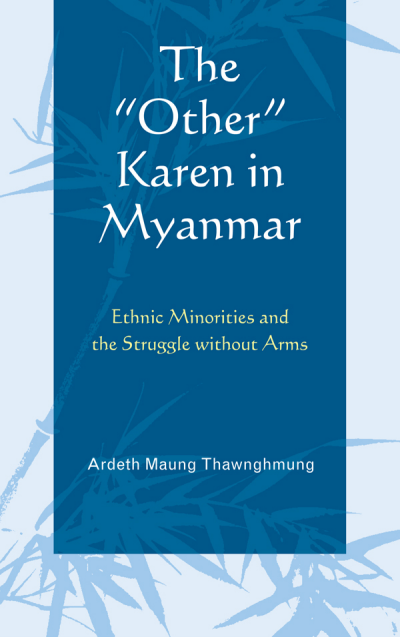
The Other Karen in Myanmar
Ethnic Minorities and the Struggle without Arms
Authors:
Publisher:
2011
Summary
The “Other” Karen in Myanmar looks at the “other” or “quiet” minorities, who are members of ethnic groups associated with well-known armed resistance organizations, but who pursued non-violent approaches to promote their individual and collective interests. This is the first in-depth study to uncover the existence and activities of the “other” Karen and analyze the nature of relationships with their “rebel” counterparts and the state authorities. It also discusses other ethnic armed organizations that have experienced similar situations and assesses their implications for inter-ethnic relations, negotiations with state authorities and political reform.
Most previous studies have focused on violent aspects of ethnic relations and on ethnic armed organizations, such as the Karen National Union (KNU) in Burma, the Moro Islamic Liberation Front (MNLF) in the Philippines, and the LTTE in Sri Lanka. However, even among these minorities which are locked in armed conflicts, the majority of people have shunned armed resistance and sought to remain ‘quietly’ beyond the struggle and pursued non-violent approaches to promote their individual and collective interests in the face of authoritarian, governments.
This study, which sheds light on the lives and growing political significance of non-armed, non-insurgent members of ethnic minorities in Burma, draws heavily on opinion surveys and open-ended interviews among Karen diaspora (among individuals who lived a minimum of 20 years in Burma), “quiet Karens” who live inside Burma, KNU officials, personnel, and soldiers, and Karen refugees and IDPs who are currently living in Thai-Burma border areas. These interviews, which covered approximately two hundred respondents, have been conducted since 2002.
It is mainly directed toward social scientists, historians, humanitarian workers, policy makers, and practitioners, and non-specialist ordinary audience who are interested in Southeast Asian/Burmese politics and society, comparative politics, identity politics, ethnic conflict, social movements, conflict resolution, and political reform.
Search publication
Bibliographic data
Edition
1/2011
Copyright Year
2011
ISBN-Print
978-0-7391-6852-3
ISBN-Online
978-0-7391-7107-3
Publisher
Lexington, Lanham
Language
English
Pages
200
Product Type
Monograph
Table of contents
ChapterPages
Contents No access
Acknowledgments No access
Introduction No access
Acronyms No access
Chapter 01. Who are the “Other” or “Quiet” Minorities? No access Pages 1 - 18
Chapter 02. The Emergence of the Karen Ethno-nationalist Movement No access Pages 19 - 62
Chapter 03. Kawthoolei Karen No access Pages 63 - 90
Chapter 04. The “Rebel” and the “Accommodator” No access Pages 91 - 126
Chapter 05. The “Other” Ethno-nationalities in Myanmar/Burma No access Pages 127 - 160
Chapter 06. Conclusion No access Pages 161 - 178
Bibliography No access Pages 179 - 190
Index No access Pages 191 - 198
About the Author No access Pages 199 - 200
Similar publications
from the topics "Soziologie allgemein"
Edited Book Full access
Christoph T. Burmeister, Thorsten Hertel, Sophia Richter