, to see if you have full access to this publication.
Book Titles No access
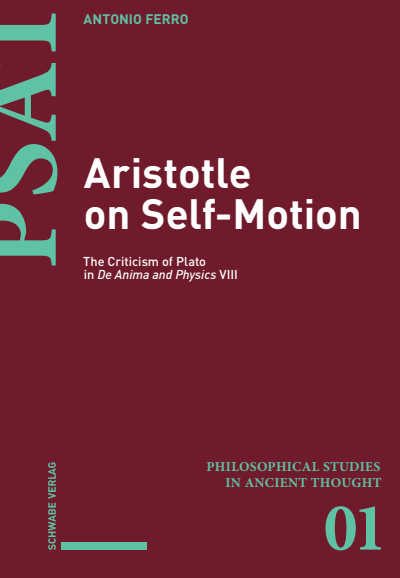
Aristotle on Self-Motion
The Criticism of Plato in De Anima and Physics VIII- Authors:
- Series:
- Philosophical Studies in Ancient Thought, Volume 1
- Publisher:
- 2022
Keywords
Search publication
Bibliographic data
- Copyright year
- 2022
- ISBN-Print
- 978-3-7965-4163-6
- ISBN-Online
- 978-3-7965-4363-0
- Publisher
- Schwabe, Basel / Berlin
- Series
- Philosophical Studies in Ancient Thought
- Volume
- 1
- Language
- English
- Pages
- 465
- Product type
- Book Titles
Table of contents
ChapterPages
- Titelei/Inhaltsverzeichnis No access Pages 1 - 8
- Note to the reader No access
- 0.1 Preliminaries: A bird's eye view No access
- 0.2.1 Scope of the present investigation: What is not found in this book No access
- 0.2.2 Contents: What is found in this book No access
- 1.1 Dialectic and diaporetic method in de An. I 2–5: Three plausibility constraints No access
- a) Concern 1: The definition of soul as self-motion No access
- b) Concern 2: Soul as a first mover No access
- 1.3.1 Overall strategy of refutation No access
- 1.3.2 Plato's self-moving souls No access
- 1.3.3.1 Aristotle's concerns about causal synonymy: T8.(i) No access
- 1.3.3.2 The distinction between motion καθ᾽ αὑτό and καθ᾽ ἕτερον: T8.(ii) No access
- 1.3.3.3 The per se motions of soul are neither natural nor violent: Arguments (1)–(5) No access
- 1.3.3.4 The ekstasis argument and Plato's definition of soul No access
- 1.4 A positive lesson on the soul-body causal relation No access
- 1.5 Timean “perceptions” as sui generis per se motions of soul No access
- 1.6 Summary No access
- 2.1 An overview No access
- 2.2.1.1 Aristotle's proof No access
- 2.2.1.2 The eternity claim: Two readings No access
- 2.2.2.1 Brief aperçu on Aristotle's argument in Ph. VIII 3–6 No access
- 2.2.2.2 The third aporia in Ph. VIII 2 No access
- 2.2.2.3 Aristotle's interim solution to the third aporia No access
- 2.3 The relation between Ph. VIII 2 and Ph. VIII 6 No access
- 2.4.1 The argument in context No access
- 2.4.2.1 From weak causal autonomy to the inability to cause continuous motion in two steps (Ph. VIII 6, 259b1–31) No access
- 2.4.2.2 The conclusion of the overarching argument in Ph. VIII 3–6 (Ph. VIII 6, 259b32–260a19) No access
- 2.4.3.1.1 The “orthodox” interpretation No access
- 2.4.3.1.2 Morison's interpretation No access
- 2.4.3.2 Justification of the οὐ κυρίως claim No access
- 2.4.4 Some loose ends: Metaphysical aspects of strong causal autonomy No access
- 3.1 An overview No access
- 3.2 A methodological prolegomenon: ^Plato, Aristotle, and two senses of capacity No access
- 3.3.1 Individuation without Separation: Two distinct concerns No access
- 3.3.2.1 The argument in de An. III 9, 432a22–b13 No access
- 3.3.2.2 A rival interpretation of de An. III 9–10 No access
- 3.4.1 de An. III 10, 433a9–21: Occurrent desires and extensional distinctness No access
- 3.4.2 de An. III 10, 433a21–30: Erring desires and the ὀρεκτόν as a mover No access
- 3.4.3 de An. III 10, 433b5–13: Conflict of (occurrent) desires and the formal unity of the capacity for desire No access
- 3.4.4 de An. III 10, 433b13–30: Locomotive capacity defined and a coda No access
- 3.5. Self-motion at the crossroads of ^de Anima III 9–10 and ^Ph. VIII: The daunting task of ^MA No access
- 4.1.1 Chapter 1 No access
- 4.1.2 Chapter 2 No access
- 4.1.3 Chapter 3 No access
- 4.2 Ph. VIII 5: Self-motion and the unity of life No access
- References No access Pages 433 - 442
- Index locorum No access Pages 443 - 454
- Index of names No access Pages 455 - 456
- Index of subjects No access Pages 457 - 465