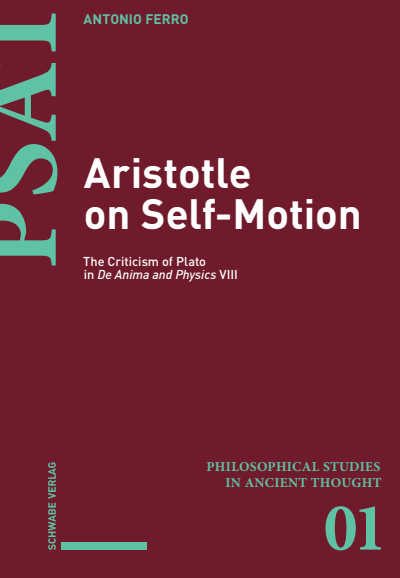
Aristotle on Self-Motion
The Criticism of Plato in De Anima and Physics VIII- Autor:innen:
- Reihe:
- Philosophical Studies in Ancient Thought, Band 1
- Verlag:
- 2022
Zusammenfassung
What is Aristotle’s considered view of animal self-motion? According to several scholars, Aristotle ends up rejecting this very notion as a result of his criticism of Plato’s theory of a self-moving soul. Contrary to this still widespread assumption, the present study argues that his critical engagement with Plato is not confined to negative results, but achieves largely positive outcomes, which add up to a rich and nuanced picture of self-motion. Ferro makes his case by offering a novel reading of a handful of controversial passages from De Anima (I 3–4; III 9–10) and Physics VIII, where Aristotle reacts to three aspects of Plato’s theory of self-motion: the claim that soul itself is a self-mover (and therefore a proper subject of motion), the assumption that self-movers enjoy strong causal autonomy, and the link between motion, desire and soul partition. Through a careful reading of the relevant passages, which does justice to their proper context and significance, Ferro shows that Aristotle’s critical re-appropriation of self-motion results in a largely coherent doctrine with major repercussions for Aristotelian psychology and philosophy of nature.
Schlagworte
Publikation durchsuchen
Bibliographische Angaben
- Copyrightjahr
- 2022
- ISBN-Print
- 978-3-7965-4163-6
- ISBN-Online
- 978-3-7965-4363-0
- Verlag
- Schwabe, Basel / Berlin
- Reihe
- Philosophical Studies in Ancient Thought
- Band
- 1
- Sprache
- Englisch
- Seiten
- 465
- Produkttyp
- Monographie
Inhaltsverzeichnis
- Titelei/Inhaltsverzeichnis Kein Zugriff Seiten 1 - 8
- Note to the reader Kein Zugriff
- 0.1 Preliminaries: A bird's eye view Kein Zugriff
- 0.2.1 Scope of the present investigation: What is not found in this book Kein Zugriff
- 0.2.2 Contents: What is found in this book Kein Zugriff
- 1.1 Dialectic and diaporetic method in de An. I 2–5: Three plausibility constraints Kein Zugriff
- a) Concern 1: The definition of soul as self-motion Kein Zugriff
- b) Concern 2: Soul as a first mover Kein Zugriff
- 1.3.1 Overall strategy of refutation Kein Zugriff
- 1.3.2 Plato's self-moving souls Kein Zugriff
- 1.3.3.1 Aristotle's concerns about causal synonymy: T8.(i) Kein Zugriff
- 1.3.3.2 The distinction between motion καθ᾽ αὑτό and καθ᾽ ἕτερον: T8.(ii) Kein Zugriff
- 1.3.3.3 The per se motions of soul are neither natural nor violent: Arguments (1)–(5) Kein Zugriff
- 1.3.3.4 The ekstasis argument and Plato's definition of soul Kein Zugriff
- 1.4 A positive lesson on the soul-body causal relation Kein Zugriff
- 1.5 Timean “perceptions” as sui generis per se motions of soul Kein Zugriff
- 1.6 Summary Kein Zugriff
- 2.1 An overview Kein Zugriff
- 2.2.1.1 Aristotle's proof Kein Zugriff
- 2.2.1.2 The eternity claim: Two readings Kein Zugriff
- 2.2.2.1 Brief aperçu on Aristotle's argument in Ph. VIII 3–6 Kein Zugriff
- 2.2.2.2 The third aporia in Ph. VIII 2 Kein Zugriff
- 2.2.2.3 Aristotle's interim solution to the third aporia Kein Zugriff
- 2.3 The relation between Ph. VIII 2 and Ph. VIII 6 Kein Zugriff
- 2.4.1 The argument in context Kein Zugriff
- 2.4.2.1 From weak causal autonomy to the inability to cause continuous motion in two steps (Ph. VIII 6, 259b1–31) Kein Zugriff
- 2.4.2.2 The conclusion of the overarching argument in Ph. VIII 3–6 (Ph. VIII 6, 259b32–260a19) Kein Zugriff
- 2.4.3.1.1 The “orthodox” interpretation Kein Zugriff
- 2.4.3.1.2 Morison's interpretation Kein Zugriff
- 2.4.3.2 Justification of the οὐ κυρίως claim Kein Zugriff
- 2.4.4 Some loose ends: Metaphysical aspects of strong causal autonomy Kein Zugriff
- 3.1 An overview Kein Zugriff
- 3.2 A methodological prolegomenon: ^Plato, Aristotle, and two senses of capacity Kein Zugriff
- 3.3.1 Individuation without Separation: Two distinct concerns Kein Zugriff
- 3.3.2.1 The argument in de An. III 9, 432a22–b13 Kein Zugriff
- 3.3.2.2 A rival interpretation of de An. III 9–10 Kein Zugriff
- 3.4.1 de An. III 10, 433a9–21: Occurrent desires and extensional distinctness Kein Zugriff
- 3.4.2 de An. III 10, 433a21–30: Erring desires and the ὀρεκτόν as a mover Kein Zugriff
- 3.4.3 de An. III 10, 433b5–13: Conflict of (occurrent) desires and the formal unity of the capacity for desire Kein Zugriff
- 3.4.4 de An. III 10, 433b13–30: Locomotive capacity defined and a coda Kein Zugriff
- 3.5. Self-motion at the crossroads of ^de Anima III 9–10 and ^Ph. VIII: The daunting task of ^MA Kein Zugriff
- 4.1.1 Chapter 1 Kein Zugriff
- 4.1.2 Chapter 2 Kein Zugriff
- 4.1.3 Chapter 3 Kein Zugriff
- 4.2 Ph. VIII 5: Self-motion and the unity of life Kein Zugriff
- References Kein Zugriff Seiten 433 - 442
- Index locorum Kein Zugriff Seiten 443 - 454
- Index of names Kein Zugriff Seiten 455 - 456
- Index of subjects Kein Zugriff Seiten 457 - 465