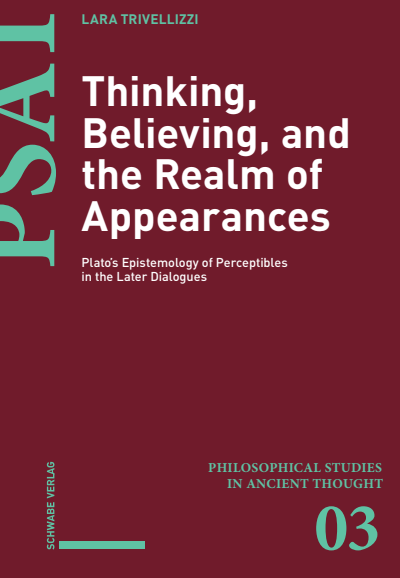
Thinking, Believing, and the Realm of Appearances
Plato's Epistemology of Perceptibles in the Later Dialogues- Authors:
- Publisher:
- 2025
Summary
This book investigates Plato’s later theory of knowledge with regard to perceptual cognition and its epistemological status. It is argued that, in Plato’s later dialogues, the three main cognitive phenomena related to acquaintance with the realm of perceptibles – sense-perception, appearance and belief – undergo a process of reciprocal conceptual disentanglement. As a result, the notions of sense-perception and belief get disambiguated and clearly separated from the notion of appearance. In addition, those notions are integrated into an innovative epistemological model, whose accuracy and reliability is clearly superior to the model previously embraced in the early and middle dialogues. In these dialogues, indeed, sense-perception and belief were still conflated with each other and with the problematic (“sophistic”) notion of appearance.
Keywords
Search publication
Bibliographic data
- Edition
- 1/2025
- Copyright Year
- 2025
- ISBN-Print
- 978-3-7965-5284-7
- ISBN-Online
- 978-3-7965-5285-4
- Publisher
- Schwabe, Basel / Berlin
- Series
- Philosophical Studies in Ancient Thought
- Language
- English
- Pages
- 254
- Product Type
- Monograph
Table of contents
- Table of Contents No access
- Acknowledgments No access
- 1. The “Aristotelian suggestion”, and an alternative to it No access
- 2.1 The general argumentative strategy No access
- 2.2 The textual material No access
- Chapter 1: The problematic starting point No access
- Chapter 2: Setting out to solve the problem No access
- Chapter 3: The proper solution to the problem No access
- Chapter 4: The new actors on the stage (part I) No access
- Chapter 5: The new actors on the stage (part II) No access
- 4. Overarching arguments, overall results No access
- 1.1 The epistemological model of the Meno: Two possible interpretations No access
- 1.2 From the Meno to the Republic: The epistemology of the “autobiographical passage” of the Phaedo No access
- 2.1 The “powers argument” No access
- 2.2 The Divided Line No access
- Does sense-perception really “speak”? No access
- Two kinds of belief? Conflicting beliefs and the Divided Line No access
- An example from the text? No access
- 3.4 Zooming in on the potential problem No access
- 4. Conclusions No access
- 1. The Protagorean underpinning: An entangled epistemology No access
- Restricting the scope of sense-perception No access
- The “common concepts” and their impact on the interpretation of sense-perception No access
- 2.2 Non-sensory belief No access
- 3.1 What we have achieved so far No access
- 3.2 What is still left to be worked out No access
- 4. Conclusions No access
- 1.1 Using the Theaetetus to explain the Sophist No access
- 1.2 Introducing appearance No access
- 1.3 Interpreting the two descriptions of appearance No access
- 1.4 Some possible objections No access
- 2. Summing up the disentanglement process No access
- Two kinds of images, two kinds of image-making No access
- 3.2 The epistemological interpretation of perceptual and linguistic appearance No access
- 3.3 (The art of) appearances, after the linguistic argument No access
- 4. Conclusions No access
- 1.1 The physiological account No access
- 1.2 The psychological implications No access
- 1.3 Timaeus and Theaetetus on sense-perception No access
- 2. Disentangled belief No access
- Interpreting the key formulation No access
- 3.2 “Appearing” vs. “believing” No access
- 4. Assessing the co-working model: Belief vs. knowledge? No access
- 5. Conclusions No access
- 1.1 The man under the tree:Sense-perception, dianoetic thinking, belief-formation No access
- 2.1 Perceptual appearances as non-standard cases of sense-perception: Pleasures of juxtaposition No access
- Disentangled appearance in the painter analogy? No access
- 3. Assessing the co-working model: Belief as a second-order form of knowledge No access
- 4. Conclusions No access
- Conclusion No access Pages 229 - 232
- A. Editions, translations and commentaries No access
- B. Articles, monographs and other volumes No access
- C. Grammars, dictionaries, lexica/indexes and other linguistic tools No access
- Index locorum No access Pages 241 - 246
- Index of names No access Pages 247 - 248
- General index No access Pages 249 - 254