, to see if you have full access to this publication.
Monograph No access
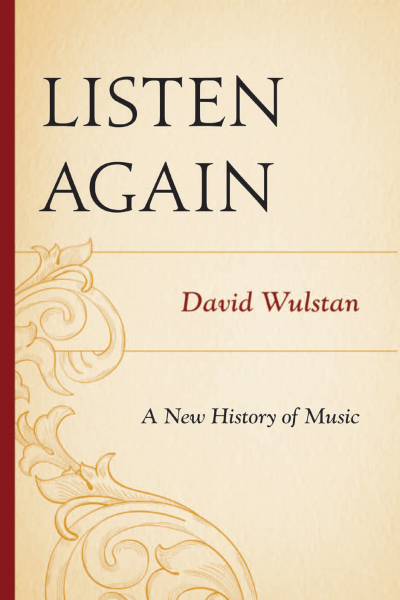
Listen Again
A New History of Music
Authors:
Publisher:
2015
Summary
How do you tell the key of a piece—without looking at a score? How do you know when a musical work ended before an audience applauds or a radio announcer returns on air? Was there, in fact, a ‘breakdown of tonality’ in the nineteenth and twentieth centuries? These questions and others are the focus of David Wulstan’s Listen Again: A New History of Music. He also shows where the nuove musiche of the early Baroque era came from and what the two critical but unlinked chords in the middle of Bach’s Brandenburg Concerto No. III signify.
Previous literature in music does not properly address these questions and innumerable others. In Listen Again, Wulstan illustrates how music from Bach to Bartók was far less "revolutionary" than customarily imagined and that the "inversionist" doctrine of Rameau and kindred acoustical misconceptions, courtesy of Heinrich Schenker and other analysts, solve fewer problems than their purveyor claim. In Listen Again, Wulstan takes to task early theorists, who were mostly clerics who ignored non-ecclesiastical music, and their modern equivalents, who consider only the blinding white of the written or printed score, whilst ignoring music as heard and interpreted by the ear and brain. Instead, Wulstan enquires into the musical activities of the common folk to addressing key issues that early and modern theorists have regularly overlooked.
The book will appeal anyone who has dismissed "harmony," "theory" and the like as alien, in effect, to practical music. Readers will find in Listen Again that the true history of music has far more practical relevance for performers than the aridity of music theory coursework, demonstrating by example how this work a book about music, not, as in the case of so much theoretical work, a "book about books."
Search publication
Bibliographic data
Edition
1/2015
Copyright Year
2015
ISBN-Print
978-1-4422-3749-0
ISBN-Online
978-1-4422-3750-6
Publisher
Rowman & Littlefield, Lanham
Language
English
Pages
458
Product Type
Monograph
Table of contents
ChapterPages
Contents No access
Foreword No access
Acknowledgements No access
Introduction No access
Glossary No access
Permissions No access
Chapter 1 Some Matters of Terminology and Other Preliminaries No access Pages 1 - 10
Chapter 2 The Recognition of Key No access Pages 11 - 22
Chapter 3 Tonal Balance and Minor Tonality: The Use of Sequences; Dissonance No access Pages 23 - 38
Chapter 4 The Rule of the Octave: Harmony and Rhythm No access Pages 39 - 52
Chapter 5 The Enhanced Tonic: Fugal Technique and Tonality No access Pages 53 - 76
Chapter 6 Complex Key No access Pages 77 - 94
Chapter 7 The Classical Style (1) No access Pages 95 - 110
Chapter 8 The Classical Style (2) No access Pages 111 - 124
Chapter 9 Classical to Romantic: Beethoven and Schubert No access Pages 125 - 154
Chapter 10 The Romantic Era (1): Chopin, Brahms and Mendelssohn No access Pages 155 - 180
Chapter 11 The Romantic Era (2): The Age of Wagner No access Pages 181 - 200
Chapter 12 The Perception of Music No access Pages 201 - 234
Chapter 13 The Twentieth Century (1): The Palette of Debussy No access Pages 235 - 250
Chapter 14 The Twentieth Century (2): Themes and Theories in the Music of Stravinsky and Others No access Pages 251 - 270
Chapter 15 The Twentieth Century (3): Techniques and Treatises—Bartók, Hindemith, and others No access Pages 271 - 296
Chapter 16 Saturday Night and Sunday Morning No access Pages 297 - 318
Chapter 17 Two Cultures No access Pages 319 - 344
Chapter 18 Mediæval to Renaissance No access Pages 345 - 384
Chapter 19 Renaissance to Baroque No access Pages 385 - 406
Chapter 20 Back to the Future No access Pages 407 - 426