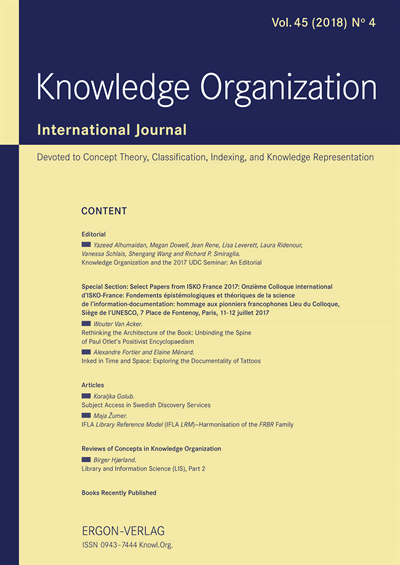
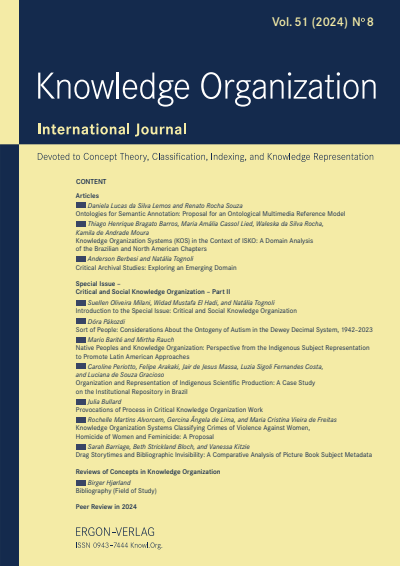
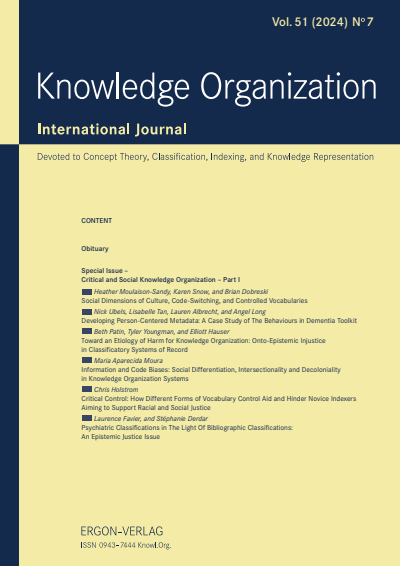
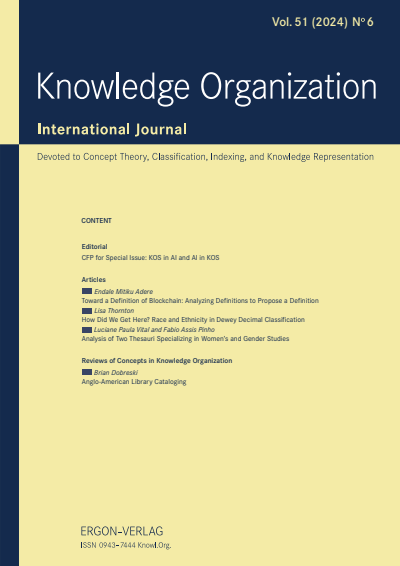
KNOWLEDGE ORGANIZATION is a forum for all those interested in the organization of knowledge on a universal or a domain-specific scale, using concept-analytical or concept-synthetical approaches, as well as quantitative and qualitative methodologies. KNOWLEDGE ORGANIZATION also addresses the intellectual and automatic compilation and use of classification systems and thesauri in all fields of knowledge, with special attention being given to the problems of terminology.KNOWLEDGE ORGANIZATION publishes original articles, reports on conferences and similar communications, as well as book reviews, letters to the editor, and an extensive annotated bibliography of recent classification and indexing literature.KNOWLEDGE ORGANIZATION should therefore be available at every university and research library of every country, at every information center, at colleges and schools of library and information science, in the hands of everybody interested in the fields mentioned above and thus also at every office for updating information on any topic related to the problems of order in our information-flooded times.
Paul Otlet’s exploration of the idea to record information in separate chunks or units according to the “monographic principle” has provoked considerable interest in information history for the way in which it resonates with the present...
This project explores whether tattoos possess, according to those who sport them, the characteristics of a document and, if yes, to what extent. Eighty-eight tattoos, which were described in eighteen in-depth interviews with tattooed adults, are...
While support for subject searching has been traditionally advocated for in library catalogs, often in the form of a catalog objective to find everything that a library has on a certain topic, research has shown that subject access has not been...
In 1998, the FRBR model (Functional Requirements for Bibliographic Records) was developed under the auspices of the International Federation of Library Associations and Institutions (IFLA). The library domain finally developed its conceptual model...
This article outlines the history of library and information science (LIS), from its roots in library science, information science and documentation. It considers various conceptions or “paradigms” in the field and discusses the topical content...