SEER tries to stimulate the exchange of information among researchers, trade unionists and people who have a special interest in the political, social and economic development of the region of south-east Europe. The journal tries to draw attention to new research results and the latest analyses about the ongoing process of political and social changes in the south-east of Europe. It tries to create more understanding for the importance of the elaboration of democratic structures in industrial relations. The SEER combines contributions from different disciplines and »political schools« into an information package of interest for policy makers, researchers, academics and trade unionists from various backgrounds. Website: www.seer.nomos.de
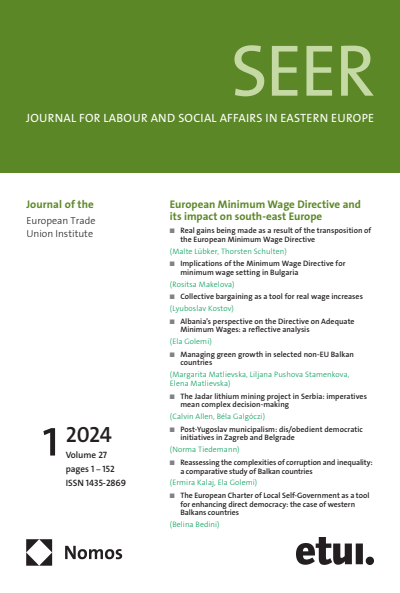
In most EU countries there were significant increases in minimum wages on 1 January 2024. Despite persistently high inflation rates in the majority of member states, these were sufficient to maintain or even expand the purchasing power of the...
This article explores the criteria for minimum wage setting as set out in Article 5 of the European Minimum Wage Directive. Bulgaria must transpose the Directive and, as a result, some processes have already been initiated. However, tripartite...
Over the past three years, the cumulative Consumer Price Index in Bulgaria has reached nearly 35%, while inflation in the small consumer basket rose even more. Low and middle-income earners spend an ever-increasing proportion of their income on...
The minimum wage serves as a fundamental aspect of labour rights aimed at safeguarding workers from exploitation and ensuring a basic standard of living. In recent years, the European Union has taken significant steps to harmonise minimum wage...
It has become clear that economic growth is not the only way of expressing a country’s development and progress. Recently, development has also come to incorporate the components of environmental protection and social equity within a broader...
This article examines the decision by the Serbian government to approve the highly controversial Jadar project to mine lithium at a site in the western part of Serbia. Lithium is a critical raw material with a variety of applications including, most...
New municipalism as a political-strategic approach is a reaction to the authoritarian management of the deep and multiple crises of capitalism after 2008. From their base in Spain, municipalist platforms have extended elsewhere across the globe,...
This article analyses the relationship between corruption and income inequality in western Balkan countries in the period from 2012 to 2023. The International Labour Organization, Transparency International and World Development Indicators are the...
Five of the six non-EU countries in the western Balkans region have signed the Council of Europe’s European Charter of Local Self-Government, the exception being the Republic of Kosovo which is not yet a formal member of the Council of Europe....