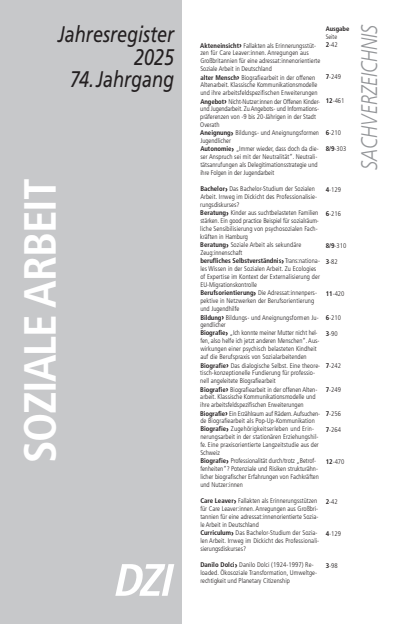
Soziale Arbeit, founded in 1951, is an independent academic journal which addresses developments in the context of social work. It is one of the most important publication media in its field and is read by teachers, students and researchers in social work and social pedagogy as well as by professionals and managers from associations and institutions. The journal’s aim is to promote professional development in social work fields by presenting methods and new concepts, in addition to subject-specific practical reports. In the ‘Rundschau’ (Review) section, information from all social fields is compiled. The ‘Tagungskalender’ (Conference Calendar) refers to important events, and the ‘Zeitschriftenbibliographie’ (Bibliography of Journals) lists current articles from professional journals. Soziale Arbeit is published 11 times a year with an annual focus issue published as a double issue. All scholarly articles submitted for publication in the journal undergo a double-blind peer review process. The editorial board is supported in an advisory capacity by a professional advisory board consisting of individuals from associations, universities, politics and administrative bodies. The journal cooperates with the academic societies of social work from Germany (DGSA) and Austria (OGSA). All social work contributions are indexed in the literature database DZI SoLit.
Digital spaces challenge the notion of a concept of hybridity, the relevance of which for social work will be outlined in this article based on the platforms TikTok and Twitch. Such hybridization can be conceptually framed with different approaches...
Counselling in open youth work with its low-threshold settings is hardly discussed in the professional discourse of social work. Based on an explorative research project as part of an Erasmus+ project, this article presents results on the specific...
The article summarizes the results of a qualitative study on diversity in open youth work from the perspective of professionals. The open door to the youth center is mentioned as a prerequisite for young people to access and an open attitude on the...
How can professional identities that manage a consistent balance between closeness and distance toward the client, evolve in caring professions? To describe such professional identities, the author introduces the term approachability. To retrace the...