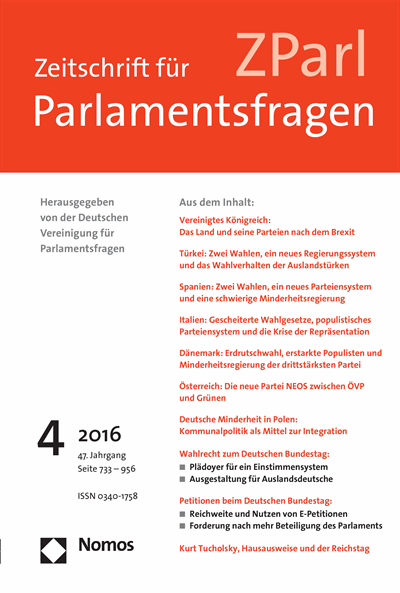
The general elections on June 26, 2016 were the second elections within seven months . Already on December 20, 2015, the Spanish citizens were asked to elect a new government . The elections in December can be seen as a political watershed, which...
Italian party pluralism is rooted in its constitutional history . On the basis of its three phases (1949 - 1994; 1994 - 2013; since 2013), both the relationship between electoral law and political parties and the ‘serious’ transformation of the...
The electoral success of the new party „NEOS - Das Neue Österreich und Liberales Fo- rum“ has consequences for the Austrian party system . Drawing on data from the Austrian National Election Study (AUTNES) that cover the political supply side...
The German minority is concentrated in the area of Opole Silesia and is an important po- litical factor in this region . The Germans regularly gain many seats in the municipality, city and county councils, mostly in rural areas in the Eastern part...
In 1985, German expatriates were given the right to vote in parliamentary elections . In 2012, the election law governing this right was challenged before the German Constitu- tional Court, which ruled that, among others, a mandatory residence...
Since 2005, the German Bundestag offers the possibility to submit individual petitions through the use of an Internet form . In 2009, following a pilot experiment, it established the category of “public petitions” for issues of common interest,...
Germany’s two-vote system - effective at the federal level since 1953 and adopted by most of the 16 states thereafter - shows several deficits . For instance, due to the fact that the electorate does not base its electoral choice on the local...
Petitions against measures by official authorities are usually filed by individuals or groups to the responsible departments or parliaments . These requests or complaints are examined mostly without public debate by the petitions committee or the...