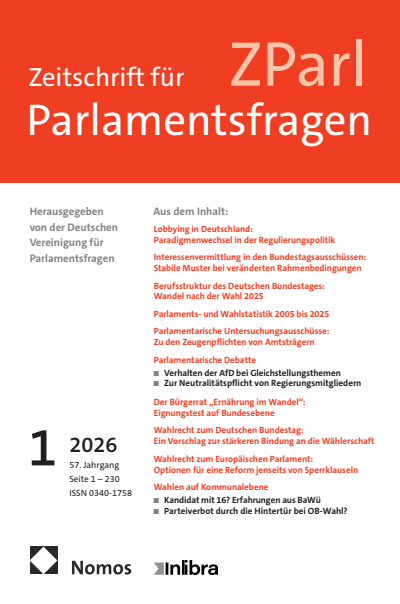
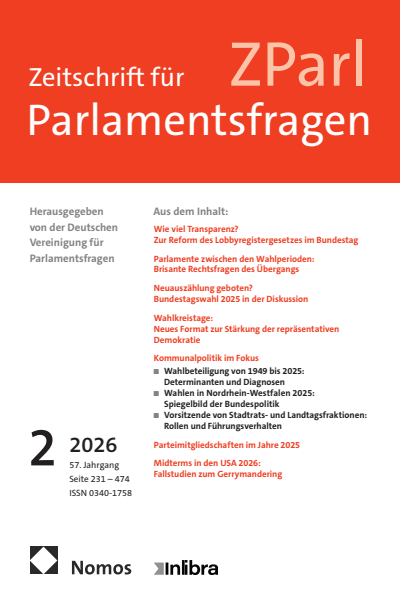
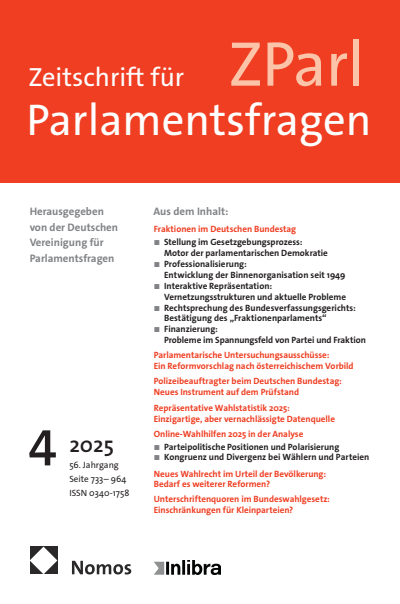
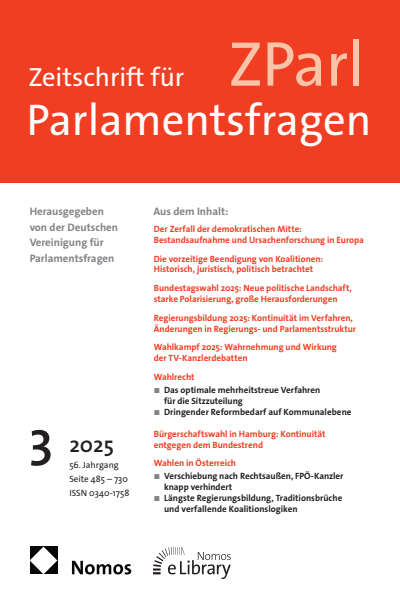
Zeitschrift für Parlamentsfragen contains articles on political issues dealing with representation and legitimation of the political system. The articles provide a broad overview of the functioning of national and regional parliaments as well as a forum for comparative analysis of international parliaments. One stress is on the parliamentary development of different countries. Indices are provided in every issue which makes the ZParl an outstanding reference book for institutional and comparative political studies. Website: www.zparl.nomos.de
How the Bundestag works depends largely on the skills and abilities of its members. The expertise of MPs is determined in particular by their previous professional experience. Building on earlier studies, changes in the parliamentary composition can...
This article extends previous data collections on interest articulation in the committees of the German Bundestag. The analysis shows a further increase in the relevance of expert participation, without a corresponding expansion in the number of...
At the center of this mixed methods study is the research question, how the parliamentary communication on gender equality issues has deteriorated since the Alternative for Germany (AfD) has entered the German Bundestag. The analysis is based on a...
This article examines the limits of government information and expression activities in the context of parliamentary debates. It explores the extent to which members of the government are subject to a duty of political neutrality when speaking in...
Public officials play a particularly important role in the work of parliamentary committees of inquiry. Thanks to their official knowledge, they can explain contexts to members of parliament that cannot be gleaned from reading files alone. In...
For elections to the European Parliament in Germany, an electoral system is used that entails four major disadvantages: (1) there is no mechanism to ensure a regionally balanced distribution of representatives; (2) closed party lists prevent a close...
In the direct election of the mayor of Ludwigshafen in 2025, the candidate of the Alternative for Germany (AfD) party was not allowed to stand for election because of doubts about his loyalty to the constitution. The AfD criticized this as “a...
So far, the literature on descriptive youth representation in parliaments has mostly focused on the national and occasionally in federal states on the subnational level. We broaden this focus by analyzing the local level that often serves as an...
Parliamentary democracy is in crisis, and society’s trust in democratic institutions and their representatives is dwindling. While plebiscites are considered a risky option for alleviating these problems in times of right-wing populism, interest...
In German politics for a long time, issues of lobbying regulation were put on the political agenda only in some periods and with varying subjects. Only at the beginning of the 2000s the isolated rules were recognized by political actors as a...
The German Bundestag is caught in an endless cycle of tortuous amendments of its electoral system. Past attempts were restricted by retaining the traditional ballot design. Without this restriction new options become feasible. The article outlines a...