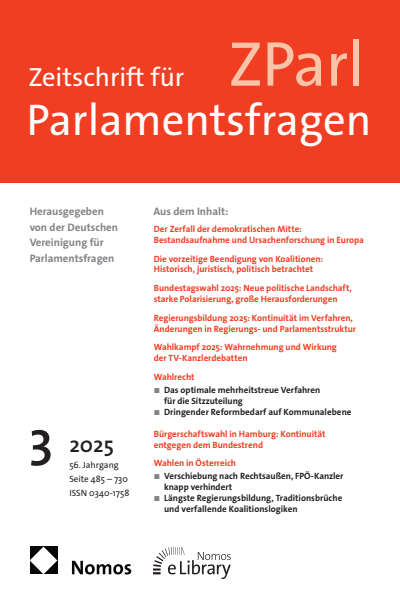
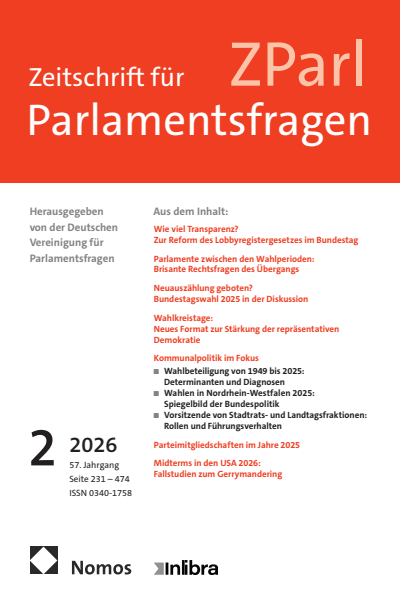
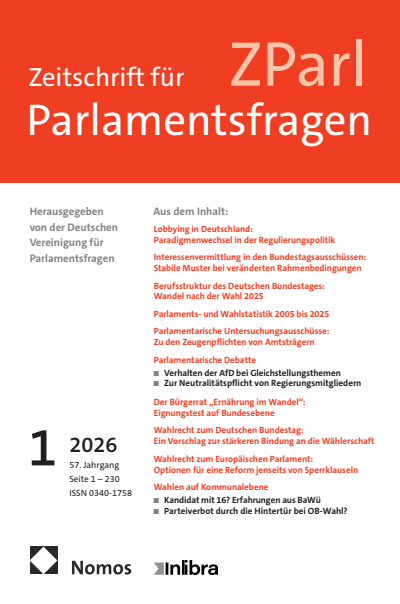
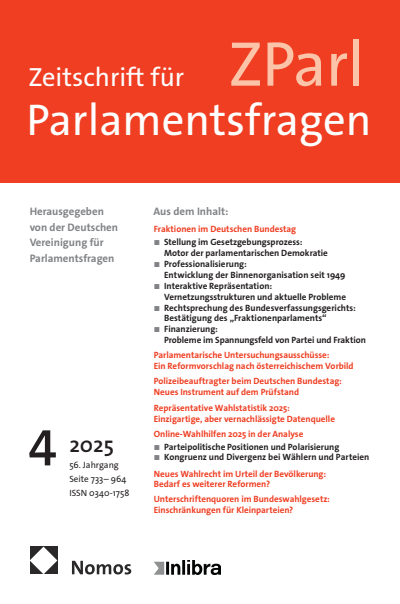
Zeitschrift für Parlamentsfragen contains articles on political issues dealing with representation and legitimation of the political system. The articles provide a broad overview of the functioning of national and regional parliaments as well as a forum for comparative analysis of international parliaments. One stress is on the parliamentary development of different countries. Indices are provided in every issue which makes the ZParl an outstanding reference book for institutional and comparative political studies. Website: www.zparl.nomos.de
The end of the so-called “traffic light coalition” in November 2024 demonstrated once again that party coalitions in Germany sometimes end prematurely – that is, before the regular end of the legislative period. Against this background, this...
In the last two weeks of the 2025 federal election campaign, the chancellor candidates from the CDU/CSU, SPD, Bündnis 90/Die Grünen, and AfD parties met in three televised debates in various constellations, continuing a tradition of televised...
Traditional seat apportionment methods focus on proportionality in order to ensure equal suffrage. They may violate a property called majority preservation, though, as we expose on a number of recent elections in Germany. As such, a coalition of...
The Schleswig-Holstein local election system features four problematic aspects, which are associated with paradoxical effects that are not appropriate to the local context. These include the fact that individual candidates sometimes do not receive a...
The outcome of the Hamburg state election held on March 2, 2025, was principally shaped by city-specific issues, despite the extraordinary context of an early federal election just one week prior, which was triggered by the collapse of the federal...
The Austrian National Council election on September 29, 2024 marks the endpoint of the longest legislative period since the extension of the term of office in 2007. There have been five elections since then, and it was only the second time that it...
The coalition negotiations following the Austrian National Council elections in 2024 developed into the longest government formation in the Second Republic and led to an oversized three-party coalition of the ÖVP, SPÖ and NEOS for the first time...
The federal election on February 23, 2025, was marked by high polarization, which focused mainly on the issue of migration, leading to a record turnout of 82.5 percent. The Union (CDU/CSU) achieved 28.5 percent, but fell short of expectations, while...
After the break-up of the traffic light coalition in November 2025, the question of confidence was used to bring about early general elections. Mathematically and politically, the results allowed only for a coalition between the CDU/CSU and the SPD....
Since the 1970s, the party systems of European democracies have undergone fundamental changes. In all countries, the centrist parties that had shaped political life for decades lost support among the electorate. The first phase of change was...