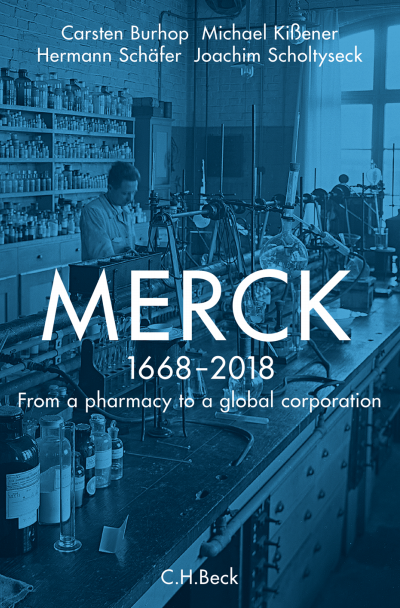
Merck
From a Pharmacy to a Global Corporation- Authors:
- | | |
- Publisher:
- 2018
Summary
Merck is the oldest pharmaceutical-chemical company in the world. It developed into a global corporation from a Darmstadt pharmacy that Jacob Friedrich Merck received the pharmacist’s license for in 1668. This book tells the 350-year history of the company for the first time in its entirety and on the basis of all the available sources, as well as the newest research in business history.
For a long time, family-owned companies were regarded as a dying breed. The future seemed to belong to jointstock companies with an anonymous stockholder structure. Yet there are numerous successful counterexamples in Germany, such as Bosch, C&A and Bertelsmann. Merck, too, counts among them. How did the Merck family manage to keep the company in its possession for 13 generations through all the political ruptures and historical crises and turn it into a global leader among science and technology firms? With this as their central question, four acclaimed historians recount the fascinating history of the Merck company between 1668 and 2018, embedding it in the eventful course of world history.
Search publication
Bibliographic data
- Edition
- 1/2018
- Copyright Year
- 2018
- ISBN-Print
- 978-3-406-70039-2
- ISBN-Online
- 978-3-406-70040-8
- Publisher
- C.H.BECK Literatur - Sachbuch - Wissenschaft, München
- Language
- English
- Pages
- 711
- Product Type
- Monograph
Table of contents
- Titelei/Inhaltsverzeichnis No access Pages 2 - 8
- Sources No access
- The Merck Archive No access
- Other Archives No access
- Literature No access Pages 28 - 28
- 1.1 Origin of the family No access
- 1.2 The first Merck pharmacist in Darmstadt: Jacob Friedrich No access
- 1.3 The nephew as successor: Georg Friedrich Merck (1647–1715) and the continuation of the Darmstadt pharmacy No access
- 1.4. Establishing the pharmacy and family in Darmstadt: Johann Franz Merck (1687–1741) No access
- 1.5. Guardianship and management: Elisabeth Catharina Merck, née Kayser (1706–1786) No access
- 2.1. The Merck family as lenders No access
- 2.2. Intellectual and social influences: The role of Johann Heinrich Merck No access
- 2.3 A new type of pharmacist: Johann Anton Merck (1756–1805) No access
- 3.1 The Merck family and pharmacy at the turn of the 19th century No access
- 3.2 Emanuel Merck No access
- 3.3 The pharmacy and Darmstadt society No access
- 3.4 New fields of business No access
- 3.5 Emanuel Merck the scientist No access
- 1.1 An industrial company in three steps No access
- 1.2 Scientific networks and the expansion of industrial manufacturing No access
- 1.3 Secondary activities, diversification, and investments No access
- 1.4 Socio-patriarchal traditions, family ties, and political background No access
- 2.1 The founding of the E. Merck Partnership No access
- 2.2 Political-economic background, the death of Emanuel Merck, focus on tradition No access
- 2.3 The pharmacy, the “House,” and the three-factory operation – organizational and structural problems No access
- 2.4 Social development and environmental issues No access
- 3.1. Emanuel Merck’s grandsons in the industrial era – The partnership agreement (1888) No access
- 3.2 Pressures to modernize and falling profits No access
- 3.3 Family conflict and renewal of the partnership agreement (1899) No access
- 3.4 Modernization, construction of the new factory, and expansion No access
- 3.5 Regulatory battles on the pharmaceutical market, research and development No access
- 3.6 Factory rules, social issues, paternalism, and unions No access
- 3.7 National and international expansion No access
- 1.1. General development No access
- 1.2. The loss of Merck & Co. No access
- 1.3. Areas of competition and cooperation No access
- 1.4. Marketing No access
- 1.5. Workforce and company culture No access
- 1.6. Merck in the food and agricultural industries No access
- 2.1 General development No access
- 2.2 Foreign business No access
- 2.3. Business and politics – The Mercks in the Third Reich No access
- 2.4. Research No access
- 2.5. Vitamins No access
- 3.1. General development No access
- 3.2. Anti-Semitism and the “Jewish question” No access
- 3.3. Forced labor No access
- 3.4. The palace revolution of 1942 No access
- 3.5. Hydrogen peroxide: From disinfectant to rocket fuel No access
- 3.6. Defeat, war’s end, denazifi cation, and a new beginning No access
- 1.1. In the land of the Wirtschaftswunder No access
- 1.2 Merck 1948 No access
- 1.3 Corporate governance, company organization, and the family No access
- 1.4 The workforce during the Wirtschaftswunder No access
- 1.5 The products: Caught between cost pressures and obsolescence No access
- 1.6 Research during the reconstruction No access
- 1.7 The return to the global market No access
- 2.1 Between stagflation and Europeanization No access
- 2.2 Reorienting the corporate governance and organization No access
- 2.3 The workforce No access
- 2.4 Research and development No access
- 2.5 The slow departure from the mass market No access
- 2.6 On the path to becoming a global company No access
- 2.7 Acquisition as a growth strategy No access
- 2.8 Sales and advertising No access
- 2.9 Environmental protection No access
- 3. A Company History of the Present No access Pages 473 - 483
- Conclusion No access Pages 484 - 499
- Epilogue and Acknowledgments No access Pages 500 - 502
- Notes No access Pages 503 - 646
- Genealogy No access Pages 647 - 654
- List of Abbreviations No access Pages 655 - 657
- List of Archives No access Pages 658 - 658
- Bibliography No access Pages 659 - 694
- Image credits No access Pages 695 - 696
- Index of companies No access Pages 697 - 702
- Index of persons No access Pages 703 - 711