, to see if you have full access to this publication.
Monograph No access
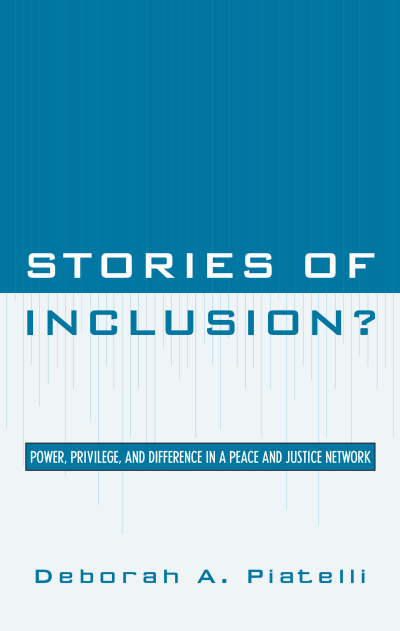
Stories of Inclusion?
Power, Privilege, and Difference in a Peace and Justice Network
Authors:
Publisher:
2009
Summary
Why are some white, middle-class activists experiencing difficulty creating alliances across racial and class differences? What are the obstacles and what is being done to overcome them? What type of movement structures, cultures, and practices can best facilitate inter-racial, inter-class solidarity? Stories of Inclusion? explores these questions through an ethnographic study of a predominately white, middle-class contemporary peace and justice network that is working to create a racially and class diverse community of activists. Addressing a very significant and greatly under researched topic, Stories of Inclusion? raises important and critical questions for the peace movement as well as larger society. In accessible prose, this study bridges the literatures of social movement theory, critical race studies, and feminist theory, and offers new insight into how power and privilege can affect the process of creating inclusive communities. Drawing on data the author collected through in-depth interviews, interpretive focus groups, and over two years of participant observation, this study explores how white, middle-class privilege influences political analyses, definitions of peace work, and approaches to alliance building. The findings are compelling and reveal that even those who have developed an oppositional political consciousness and have pledged to work across racial and class divides can still foster exclusive organizing practices. This study also offers examples on how some activists are acknowledging privilege, transforming their worldviews, and beginning to establish fruitful relationships across differences. This important work emphasizes the continuing importance of race for those collective actors attempting to construct inclusive movements across diverse groups, while also offering important practical solutions on how to bridge differences. The conclusion offers a framework for building a new agenda for the peace and justice movement.
Search publication
Bibliographic data
Edition
1/2009
Copyright Year
2009
ISBN-Print
978-0-7391-3147-3
ISBN-Online
978-0-7391-3149-7
Publisher
Lexington, Lanham
Language
English
Pages
202
Product Type
Monograph
Table of contents
ChapterPages
Contents No access
Acknowledgments No access
Chapter 01. Introduction No access Pages 1 - 12
Chapter 02. Through a Gendered Lens: Feminist Ways of Organizing No access Pages 13 - 40
Chapter 03. Inclusive and Neighborhood-based Organizing Models No access Pages 41 - 64
Chapter 04. Bringing the Pieces Together: Evaluating the Models No access Pages 65 - 88
Chapter 05. A Culture of Privilege No access Pages 89 - 116
Chapter 06. Practical Solutions for Working across Differences No access Pages 117 - 136
Chapter 07. Conclusion No access Pages 137 - 158
Appendix A: The Process of Investigation No access Pages 159 - 178
Appendix B: Interview Participants No access Pages 179 - 182
References No access Pages 183 - 196
Index No access Pages 197 - 200
About the Author No access Pages 201 - 202
Similar publications
from the topics "Soziologie allgemein"
Edited Book Full access
Michael Friedewald, Alexander Roßnagel, Murat Karaboga, Christian Geminn