, to see if you have full access to this publication.
Monograph No access
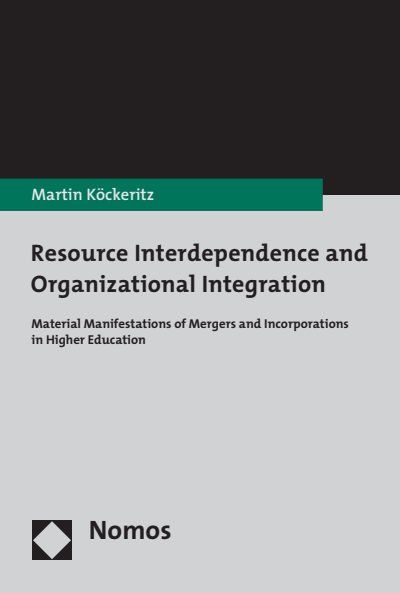
Resource Interdependence and Organizational Integration
Material Manifestations of Mergers and Incorporations in Higher Education
Authors:
Publisher:
2019
Keywords
Search publication
Bibliographic data
Edition
1/2019
Copyright Year
2019
ISBN-Print
978-3-8487-5659-9
ISBN-Online
978-3-8452-9804-7
Publisher
Nomos, Baden-Baden
Language
German
Pages
269
Product Type
Monograph
Table of contents
ChapterPages
Titelei/Inhaltsverzeichnis No access Pages 1 - 13
1.1.1 Working toward a preliminary definition No access
1.1.2 Where and why? Merger motives and incidence No access
1.1.3 Merger context considerations No access
1.1.4 Research question outline No access
1.2.1 Business-related M&A research No access
1.2.2 Success factor research ambiguities No access
1.2.3 Organizational integration: conceptualizations and empirical applications No access
1.2.4 M&A research in the field of higher education No access
1.3.1 Isolation and fragmentation of extant M&A research No access
1.3.2 Higher education institutions as a specific organization type No access
1.3.3 What a theory should provide (adequacy criteria) No access
1.3.4 Study positioning in the larger meta-theoretical debate No access
1.3.5 Structure of the book, study design and methodological approach No access
2.1.1 Introducing RDT: basic concepts and propositions No access
2.1.2 RDT-based merger analysis No access
2.1.3 Opening the black box: RDT as a multilevel approach No access
2.1.4 RDT and institutions of higher education No access
2.2.1 RDT precursors and related approaches No access
2.2.2 Paradigmatic assumptions and positioning No access
2.3 Is RDT an appropriate framework for post-merger integration analysis? No access
3.1.1 Emergentist materialism: basic terminology and categories No access
3.1.2 Higher education institutions as systems No access
3.1.3 Systemism as a worldview, scientific orientation and research strategy No access
3.2.1 HEIs as open allocation systems: from transformation to power No access
3.2.2 HEIs as integrated social systems: from power to control (and back) No access
3.2.3 HEIs as distinct social systems (interior, exterior, boundaries) No access
3.3.1 The dependent variable: organizational integration defined No access
3.3.2 Interdependence patterns and their general relation to organizational (dis)integration No access
3.4.1 The explanatory variables: qualitative (in)consistency and the power relation of interdependence patterns No access
H1 (Directionality Hypothesis): The degree of qualitative (in)consistency between the merging parties’ interdependence patterns affects the subunits’ political positioning toward the realization of in... No access
H 2 (Level Hypothesis): The actual realization of attempted integration measures depends on the degree of resource dependence on the potentially impaired external demands. No access
H3 (Orientation Hypothesis): The overall orientation of post-integration measures actually realized should be toward the powerful subunits. No access
4.1.1 Background information and time frame No access
4.1.2 Research design No access
Education and research centrality No access
Effectiveness of coping No access
4.2.2 Results of the dimensional analysis No access
4.2.3 Post-merger integration: orientation and level analysis No access
4.3.1 The integration of physics No access
4.3.2 Educational and social sciences No access
4.3.3 Economics No access
4.4 Résumé and case-specific study limitations No access
University economics (Dept. 03 / post-merger: DE) No access
Hamburger Universität für Wirtschaft und Politik (HWP / post-merger: DEP) No access
University social sciences (ex Dept. 05 / post-merger: DSS) No access
Response (position) of the Department of Economics (Dept. 03 / DE) No access
Response (position) of the HWP (DEP) No access
Response (position) of the Department of Social Sciences (DSS) No access
Pre-merger negotiations No access
5.1.3 Intraorganizational power distribution No access
5.2.1 Basic system structuring—retaining the old parties No access
5.2.2 Homogenization of appointment and endowment policies No access
5.2.3 Education-related integration attempts I: the Graduate School No access
5.2.4 Education-related integration attempts II: teaching exchange and dissertation statute No access
5.2.5 Research and transfer-related integration attempts No access
5.2.6 Administration and support-related integration No access
5.3.1 Recapitulation of integration outcomes No access
5.3.2 Coping with merger demands (and coping consequences) No access
6.1.1 What have we done? No access
6.1.2 Recapitulation of the empirical results No access
How is the merger-analysis record of neo-institutionalism? No access
How about multilevel explanations in neo-institutionalism? No access
Neo-institutionalism and organizational integration No access
Do culturalist approaches provide multilevel explanations? No access
What concepts of organizational integration does culturalism provide? No access
6.3 Conclusion: stuck in the immaterial? No access
Annex B (Information on documents) No access
Annex C No access
References No access Pages 253 - 269
Similar publications
from the topics "Wettbewerbspolitik & Ordnungspolitik & Wirtschaftspolitik"