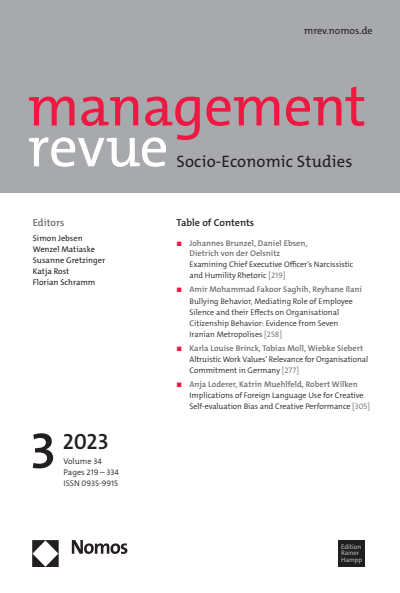
The management revue is a peer-reviewed interdisciplinary European journal publishing both qualitative and quantitative work as well as purely theoretical papers that advance the study of management, organisation and industrial relations. The management revue publishes articles that contribute to theory from a number of disciplines, including business and public administration, organizational behavior, economics, sociology and psychology. Reviews of books relevant to management and organisation studies are a regular feature. Special issues provide a unique and rich insight into the issue's research field. The journal offers insights into selected research topics by providing potentially controversial perspectives, new theoretical insights, valuable empirical analyses and brief reviews of key publications. The aim is to establish the management revue as a top quality symposium journal for the international academic community. The journal is available online via the Nomos eLibrary, ABI/INFORM Global and JSTOR. The management revue is indexed in the Web of Science™ Emerging Sources Citation Index (ESCI), Elesevier's Scopus and the RePEc services IDEAS and EconPapers.
Chief Executive Officer (CEO) narcissism has received considerable attention across academia and practitioner-orientated outlets. While the voluminous research stream of CEO narcissism is mostly linked to a dark personality trait, research indicates...
Depending on dominant organisational conditions, various factors may affect the service quality and employees' willingness to behave positively. Therefore, this study investigated the effects of bullying behaviour on organisational citizenship...
Work values characterise employees’ goals in organisations across situations and influence employees’ work behaviour. Due to demographic change and the shortage of skilled workers in many industrialised countries, the importance of...
Creative self-evaluations are important determinants of future creativity. Despite extensive research that identifies antecedents of individual creativity, little is known about what determines individuals’ biases in self-assessing their own...