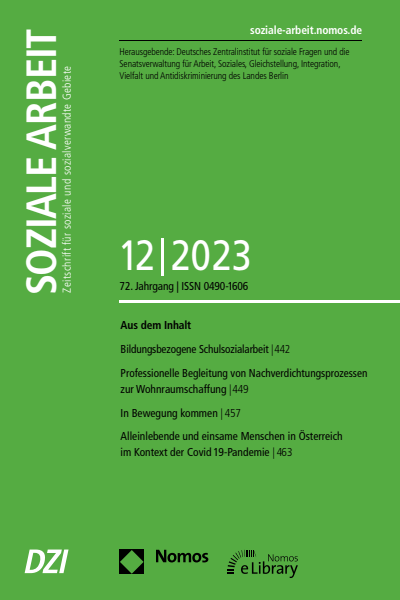
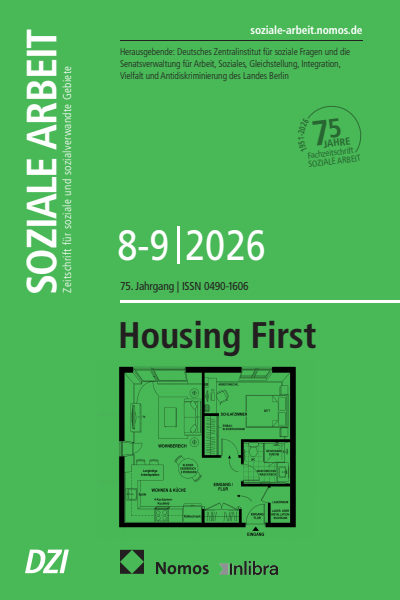
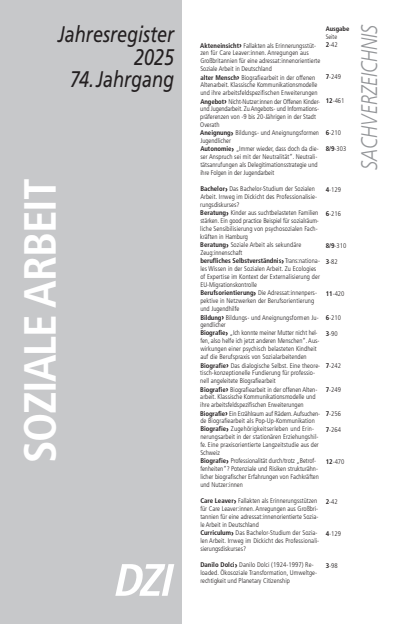
Soziale Arbeit, founded in 1951, is an independent academic journal which addresses developments in the context of social work. It is one of the most important publication media in its field and is read by teachers, students and researchers in social work and social pedagogy as well as by professionals and managers from associations and institutions. The journal’s aim is to promote professional development in social work fields by presenting methods and new concepts, in addition to subject-specific practical reports. In the ‘Rundschau’ (Review) section, information from all social fields is compiled. The ‘Tagungskalender’ (Conference Calendar) refers to important events, and the ‘Zeitschriftenbibliographie’ (Bibliography of Journals) lists current articles from professional journals. Soziale Arbeit is published 11 times a year with an annual focus issue published as a double issue. All scholarly articles submitted for publication in the journal undergo a double-blind peer review process. The editorial board is supported in an advisory capacity by a professional advisory board consisting of individuals from associations, universities, politics and administrative bodies. The journal cooperates with the academic societies of social work from Germany (DGSA) and Austria (OGSA). All social work contributions are indexed in the literature database DZI SoLit.
Social work in schools promotes educational opportunities and personality development of children and young people, in awareness of an interdependence between (school) education and social inequalities. This contribution is shown alongside three...
Urban transformation is driven, among other things, by population growth and the need for housing, which is why redensification is becoming more important as a means of creating living space. Denser social life is associated with conflict potential,...
From the perspective of social work in Austria, the relationship between social work and social movements in times of multiple ecological crises is examined. Using the example of local struggles towards social and ecological justice in spaces, the...
The number of oneperson households has been rising steadily since the 1980s. Living alone requires active forms of establishing social contact to avoid social isolation and loneliness. The contact restrictions of the Covid 19 pandemic exacerbated...