, to see if you have full access to this publication.
Monograph No access
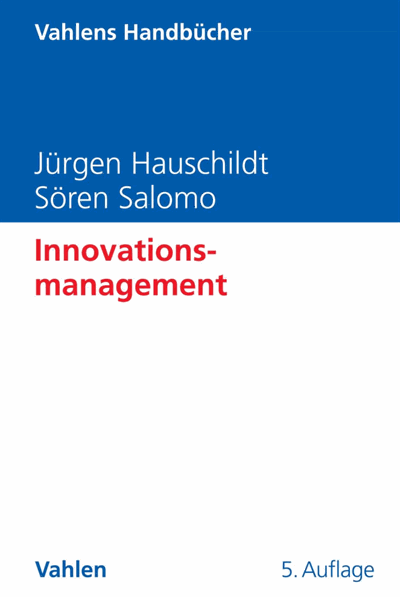
Innovationsmanagement
- Authors:
- |
- Publisher:
- 2010
Search publication
Bibliographic data
- Edition
- 5/2010
- Copyright Year
- 2010
- ISBN-Print
- 978-3-8006-3655-6
- ISBN-Online
- 978-3-8006-4353-0
- Publisher
- Vahlen, München
- Series
- Vahlens Handbücher der Wirtschafts- und Sozialwissenschaften
- Language
- German
- Pages
- 420
- Product Type
- Monograph
Table of contents
ChapterPages
- Titelei/Inhaltsverzeichnis No access Pages 1 - 14
- 1.1 Fallstudien: Innovative Verknüpfung von Zwecken und Mitteln No access Pages 15 - 17
- 1.2 Innovation – mehr als ein Schlagwort No access Pages 17 - 38
- 2.1 Fallstudien zu den Funktionen des Innovationsmanagements No access Pages 38 - 42
- 2.2 Begriff und Abgrenzung des Innovationsmanagements No access Pages 42 - 44
- 2.3 Die traditionelle Forschung zu den Erfolgsfaktoren von Innovationen No access Pages 44 - 47
- 2.4 Die theoretischen Leitlinien No access Pages 47 - 54
- 2.5 Handlungsspielräume und Gestaltungszwänge No access Pages 54 - 55
- Unternehmens- und Inno vationshistorie No access Pages 55 - 59
- 2.6 Trennung und Verknüpfung von Innovation und Routine No access Pages 59 - 60
- 2.7 Die Funktionen des Innovationsmanagements als Ergebnis strategischer Entscheidungen No access Pages 60 - 63
- 2.8 Personalwirtschaftliche Konsequenzen: Innovationsmanager als Beruf? No access Pages 63 - 66
- 3.1 Fallstudien zum Innovationssystem No access Pages 66 - 70
- 3.2 Was ist und wozu dient ein Innovationssystem? No access Pages 70 - 72
- 3.3 Management der Innovationskultur: Ganzheitliche Ausrichtung der Unternehmung auf Innovationen No access Pages 72 - 81
- 3.4 Institutionalisierung der Innovationstätigkeit No access Pages 81 - 89
- 3.5 Hierarchische Koordination der Innovationstätigkeit No access Pages 89 - 92
- 3.6 Nicht-hierarchische Koordination: Schnittstellenmanagement No access Pages 92 - 107
- 4.1 Fallstudien: Innovationswiderstände in Biographien von Innovatoren No access Pages 107 - 111
- 4.2 Widerstand – Wesensmerkmal der Innovation No access Pages 111 - 114
- 4.3 Ursachen des Widerstandes und ihre Verstärkungen No access Pages 114 - 126
- 4.4 Verstärkung des Widerstandes durch Eigendynamik der Administration No access Pages 126 - 131
- 5.1 Eine Fallstudie: Die Promotoren des Audi Quattro No access Pages 131 - 134
- 5.2 Kennzeichen von Promotoren: Leistungsbeiträge und Machtquellen No access Pages 134 - 137
- 5.3 Theoretische Erwägungen zum Promotoren-Modell No access Pages 137 - 141
- 5.4 Empirische Befunde zum Promotoren-Modell No access Pages 141 - 146
- 5.5 Gestaltungsansätze No access Pages 146 - 163
- 6.1 Fallstudien zur Kooperation No access Pages 163 - 166
- 6.2 Kennzeichnung von Innovationskooperation No access Pages 166 - 170
- 6.3 Theoretische Erwägungen zur Innovationskooperation No access Pages 170 - 179
- 6.4 Empirische Befunde zur Innovationskooperation No access Pages 179 - 198
- 6.5 Konsultation von Beratern No access Pages 198 - 203
- 7.1 Fallstudien aus der Geschichte der Bayer AG No access Pages 203 - 206
- 7.2 Kennzeichnung von Initiative und Problemdefinition No access Pages 206 - 212
- 7.3 Theoretische Ansätze No access Pages 212 - 221
- 7.4 Empirische Befunde No access Pages 221 - 226
- 7.5 Gestaltungskonzepte No access Pages 226 - 236
- 7.6 Ergebnis No access Pages 236 - 239
- 8.1 Eine Fallstudie: Zielbildung für GROWIAN No access Pages 239 - 242
- 8.2 Kennzeichnung von Innovationszielen No access Pages 242 - 245
- 8.3 Theoretische Erwägungen zur Zielbildung No access Pages 245 - 248
- 8.4 Empirische Befunde zur Zielbildung No access Pages 248 - 256
- 8.5 Zur Organisation der Zielbildung No access Pages 256 - 261
- 9.1 Eine Fallstudie: Alternativen zur Raumlenker-Hinterachse für den Mercedes-Benz 190 No access Pages 261 - 264
- 9.2 Kennzeichnung der Alternativengenerierung No access Pages 264 - 266
- 9.3 Generierung neuartiger Alternativen als Ergebnis persönlicher Kreativität No access Pages 266 - 268
- 9.4 Generierung neuartiger Alternativen als Ergebnis bewussten Informationsverhaltens No access Pages 268 - 284
- 9.5 Gestaltungsansätze zur Alternativengenerierung No access Pages 284 - 311
- 10.1 Eine Fallstudie: Projektmanagement für das „Schiff der Zukunft" No access Pages 311 - 317
- 10.2 Theoretische Erwägungen zur Prozess-Steuerung No access Pages 317 - 329
- 10.3 Empirische Befunde zur Prozess-Steuerung No access Pages 329 - 337
- 10.4 Einzelne Gestaltungsansätze No access Pages 337 - 346
- 11.1 Eine Fallstudie: Abbruchentscheidungen bei der Kautschuk-Synthese No access Pages 346 - 349
- 11.2 Evaluierung als Mess- und Bewertungsproblem No access Pages 349 - 359
- 11.3 Theoretische Erwägungen zur Evaluierung No access Pages 359 - 365
- 11.4 Empirische Befunde zur Evaluierung No access Pages 365 - 370
- 11.5 Einzelne Gestaltungsvorschläge zur Evaluierung No access Pages 370 - 381
- Literaturverzeichnis No access Pages 381 - 414
- Stichwortverzeichnis No access Pages 414 - 420
Bibliography (787 entries)
No match found. Try another term.
- Literaturverzeichnis A Ahlbrandt, R. S./Blair, A. R. (1986): What takes it for large organizations to be innovative, in: Research Management, Jg. 29, S. 34–37. Open Google Scholar DOI: 10.15358/9783800643530
- Aiken, M./Krosp, J./Shirani, A./Martin, J. (1994): Electronic brainstorming in small and large groups, in: Information & Management, Jg. 27, S. 141–149. Open Google Scholar DOI: 10.15358/9783800643530
- Akgün, A. E./Byrne, J. C./Keskin, H./Lynn, G. S. (2006a): Transactive Memory System in New Product Development Teams, in: IEEE Transactions on Engineering Management, Jg. 53(1), S. 95–111. Open Google Scholar DOI: 10.15358/9783800643530
- Akgün, A. E./Lynn, G. S./Byrne, J. C. (2006b): Antecedents and Consequences of Unlearning in New Product Development Teams, in: Journal of Product Innovation Management, Jg. 23(1), S. 73–88. Open Google Scholar DOI: 10.15358/9783800643530
- Albach, H. (1994): Culture and Technical Innovation – A Cross-Cultural Analysis and Policy Recommendations. Berlin/New York. Open Google Scholar DOI: 10.15358/9783800643530
- Albala, A. (1975): Stage Approach for the Evaluation and Selection of R&D Projects, in: IEEE – Transactions on Engineering Management, Jg. EM–22, S. 153–163. Open Google Scholar DOI: 10.15358/9783800643530
- Albers, S. (2001): Marktdurchsetzung von technologischen Nutzungsinnovationen. In: Hamel, W./Gemünden, H. G. (Hrsg.), Außergewöhnliche Entscheidungen, Festschrift für J. Hauschildt, München. Open Google Scholar DOI: 10.15358/9783800643530
- Albers, S./Gassmann, O. (2005): Handbuch Technologie- und Innovationsmanagement: Strategie, Umsetzung, Controlling, 1. Aufl. Wiesbaden. Open Google Scholar DOI: 10.15358/9783800643530
- Allen, L. A. (1964): The Management Profession. New York/Toronto/London. Open Google Scholar DOI: 10.15358/9783800643530
- Allen, T. J. (1970): Communication networks in R&D Laboratories, in: R&D Management, Jg. 1, S. 14–21. Open Google Scholar DOI: 10.15358/9783800643530
- Allen, T. J. (1977): Managing the Flow of Technology and the Dissemination of Technology Information within in the R&D Organization. Cambridge Mass./London. Open Google Scholar DOI: 10.15358/9783800643530
- Altschuller, G. S. (1998): Erfinden – Wege zur Lösung technischer Probleme. Cottbus. Open Google Scholar DOI: 10.15358/9783800643530
- Amabile, T. M. (1983): The Social Psychology of Creativity. New York/Berlin/Heidelberg/ Tokyo. Open Google Scholar DOI: 10.15358/9783800643530
- Amelingmeyer, J. (2004): Wissensmanagement-Analyse und Gestaltung der Wissensbasis von Unternehmen. 3. Aufl. Wiesbaden. Open Google Scholar DOI: 10.15358/9783800643530
- Amelingmeyer, J./Gerhard, B./Specht, G. (1997): The influence of external participation on the th success of innovation processes in business-to-business Markets. Proceedings 13 IMP Conference, Lyon, 5–19. Open Google Scholar DOI: 10.15358/9783800643530
- Ancona, D. G./Caldwell, D. F. (1992): Bridging the Boundary: External Activity and Performance in Organizational Teams., in: Administrative Science Quarterly, Jg. 37, S. 634–665. Open Google Scholar DOI: 10.15358/9783800643530
- Anderson, C. J./Glassman, M./McAfee, R. B./Pinelli, T. (2001): An Investigation of Factors Affecting how Engineers and Scientists Seek Information, in: Journal of Engineering and Technology Management, Jg. 18, S. 131–155. Open Google Scholar DOI: 10.15358/9783800643530
- Anderson, P./Tushman, M. L. (1990): Technological Discontinuities and Dominant Designs: A Cyclical Model of Change, in: Administrative Science Quarterly, Jg. 35, S. 604–633. Open Google Scholar DOI: 10.15358/9783800643530
- Aregger, K. (1976): Innovation in sozialen Systemen – Einführung in die Innovationstheorie der Organisation. Bern/Stuttgart. Open Google Scholar DOI: 10.15358/9783800643530
- Argote, L./McEvily, B./Reagans, R. (2003): Managing Knowledge in Organizations: An Integrative Framework and Review of Emerging Themes, in: Management Science, Jg. 49(4), S. 571–582. Open Google Scholar DOI: 10.15358/9783800643530
- Aronson, Z. H./Reilly, R. R./Lynn, G. S. (2006): The Impact of Leader Personality on New Product Development Teamwork and Performance: The Moderating Role of Uncertainty, in: Journal of Engineering and Technology Management, Jg. 23(3), S. 221–247. Open Google Scholar DOI: 10.15358/9783800643530
- Vahlens Handbücher; Hausschildt/Salomol „Innovationsmanagement“ (5. Auflage); Hersteller: Frau Deuringer; Stand: 02.11.2010 Seite 371 372 Literaturverzeichnis Arrow, K. J. (1962): The Rational Direction of Inventive Activity: Economic and Social Factors. Princeton. Open Google Scholar DOI: 10.15358/9783800643530
- Astebro, T. (2004): Key Success Factors for Technological Entrepreneurs’ R&D Projects, in: IEEE Transactions on Engineering Management, Jg. 51(3), S. 314–321. Open Google Scholar DOI: 10.15358/9783800643530
- Augsdorfer, P. (1996): Forbidden Fruit – An Analysis of Bootlegging and Uncertainty and Learning in Coporate R&D. Bookfield et al. Augsdorfer, P. (2008): Managing the Unmanageable, in: Research-Technology Management, Jg. 51(4), S. 41–47. Open Google Scholar DOI: 10.15358/9783800643530
- Augsdorfer, P. H. L. (2005): Bootlegging and path dependency, in: Research Policy, Jg. 34, S. 1–11. Open Google Scholar DOI: 10.15358/9783800643530
- B Baker, N. R./Green, S. G./Bean, A. S. (1985): How Management can Influence the Generation of Ideas, in: Research Management, Jg. 28, S. 35–42. Open Google Scholar DOI: 10.15358/9783800643530
- Baker, N. R./Siegman, J./Rubenstein, A. H. (1967): The Effects of Perceived Needs and Means on the Generation of Ideas for Industrial Research and Development Projects, in: IEEE-Transactions on Engineering Management, Jg. EM-14, S. 156–163. Open Google Scholar DOI: 10.15358/9783800643530
- Baker, N. R./Winkofsky, E. P./Langmeyer, L./Sweeny, D. J. (1980): Idea Generation: A Procrustean Bed of Variables, Hypotheses, and Implications. In: Dean, B. V./Goldhar, J. L. (Hrsg.), M anagement of Research and Innovation, Amsterdam/New York/Oxford, S. 33–51. Open Google Scholar DOI: 10.15358/9783800643530
- Balachandra, R./Brockhoff, K. K./Pearson, A. W. (1996): R&D Project Termination Decisions: Processes, Communication, and Personnel Changes, in: Journal of Product Innovation Management, Jg. 13, S. 245–256. Open Google Scholar DOI: 10.15358/9783800643530
- Balachandra, R./Friar, J. H. (1997): Factors for success in R&D projects and new product innovation: A contextual framework, in: IEEE-Transactions on Engineering Management, Jg. 44(3), S. 276–287. Open Google Scholar DOI: 10.15358/9783800643530
- Baldridge, J. V./Burnham, R. A. (1975): Organizational Innovation: Individual, Organizational, and Environmental Impacts, in: Administrative Science Quarterly, Jg. 20, S. 165–176. Open Google Scholar DOI: 10.15358/9783800643530
- Bantel, K. A./Jackson, S. E. (1989): Top management and innovations in banking: Does the composition of the top team make a difference?, in: Strategic Management Journal, Jg. 10, S. 107–124. Open Google Scholar DOI: 10.15358/9783800643530
- Bappert, R. (1996): Fliegen und Schwimmen. In: Landesmuseum für Technik undA rbeit (Hrsg.), Bionik – Zukunfts-Technik lernt von der Natur, Mannheim, S. 27–33. Open Google Scholar DOI: 10.15358/9783800643530
- Barker, J./Tjosvold, D./Andrews, R. (1988): Conflict Approches of Effective and Ineffective Project Managers : A Field Studie in a Matrix Organization, in: Journal of Management Studies, S. 167–178. Open Google Scholar DOI: 10.15358/9783800643530
- Barnett, H. G. (1953): Innovation: The Basis of Cultural Change. New York. Open Google Scholar DOI: 10.15358/9783800643530
- Baron, W./Häußler, S./Luther, W./Zweck, A. (2003): Innovations- und Technikanalyse – Chancen und Barrieren betrieblicher Integration. Frankfurt/New York. Open Google Scholar DOI: 10.15358/9783800643530
- Bart, C./Pujari, A. (2007): The Performance Impact of Content and Process in Product Innovation Charters, in: Journal of Product Innovation Management, Jg. 24(1), S. 3–19. Open Google Scholar DOI: 10.15358/9783800643530
- Bart, C. K. (1999): Controlling new products: a contingency approach, in: International Journal of Technology Management, Jg. 18, S. 395–413. Open Google Scholar DOI: 10.15358/9783800643530
- Bart, C. K. (2002): Product innovation charters: mission statements for new products, in: R&D Management, Jg. 32(1), S. 23–34. Open Google Scholar DOI: 10.15358/9783800643530
- Barthel, J. (2001): Standardisierung in Innovationsprozessen – Möglichkeiten für eine entwicklungsbegleitende Koordination. München/Mering. Open Google Scholar DOI: 10.15358/9783800643530
- Becker, F. G. (1987): Innovationsfördernde Anreizsysteme. Ein konzeptioneller Beitrag zu einem Innovationsmanagement, in: Zeitschrift für Personalforschung, Jg. 1, S. 29–60. Open Google Scholar DOI: 10.15358/9783800643530
- Becker, W./Dietz, J. (2004): R&D cooperation and innovation activities of firms : evidence for the German manufacturing industry, in: Research Policy, Jg. 33, S. 209–223. Open Google Scholar DOI: 10.15358/9783800643530
- Beier, W./Glaß, K. (1968): Bionik, eine Wissenschaft der Zukunft. Leipzig et al. Belderbos, R./Carree, M./Lokshin, B. (2004): Cooperative R&D and firm performance, in: Research Policy, Jg. 33, S. 1477–1492. Open Google Scholar DOI: 10.15358/9783800643530
- Bendixen, P./Kemmler, H. W. (1972): Planung – Organisation und Methodik innovativer Entscheidungsprozesse. Berlin/New York. Open Google Scholar DOI: 10.15358/9783800643530
- Vahlens Handbücher; Hausschildt/Salomol „Innovationsmanagement“ (5. Auflage); Hersteller: Frau Deuringer; Stand: 02.11.2010 Seite 372 Literaturverzeichnis 373 Benkenstein, M. (1987): F&E und Marketing – Eine Untersuchung zur Leistungsfähigkeit von Koordinationskonzeptionen bei Innovationsentscheidungen. Wiesbaden. Open Google Scholar DOI: 10.15358/9783800643530
- Benkenstein, S./Steiner, M. (2005): Schnittstellenmanagement im Innovationsprozess. In: Albers, S./Gassmann, O. (Hrsg.), Handbuch Technologie- und Innovationsmanagement – Strategie – Umsetzung – Controlling, Wiesbaden, S. 529–546. Open Google Scholar DOI: 10.15358/9783800643530
- Benner, M. J. (2007): The Incumbent Discount: Stock Market Categories and Response to Radical Technological Change, in: Academy of Management Review, Jg. 32(3), S. 703–703. Open Google Scholar DOI: 10.15358/9783800643530
- Benner, M. J. (2009): Dynamic or Static Capabilities? Process Management Practices and Response to Technological Change, in: Journal of Product Innovation Management, Jg. 26(5), S. 473–486. Open Google Scholar DOI: 10.15358/9783800643530
- Berdrow, W. (1928): Alfred Krupps Briefe 1826 – 1887. Berlin. Open Google Scholar DOI: 10.15358/9783800643530
- Berens, W./Delfmann, W. (1994): Quantitative Planung – Konzeption, Methoden, Anwendungen. Stuttgart. Open Google Scholar DOI: 10.15358/9783800643530
- Bessant, J. (2003): Challenges in Innovation Management. In: Shavinina, L. V. (Hrsg.), The International Handbook on Innovation, S. 761–774. Open Google Scholar DOI: 10.15358/9783800643530
- Bharadwaj, S./Menon, A. (2000): Making Innovation Happen in Organizations: Individual Creativity Mechanisms, Organizational Creativity Mechanisms or Both?, in: Journal of Product Innovation Management, Jg. 17, S. 424–434. Open Google Scholar DOI: 10.15358/9783800643530
- Bidault, F./Despres, C./Butler, C. (1998): The drivers of cooperation between buyers and suppliers for product innovation, in: Research Policy, Jg. 26, S. 719–732. Open Google Scholar DOI: 10.15358/9783800643530
- Biehl, W. (1981): Bestimmungsgründe der Innovationsbereitschaft und des Innovationserfolges – Eine empirische Untersuchung von Investitionsentscheidungen mittelständischer Maschinenbauunternehmen. Berlin. Open Google Scholar DOI: 10.15358/9783800643530
- Bierfelder, W. H. (1994): Innovationsmanagement – Prozessorientierte Einführung. 3. Aufl. München/Wien. Open Google Scholar DOI: 10.15358/9783800643530
- Billing, F. (2003): Koordination in radikalen Innovationsvorhaben. Wiesbaden. Open Google Scholar DOI: 10.15358/9783800643530
- Birkinshaw, J./Hamel, G./Mol, M. J. (2008): Management Innovation, in: Academy of Management Review, Jg. 33(4), S. 825–845. Open Google Scholar DOI: 10.15358/9783800643530
- Birnbacher, D. (1991): Ethische Aspekte der Bewertung technischer Risiken. In: Albach, H./ Schade, D./Sinn, H. (Hrsg.), Technikfolgenforschung und Technikfolgen abschätzung, Berlin u. a., S. 81–105. Open Google Scholar DOI: 10.15358/9783800643530
- Bitzer, B. (1990): Innovationshemmnisse im Unternehmen. Wiesbaden. Open Google Scholar DOI: 10.15358/9783800643530
- Björk, J./Magnusson, M. (2009): Where Do Good Innovation Ideas Come From? Exploring the Influence of Network Connectivity on Innovation Idea Quality, in: Journal of Product Innovation Management, Jg. 26(6), S. 662–670. Open Google Scholar DOI: 10.15358/9783800643530
- Bleicher, F. (1989): Effiziente Forschung und Entwicklung – Personelle, organisatorische und führungstechnische Instrumente. Wiesbaden. Open Google Scholar DOI: 10.15358/9783800643530
- Bleicher, K. (1988): Grenzen des Rechnungswesens für die Lenkung der Unternehmensentwicklung. In: Lücke, W. (Hrsg.), Betriebswirtschaftliche Steuerungs- und Kontrollprobleme, Wiesbaden, S. 33–47. Open Google Scholar DOI: 10.15358/9783800643530
- Bode, J. (1997): Der Informationsbegriff in der Betriebswirtschaftslehre, in: Zeitschrift für betriebswirtschaftliche Forschung, Jg. 49, S. 449–468. Open Google Scholar DOI: 10.15358/9783800643530
- Bolton, L. E. (2003): Stickier Priors: The Effects of Nonanalytic Versus Analytic Thinking in New Product Forecasting, in: Journal of Marketing Research, Jg. XL, S. 65–79. Bonner, J. M./Rueckert, R. W./Walker, O. C. J. (2002): Upper management control of new product development projects and project performance, in: The Journal of Product Innovation Management, Jg. 19, S. 233–245. Bonner, J. M./Walker Jr., O. C. (2004): Selecting Influential Business-to-Business Customers in New Product Development: Relational Embeddedness and Knowledge Heterogeneity Considerations, in: Product Innovation Management, Jg. 21, S. 155–169. Open Google Scholar DOI: 10.15358/9783800643530
- Borchardt, G. (1937): Die Randbemerkungen Friedrichs des Großen. 2. Aufl. Potsdam. Open Google Scholar DOI: 10.15358/9783800643530
- Bouchard, T. J./Barsaloux, J./Drauden, G. (1974): Brainstorming Procedure, Group Size, and Sex as Determinants of the Problem-Solving Effectiveness of Groups and Individuals, in: Journal of Applied Psychology, Jg. 59, S. 135–138. Open Google Scholar DOI: 10.15358/9783800643530
- Boulding, W./Morgan, R./Staelin, R. (1997): Pulling the Plug to Stop the New Product Drain, in: Journal of Marketing Research, Jg. 34(February), S. 164–176. Open Google Scholar DOI: 10.15358/9783800643530
- Vahlens Handbücher; Hausschildt/Salomol „Innovationsmanagement“ (5. Auflage); Hersteller: Frau Deuringer; Stand: 02.11.2010 Seite 373 374 Literaturverzeichnis Bouwman, M. J. (1982): The Use of Accounting Information: Expert versus Novice Behavior. In: Ungson, R. G./Braunstein, D. N. (Hrsg.), Decision Making – An Interdisciplinary Inquiry, Boston, MA., S. 137–167. Open Google Scholar DOI: 10.15358/9783800643530
- Brandenburg, A. G./Brödner, P./Hetzler, H.–W./Schienstock, G. (1975): Die Innovationsentscheidung – Bestimmungsgründe für die Bereitschaft zur Investition in neue Technologien. Göttingen. Open Google Scholar DOI: 10.15358/9783800643530
- Brockhoff, K. (1981): Die Produktinnovationsrate im Lagebericht, in: Der Betrieb, Jg. 34, S. 433– 437. Open Google Scholar DOI: 10.15358/9783800643530
- Brockhoff, K. (1989): Schnittstellen-Management – Abstimmungsprobleme zwischen Marketing und Forschung und Entwicklung. Stuttgart. Open Google Scholar DOI: 10.15358/9783800643530
- Brockhoff, K. (1991): R&D cooperation between firms: a classification by structural variables, in: International Journal of Technology Management, Special Issue on Manufacturing Strategy, Jg. 6, S. 361–373. Open Google Scholar DOI: 10.15358/9783800643530
- Brockhoff, K. (1992): Forschung und Entwicklung, Überwachung der. In: Coenenberg, A. G./ Wysocki, K. v. (Hrsg.), Handwörterbuch der Revision, 2. Aufl., Stuttgart, Sp. 567–583. Open Google Scholar DOI: 10.15358/9783800643530
- Brockhoff, K. (1996a): Technology Management in the Company of the Future, in: Technology Analysis & Strategic Management, Jg. 8, S. 175–189. Open Google Scholar DOI: 10.15358/9783800643530
- Brockhoff, K. (1997): Wenn der Kunde stört – Differenzierungsnotwendigkeiten bei der Einbeziehung von Kunden in die Produktentwicklung. In: Bruhn, M./Steffenhagen, H. (Hrsg.), Marktorientierte Unternehmensführung – Reflexionen – Denkanstöße – Perspektiven, Festschrift für H. Meffert, Wiesbaden, S. 351–370. Open Google Scholar DOI: 10.15358/9783800643530
- Brockhoff, K. (1999a): Forschung und Entwicklung – Planung und Kontrolle. 5. Aufl. München/ Wien. Open Google Scholar DOI: 10.15358/9783800643530
- Brockhoff, K. (1999b): Produktpolitik. 4. Aufl. Stuttgart/New York. Open Google Scholar DOI: 10.15358/9783800643530
- Brockhoff, K. (2003): Customers’ perspectives of involvement in new product development, in: International Journal of Technology Management, Jg. 26, S. 464–481. Open Google Scholar DOI: 10.15358/9783800643530
- Brockhoff, K. (2005a): Konflikte bei der Einbeziehung von Kunden in die Produktentwicklung, in: Zeitschrift für Betriebswirtschaft, Jg. 75(9), S. 859–877. Open Google Scholar DOI: 10.15358/9783800643530
- Brockhoff, K. (2005b): Organisation angewandter Forschung in Unternehmen. In: Amelingmeyer, J./Harland, P. E. (Hrsg.), Technologiemanagement & Marketing: Herausforderungen eines integrierten Innovationsmanagements; Festschrift für G. Specht, Wiesbaden, S. 29–43. Open Google Scholar DOI: 10.15358/9783800643530
- Brockhoff, K./Hauschildt, J. (1993): Schnittstellen-Management – Koordination ohne Hierarchie, in: Zeitschrift für Organisation, Jg. 62, S. 396–403. Open Google Scholar DOI: 10.15358/9783800643530
- Brockhoff, K. H. (1996b): Management von Innovationen – Planung und Durchsetzung – Erfolge und Misserfolge. Fallstudien mit Lösungen. Wiesbaden. Open Google Scholar DOI: 10.15358/9783800643530
- Bröring, S./Leker, J./Germany, M. (2007): Industry Convergence and its Implications for the Front End of Innovation: A Problem of Absorptive Capacity, in: Creativity & Innovation Management, Jg. 16(2), S. 165–175. Open Google Scholar DOI: 10.15358/9783800643530
- Brown, M. G./Svenson, R. A. (1988): Measuring R&D Productivity, in: Research Technology Management, Jg. 31, S. 11–15. Open Google Scholar DOI: 10.15358/9783800643530
- Brown, S. L./Eisenhardt, K. M. (1995): Product Development: Past Research, Present Findings, and Future Directions, in: Academy of Management Review, Jg. 20(2), S. 343–378. Open Google Scholar DOI: 10.15358/9783800643530
- Bullinger, H.–J. (2000): Förderung der Unternehmenskreativität. In: Bullinger, H.–J./Hermann, S. (Hrsg.), Wettbewerbsfaktor Kreativität, Wiesbaden, S. 21–30. Open Google Scholar DOI: 10.15358/9783800643530
- Bürgel, H.–D./Reger, G./Ackel-Zakour, R. (2005): Technologie-Früherkennung in multinationalen Unternehmen: Ergebnisse einer empirischen Untersuchung. In: Möhrle, M./Isenmann, R. (Hrsg.), Technologie-Roadmapping – Zukunftsstrategien für Technologieunternehmen, Berlin/Heidelberg/New York, S. 27–53. Open Google Scholar DOI: 10.15358/9783800643530
- Bürgel, H. D. (1983): Forschungs- und Entwicklungscontrolling aus der Sicht des Controllers. In: Blohm, H./Danert, G. (Hrsg.), Forschungs- und Entwicklungsmanagement, Stuttgart, S. 93–101. Open Google Scholar DOI: 10.15358/9783800643530
- Burgelman, R. A. (1983): A Process Model of Internal Corporate Venturing in the Diversified Major Firm, in: Administrative Science Quarterly, Jg. 28, S. 223–244. Open Google Scholar DOI: 10.15358/9783800643530
- Burghardt, M. (1993): Projektmanagement – Leitfaden für die Planung, Überwachung und Steuerung von Entwicklungsprojekten. 2. Aufl. München. Open Google Scholar DOI: 10.15358/9783800643530
- Burns, T./Stalker, G. M. (1961): The Management of Innovation. London. Open Google Scholar DOI: 10.15358/9783800643530
- Vahlens Handbücher; Hausschildt/Salomol „Innovationsmanagement“ (5. Auflage); Hersteller: Frau Deuringer; Stand: 02.11.2010 Seite 374 Literaturverzeichnis 375 C Cagliano, R./Chiesa, V./Manzini, R. (2000): Differences and similarities in managing technological collaborations in research, development and manufacturing: a case study, in: Journal of Engineering and Technology Management, Jg. 17(2), S. 193–224. Open Google Scholar DOI: 10.15358/9783800643530
- Cameron, K. S./Freemann, S. J. (1991): Cultural congruence, strength and type: Relationship to effectiveness. In: Woodman, R. W./Passmore, W. A. (Hrsg.), Research in Organizational Change and Development, S. 23–58. Open Google Scholar DOI: 10.15358/9783800643530
- Capon, N./Farley, J. U./Lehman, D. R./Hulbert, J. H. (1992): Profiles of product innovators among large U.S. manufacturers, in: Management Science, Jg. 38(2), S. 157–160. Open Google Scholar DOI: 10.15358/9783800643530
- Carbonell, P./Rodríguez-Escudero, A. I. (2009): Relationships Among Team’s Organizational Context, Innovation Speed, and Technological Uncertainty: An Empirical Analysis, in: Journal of Engineering and Technology Management, Jg. 26(1–2), S. 28–45. Open Google Scholar DOI: 10.15358/9783800643530
- Cardinal, L. B. (2001): Technological Innovation in the Pharmaceutical Industry: The Use of Organizational Control in Managing Research and Development, in: Organizations Science, Jg. 12(1), S. 19–36. Open Google Scholar DOI: 10.15358/9783800643530
- Chakrabarti, A. K. (1974): The Role of Champion in Product Innovation, in: California Management Review, Jg. XVII, S. 58–62. Open Google Scholar DOI: 10.15358/9783800643530
- Chakrabarti, A. K./O’Keefe, R. D. (1977): A Study of Key Communicators in Research and Development Laboratories, in: Groups and Organization Studies, Jg. 2(3), S. 336–346. Open Google Scholar DOI: 10.15358/9783800643530
- Chandler, A. (1984): Strategy and Structure: Chapters in the History of the American Industrial Enterprise. 13. Aufl. (Erstauflage 1962). Cambridge, Mass. Open Google Scholar DOI: 10.15358/9783800643530
- Chandy, R. K./Tellis, G. J. (1998): Organizing for Radical Product Innovation: The Overlooked Role of Willingness to Cannibalize, in: Journal of Marketing Research, Jg. XXXV, S. 474–487. Open Google Scholar DOI: 10.15358/9783800643530
- Chen, M.–H. (2006): Understanding the Benefits and Detriments of Conflict on Team Creativity Process, in: Creativity & Innovation Management, Jg. 15(1), S. 105–116. Open Google Scholar DOI: 10.15358/9783800643530
- Chesbrough, H. W. (2003): Open Innovation – The imperative for creating and profiting from technology. Boston. Open Google Scholar DOI: 10.15358/9783800643530
- Chiesa, V./Coughlan, P./Voss, C. A. (1996): Development of a Technical Innovation Audit, in: Journal of Product Innovation Management, Jg. 13, S. 105–136. Open Google Scholar DOI: 10.15358/9783800643530
- Chiesa, V./Frattini, F./Lazzarotti, V./Manzini, R. (2008): Defining a Performance Measurement System for the Research Activities: A Reference Framework and an Empirical Study, in: Journal of Engineering and Technology Management. Open Google Scholar DOI: 10.15358/9783800643530
- Chiesa, V./Frattini, F./Lazzarotti, V./Manzini, R. (2009): Performance Measurement in R&D: Exploring the Interplay between Measurement Objectives, Dimensions of Performance and Contextual Factors, in: R&D Management, Jg. 39(5), S. 487–519. Open Google Scholar DOI: 10.15358/9783800643530
- Child, J. (1984): Organization: A Guide to Problems and Practice, 2. Aufl. Cambridge et al. Chmielewicz, K. (1991): Unternehmensverfassung und Innovation. In: Müller-Böling, D./Seibt, D./Winand, U. (Hrsg.), Innovations- und Technologiemanagement, Festschrift für N. Szyperski, Stuttgart, S. 83–101. Open Google Scholar DOI: 10.15358/9783800643530
- Christensen, C. M./Kaufman, S. P./Shih, W. C. (2008): Innovation Killers, in: Harvard Business Review, Jg. 86(1), S. 98–105. Open Google Scholar DOI: 10.15358/9783800643530
- Clarke, T. E. (1974): Decision-Making in Technologically Based Organizations: A Literature Survey of Present Practice, in: IEEE – Transactions on Engineering Management, Jg. EM–21, S. 9–23. Open Google Scholar DOI: 10.15358/9783800643530
- Cleemann, L./Peiffer, S. (1992): Identifikation und Bewertung von Ansätzen zukünftiger Technologien – Ein integriertes Konzept zur systematischen Analyse. In: VDI-Technologiezentrum (Hrsg.), Technologiefrühaufklärung, Stuttgart, S. 95–116. Open Google Scholar DOI: 10.15358/9783800643530
- Clement, M. (2000): Interaktives Fernsehen – Analyse und Prognose seiner Nutzung. Wiesbaden. Open Google Scholar DOI: 10.15358/9783800643530
- Clift, T. B./Vandenbosch, M. B. (1999): Project Complexity and Efforts to Reduce Product Development Cycle Time, in: Journal of Business Research, Jg. 45, S. 187–198. Open Google Scholar DOI: 10.15358/9783800643530
- Cobbenhagen, J. (2000): Successful Innovation – Towards a New Theory for the Management of Small and Medium-sized Enterprises. Cheltenham, UK/Northampton, MA., USA. Open Google Scholar DOI: 10.15358/9783800643530
- Cohen, W. M./Levinthal, D. A. (1990): Absorptive Capacity: A New Perspective on Learning and Innovation, in: Administrative Science Quarterly, Jg. 35, S. 128–152. Open Google Scholar DOI: 10.15358/9783800643530
- Vahlens Handbücher; Hausschildt/Salomol „Innovationsmanagement“ (5. Auflage); Hersteller: Frau Deuringer; Stand: 02.11.2010 Seite 375 376 Literaturverzeichnis Conway, S. (1997): Strategic Personal Links in Successful Innovation: Link-pins, Bridges, and Liaisons, in: Creativity and Innovation Management, Jg. 6(4), S. 226–232. Open Google Scholar DOI: 10.15358/9783800643530
- Coombs, R./Hull, R. (1998): ,Knowledge management practices‘ and path-dependency in innovation, in: Research Policy, Jg. 27, S. 237–253. Open Google Scholar DOI: 10.15358/9783800643530
- Coombs, R./McMeekin, A./Pybus, R. (1998): Toward the development of benchmarking tools for R&D project management, in: R&D Management, Jg. 28(3), S. 175–186. Open Google Scholar DOI: 10.15358/9783800643530
- Cooper, R. G. (2003): Profitable Product Innovation: The Critical Success Factors. In: Shavinina, L. V. (Hrsg.), The International Handbook on Innovation, Amsterdam et al., S. 130–157. Open Google Scholar DOI: 10.15358/9783800643530
- Cooper, R. G. (2008): The Stage-Gate Idea-to-Launch Process-Update, What’s New and NexGen Systems, in: Journal of Product Innovation Management, Jg. 25(3), S. 213–232. Open Google Scholar DOI: 10.15358/9783800643530
- Cooper, R. G./Easingwood, C. J./Edgett, S./Kleinschmidt, E./Storey, C. (1994): What Distinguishes the Top Performing New Products in Financial Services, in: Journal of Product Innovation Management, Jg. 11, S. 281–299. Open Google Scholar DOI: 10.15358/9783800643530
- Cooper, R. G./Edgett, S. J./Kleinschmidt, E. J. (1998): Best Practices for Managing R&D Portfolios, in: Research Technology Management, Jg. 41(20–33). Open Google Scholar DOI: 10.15358/9783800643530
- Cooper, R. G./Edgett, S. J./Kleinschmidt, E. J. (2002): Optimizing the Stage-Gate Process: What Best-Practice Companies Do – II, in: Research Technology Management(Nov–Dez.), S. 43– 49. Open Google Scholar DOI: 10.15358/9783800643530
- Cooper, R. G./Kleinschmidt, E. J. (1986): An Investigation into the New Product Process: Steps, Deficiencies, and Impact, in: Journal of Product Innovation Management, Jg. 3, S. 71–85. Open Google Scholar DOI: 10.15358/9783800643530
- Cordero, R./Farris, G. F./DiTomaso, N. (1998): Technical Professionals in Cross-Functional Teams: Their Quality of Work Life, in: The Journal of Product Innovation Management, Jg. Open Google Scholar DOI: 10.15358/9783800643530
- 15(6), S. 550–563. Open Google Scholar DOI: 10.15358/9783800643530
- Coyne, K. P./Clifford, P. G./Dye, R. (2007): Breakthrough Thinking from Inside the Box, in: Harvard Business Review, Jg. 85(12), S. 70–78. Open Google Scholar DOI: 10.15358/9783800643530
- Cratzius, M. (2003): Die Einbindung des Absatz- und Produktionsbereichs in Innovationsprozesse. Wiesbaden. Open Google Scholar DOI: 10.15358/9783800643530
- Crawford, C. M. (1979): New Product Failure Rates – Facts and Fallacies, in: Research Management, Jg. 22, S. 9–13. Open Google Scholar DOI: 10.15358/9783800643530
- D Dahl, D. W./Moreau, P. (2002): The Influence and Value of Analogical Thinking During New Product Ideation, in: Journal of Marketing Research, Jg. 39, S. 47–60. Open Google Scholar DOI: 10.15358/9783800643530
- Dahlin, K. B./Behrens, D. M. (2005): When is an invention really radical? Defining and measuring technological radicalness, in: Research Policy, Jg. 34, S. 717–737. Open Google Scholar DOI: 10.15358/9783800643530
- Damanpour, F. (1991): Organizational Innovation: A Meta-Analysis of Effects of Determinants and Moderators, in: Academy of Management Journal, Jg. 34, S. 555–590. Open Google Scholar DOI: 10.15358/9783800643530
- Damanpour, F./Gopalakrishnan, S. (2001): The dynamics of adoptation of product and process innovations in organizations, in: Journal of Management Studies, Jg. 38, S. 45–65. Open Google Scholar DOI: 10.15358/9783800643530
- Damm, A. W. (1994): Organisatorische Problemanalyse – Entwicklung eines Verfahrens zur Analyse und Strukturierung von Problemen in einer Organisation. Karlsruhe. Open Google Scholar DOI: 10.15358/9783800643530
- Dammer, H./Gemünden, H. G./Lettl, C. (2006): Qualitätsdimensionen des Multiprojektmanagements, Entwicklung eines Messkonzepts, in: zfo, Jg. 75(3), S. 148–156. Open Google Scholar DOI: 10.15358/9783800643530
- Danneels, E. (2002): The Dynamics of Product Innovation and Firm Competences, in: Strategic Management Journal, Jg. 23, S. 1095–1121. Open Google Scholar DOI: 10.15358/9783800643530
- Danneels, E. (2004): Disruptive Technology Reconsidered: A Critique and Research Agenda, in: Product Innovation Management, Jg. 21, S. 246–258. Open Google Scholar DOI: 10.15358/9783800643530
- Danneels, E./Kleinschmidt, E. J. (2001): Product innovativeness from the firm’s perspective: Its dimensions and their relation with project selection and performance, in: The Journal of Product Innovation Management, Jg. 18, S. 357–373. Open Google Scholar DOI: 10.15358/9783800643530
- Davila, A. (2003): Short-term economic incentives in new product development, in: Research Policy, Jg. 32, S. 1397–1420. Open Google Scholar DOI: 10.15358/9783800643530
- Davila, T. (2000): An empirical study on the drivers of management control systems’ design in new product development, in: Accounting, Organizations and Society, Jg. 25(4,5), S. 383–409. Open Google Scholar DOI: 10.15358/9783800643530
- Day, D. L. (1994): Raising Radicals: Different Processes for Championing Innovative Corporate Ventures, in: Organization Science, Jg. 5, S. 148–172. Open Google Scholar DOI: 10.15358/9783800643530
- Vahlens Handbücher; Hausschildt/Salomol „Innovationsmanagement“ (5. Auflage); Hersteller: Frau Deuringer; Stand: 02.11.2010 Seite 376 Literaturverzeichnis 377 de Bono, E. (1982): Lateral Thinking for Management – A Handbook. Harmondsworth. Open Google Scholar DOI: 10.15358/9783800643530
- de Brentani, U. (2001): Innovative versus incremental new business services: different keys for achieving success, in: Journal of Product Innovation Management, Jg. 18, S. 169–187. Open Google Scholar DOI: 10.15358/9783800643530
- de Brentani, U./Kleinschmidt, E. J. (2004): Corporate culture and commitment: Impact on performance of international new product development programs, in: Journal of Product Innovation Management, Jg. 21, S. 309–333. Open Google Scholar DOI: 10.15358/9783800643530
- De Dreu, C. K. W./West, M. A. (2001): Minority Dissent and Team Innovation: The Importance of Participation in Decision Making, in: Journal of Applied Psychology, Jg. 86(6), S. 1191–1201. Open Google Scholar DOI: 10.15358/9783800643530
- De Tombe, D. J. (2000): Anticipating and avoiding opposition in large technological projects, in: International Journal of Technology Management, Jg. 19(3/4/5), S. 301–312. Open Google Scholar DOI: 10.15358/9783800643530
- Dean, B. V./Chaudhuri, A. K. (1980): Project Scheduling: A Critical Review. In: Dean, B. V./ Goldhar, J. L. (Hrsg.), Management of Research and Innovation, Amsterdam/New York/Oxford, S. 225–233. Open Google Scholar DOI: 10.15358/9783800643530
- Delmas, M. A. (2002): Innovating against European rigidities, Institutional environment and dynamic capabilities, in: Journal of High Technology Management Research, Jg. 13, S. 19–43. Open Google Scholar DOI: 10.15358/9783800643530
- Deng, Z./Lev, B. (2006): In-process R&D: To Capitalize or Expense?, in: Journal of Engineering and Technology Management, Jg. 23(1–2), S. 18–32. Open Google Scholar DOI: 10.15358/9783800643530
- Di Benedetto, C. A./DeSarbo, W. S./Song, M. (2008): Strategic Capabilities and Radical Innovation: An Empirical Study in Three Countries, in: IEEE Transactions on Engineering Management, Jg. 55(3), S. 420–433. Open Google Scholar DOI: 10.15358/9783800643530
- Dierkes, M./Mützel, S. (1995): Methoden der Technikfolgen-Abschätzung. In: Zahn, E. (Hrsg.), Handbuch Technologiemanagement, Stuttgart, S. 645–662. Open Google Scholar DOI: 10.15358/9783800643530
- Diesel, E. (1983): Diesel – Der Mensch, das Werk, das Schicksal. München. Open Google Scholar DOI: 10.15358/9783800643530
- Domsch, M./Gerpott, H./Gerpott, T. J. (1989): Technologische Gatekeeper in der industriellen F&E – Merkmale und Leistungswirkungen. Stuttgart. Open Google Scholar DOI: 10.15358/9783800643530
- Dorabjee, S./Lumley, C. E./Cartwright, S. (1998): Culture, innovation and successful development of new medicines: An exploratory study of the pharmaceutical industry, in: Leadership and Organization Development Journal, Jg. 19(4), S. 199–210. Open Google Scholar DOI: 10.15358/9783800643530
- Dosi, G. (1988): The nature of the innovative process. In: Dosi, G./Freeman, C./Nelson, R./ Silverberg, G./Soete, L. (Hrsg.), Technical change and economic theory, London/New York, S. 221–238. Open Google Scholar DOI: 10.15358/9783800643530
- Dougherty, D./Hardy, C. (1996): Sustained product innovation in large, mature organizations: overcoming innovation-to-organization problems, in: Academy of Management Journal, Jg. Open Google Scholar DOI: 10.15358/9783800643530
- 39(5), S. 1120–1153. Open Google Scholar DOI: 10.15358/9783800643530
- Dougherty, D./Heller, T. (1994): The Illegitimacy of Successful Product Innovation in Established Firms, in: Organization Science, Jg. 5(2), S. 200–218. Open Google Scholar DOI: 10.15358/9783800643530
- Dowling, M./Helm, R. (2006): Product development success through cooperation: A study of entrepreneurial firms, in: technovation, Jg. 26, S. 483–488. Open Google Scholar DOI: 10.15358/9783800643530
- Downs, G. W./Mohr, L. B. (1976): Conceptual Issues in the Study of Innovations, in: Administrative Science Quarterly, Jg. 21, S. 700–714. Open Google Scholar DOI: 10.15358/9783800643530
- Draeger, W. (1991): Innovation – Invention – Kreativität. Durch Erneuerung zum Erfolg – ein Leitfaden für den kreativen Ingenieur und Unternehmer. Düsseldorf. Open Google Scholar DOI: 10.15358/9783800643530
- Drexl, A. (1990): Planung des Ablaufs von Unternehmensprüfungen. Stuttgart. Open Google Scholar DOI: 10.15358/9783800643530
- Drucker, P. F. (1986): Innovations-Management für Wirtschaft und Politik. Düsseldorf/Wien. Open Google Scholar DOI: 10.15358/9783800643530
- Dvir, D./Lechler, T. (2004): Plans are nothing, changing plans is everything: the impact of changes on project success, in: Research Policy, Jg. 33, S. 1–15. Open Google Scholar DOI: 10.15358/9783800643530
- Dvir, D./Lipovetsky, S./Shenhar, A. J./Tishler, A. (1998): In search of project classification: a nonuniversal approach to project success factors, in: Research Policy, Jg. 27, S. 915–935. Open Google Scholar DOI: 10.15358/9783800643530
- E Ehrmann, T./Haas, F. (2006): Effizienz, Anreizgestaltung und Implementierung von Prozessinnovationen: Eine empirische Untersuchung anhand des Desktop-Purchasing, in: Zeitschrift für betriebswirtschaftliche Forschung, Jg. 58(März), S. 169–187. Open Google Scholar DOI: 10.15358/9783800643530
- Eisenführ, F. (1992): Budgetierung. In: Frese, E. (Hrsg.), Handwörterbuch der Organisation, 3. Auf l., Stuttgart, Sp. 363–372. Open Google Scholar DOI: 10.15358/9783800643530
- Vahlens Handbücher; Hausschildt/Salomol „Innovationsmanagement“ (5. Auflage); Hersteller: Frau Deuringer; Stand: 02.11.2010 Seite 377 378 Literaturverzeichnis Eisenhardt, K. M./Schoonhoven, C. B. (1996): Resource-based view of strategic alliance formation: Strategic and social effects in entrepreneurial firms, in: Organization Science, Jg. 7, S. 136–150. Open Google Scholar DOI: 10.15358/9783800643530
- Eisenhardt, K. M./Tabrizi, B. N. (1995): Accelerating Adaptive Processes: Product Innovation in the Global Computer Industry, in: Administrative Science Quarterly, Jg. 40, S. 84–110. Open Google Scholar DOI: 10.15358/9783800643530
- Elenkov, D. S./Judge, W./Wright, P. (2005): Strategic Leadership and Executive Innovation Influence: An International Multi-Cluster Comparative Study, in: Strategic Management Journal, Jg. 26, S. 665–682. Open Google Scholar DOI: 10.15358/9783800643530
- Ellis, D./Haugan, M. (1997): Modelling the information seeking patterns of engineers and re search scientists in an individual environment, in: Journal of Documentation, Jg. 53, S. 384– 403. Open Google Scholar DOI: 10.15358/9783800643530
- Elstein, A. S./Shulman, L. S./Sprafka, S. A. (1978): Medical Problem Solving – An Analysis of Clinical Reasoning. Cambridge, MA./London. Open Google Scholar DOI: 10.15358/9783800643530
- Erker, P. (1993): Forschung und Entwicklung in der Transistortechnologie. Entscheidungszwänge und Handlungsspielräume am Beispiel Siemens und Philips 1947–1960, in: Technikgeschichte(Bd. 60), S. 267–284. Open Google Scholar DOI: 10.15358/9783800643530
- Ernst, H. (1996): Patentinformationen für die strategische Planung von Forschung und Entwicklung. Wiesbaden. Open Google Scholar DOI: 10.15358/9783800643530
- Ernst, H. (2001): Erfolgsfaktoren neuer Produkte – Grundlagen für eine valide empirische Forschung. Wiesbaden. Open Google Scholar DOI: 10.15358/9783800643530
- Ernst, H. (2003): Unternehmenskultur und Innovationserfolg – Eine empirische Analyse, in: Zeitschrift für betriebswirtschaftliche Forschung, Jg. 55(2), S. 23–44. Open Google Scholar DOI: 10.15358/9783800643530
- Ernst, H. (2004): Virtual customer integration – Maximizing the impact of customer integration on new product performance. In: Albers, S. (Hrsg.), Cross-functional Innovation Management. Perspectives from different disciplines. Festschrift für K. Brockhoff, Wiesbaden, S. 191–208. Open Google Scholar DOI: 10.15358/9783800643530
- F Faems, D./Van Looy, B./Debackere, K. (2005): Interorganizational collaboration and innovation : toward a portfolio approach, in: Product Innovation Management, Jg. 22, S. 238–250. Open Google Scholar DOI: 10.15358/9783800643530
- Flynn, M./Dooley, L./O’Sullivan, D./Cormican, K. (2003): Idea Management for Organisational Innovation, in: International Journal of Innovation Management, Jg. 7(4), S. 417–442. Open Google Scholar DOI: 10.15358/9783800643530
- Folkerts, L. (2001): Promotoren in Innovationsprozessen – Empirische Untersuchung zur personellen Dynamik. Wiesbaden. Open Google Scholar DOI: 10.15358/9783800643530
- Folkerts, L./Hauschildt, J. (2002): Personelle Dynamik in Innovationsprozessen: neue Fragen und Befunde zum Promotorenmodell, in: Die Betriebswirtschaft, Jg. 62(1), S. 1–23. Open Google Scholar DOI: 10.15358/9783800643530
- Forker, H. (1995): Alternative Strukturierungsmöglichkeiten des F+E-Bereichs in der mittelständischen pharmazeutischen Unternehmung. In: Herzog, R. (Hrsg.), F&E-Management in der Pharma-Industrie, Aulendorf, S. 31–50. Open Google Scholar DOI: 10.15358/9783800643530
- Forrest, J. E./Martin, M. J. C. (1992): Strategic alliance between large and small research intensive organizations: experiences in the biotechnology industry, in: R&D Management, Jg. 22(41– 53). Open Google Scholar DOI: 10.15358/9783800643530
- Foxall, G. R. (1984): Corporate Innovation: Marketing and Strategy. London/Canberra. Open Google Scholar DOI: 10.15358/9783800643530
- Franke, N. (2003): Toolkits for User Innovation: Die Einbindung des Kunden in den Innovationsprozess. In: Hoffmann, W. H. (Hrsg.), Die Gestaltung der Organisationsdynamik – Konfiguration und Evolution, Festschrift für O. Grün, Stuttgart, S. 357–381. Open Google Scholar DOI: 10.15358/9783800643530
- Franke, N./Piller, F. (2004): Value Creation by Toolkits for User Innovation and Design: The Case of the Watch Market, in: Product Innovation Management, Jg. 21, S. 401–415. Open Google Scholar DOI: 10.15358/9783800643530
- Franke, N./Shah, S. (2003): How communities support innovative activities: an exploration of assistance and sharing among end-users, in: Research Policy, Jg. 32, S. 157–178. Open Google Scholar DOI: 10.15358/9783800643530
- Franke, N./von Hippel, E./Schreier, M. (2006): Finding Commercially Attractive User Innovations: A Test of Lead-User Theory, in: Journal of Product Innovation Management, Jg. 23(4), S. 301–315. Open Google Scholar DOI: 10.15358/9783800643530
- Frascati-Handbuch (1982): Die Messung wissenschaftlicher und technischer Tätigkeiten – Allgemeine Richtlinien für statistische Übersichten in Forschung und experimenteller Entwicklung. Bonn. Open Google Scholar DOI: 10.15358/9783800643530
- Vahlens Handbücher; Hausschildt/Salomol „Innovationsmanagement“ (5. Auflage); Hersteller: Frau Deuringer; Stand: 02.11.2010 Seite 378 Literaturverzeichnis 379 Frey, D. (1984): Die Theorie der kognitiven Dissonanz. In: Frey, D./Irle, M. (Hrsg.), Theorien der Sozialpsychologie, Bern et al., S. 243–292. Open Google Scholar DOI: 10.15358/9783800643530
- Friedman, L./Fleishman, E. A./Fletcher, J. M. (1992): Cognitive and interpersonal abilities related to the primary activities of R&D managers, in: Journal of Engineering and Technology Management, Jg. 9, S. 211–242. Open Google Scholar DOI: 10.15358/9783800643530
- Frohman, A. L. (1978): The Performance of Innovation: Managerial Roles, in: California Management Review, Jg. 20, S. 5–12. Open Google Scholar DOI: 10.15358/9783800643530
- Frohman, A. L. (1999): Personal Initiative Sparks Innovation, in: Research Technology Management, Jg. 42(May–Jun.), S. 32–38. Open Google Scholar DOI: 10.15358/9783800643530
- G Gaitanides, M. (1997): Integrierte Belieferung – Eine ressourcenorientierte Erklärung der Entstehung von Systemlieferanten in der Automobilindustrie, in: Zeitschrift für Betriebswirtschaft, Jg. 67, S. 737–757. Open Google Scholar DOI: 10.15358/9783800643530
- Galbraith, J. R. (1982): Designing the Innovating Organization, in: Organizational Dynamics (Winter), S. 5–25. Open Google Scholar DOI: 10.15358/9783800643530
- Galende, J./de la Fuente, J. M. (2003): Internal factors determining a firm‘s innovative behaviour, in: Research Policy, Jg. 32, S. 715–736. Open Google Scholar DOI: 10.15358/9783800643530
- Gallupe, R. B./Dennis, A. R./Cooper, W. H./Valacich, J. S./Bastianutti, L. M./Nunamaker, J. F. Open Google Scholar DOI: 10.15358/9783800643530
- (1992): Electronic Brainstorming and Group Size, in: Academy of Management Journal, Jg. Open Google Scholar DOI: 10.15358/9783800643530
- 35(2), S. 350–369. Open Google Scholar DOI: 10.15358/9783800643530
- Garcia, R./Calantone, R. (2002): A critical look at technological innovation typology and innovativeness terminology: a literature review, in: The Journal of Product Innovation Management, Jg. 19(2), S. 110–132. Open Google Scholar DOI: 10.15358/9783800643530
- Gatignon, H./Tushman, M. L./Smith, W./Anderson, P. (2002): A Structural Approach to Assessing Innovation: Construct Developmenet of Innovation Locus, Type, and Characteristics, in: Management Science, Jg. 48(9), S. 1103–1122. Open Google Scholar DOI: 10.15358/9783800643530
- Gebert, D. (1987): Führung und Innovation, in: Zeitschrift für betriebswirtschaftliche Forschung, Jg. 39, S. 941–951. Open Google Scholar DOI: 10.15358/9783800643530
- Gebert, D. (2002): Führung und Innovation. Stuttgart. Open Google Scholar DOI: 10.15358/9783800643530
- Gemünden, H. G. (1980): Effiziente Interaktionsstrategien im Investitionsgütermarketing, in: Marketing ZFP, Jg. 2(1), S. 21–32. Open Google Scholar DOI: 10.15358/9783800643530
- Gemünden, H. G. (1981): Innovationsmarketing – Interaktionsbeziehungen zwischen Hersteller und Verwender innovativer Investitionsgüter. Tübingen. Open Google Scholar DOI: 10.15358/9783800643530
- Gemünden, H. G. (2001): Die Entstehung von Innovationen: eine Diskussion theoretischer Ansätze. In: Hamel, W./Gemünden, H. G. (Hrsg.), Außergewöhnliche Entscheidungen, Festschrift für J. Hauschildt, München, S. 409–439. Open Google Scholar DOI: 10.15358/9783800643530
- Gemünden, H. G./Heydebreck, P. (1994): Geschäftsbeziehungen in Netzwerken – Instrumente der Stabilitätssicherung und Innovation. In: Kleinaltenkamp, M./Schubert, K. (Hrsg.), Netzwerkansätze im Business-to-Business-Marketing. Beschaffung, Absatz und Implementierung Neuer Technologien, Wiesbaden, S. 251–283. Open Google Scholar DOI: 10.15358/9783800643530
- Gemünden, H. G./Högl, M. (2001): Teamarbeit in innovativen Projekten: Eine kritische Bestandsaufnahme der empirischen Forschung. In: Gemünden, H. G./Högl, M. (Hrsg.), Management von Teams – theoretische Konzepte und empirische Befunde, 2. Aufl. Aufl., Wiesbaden, S. 1–31. Open Google Scholar DOI: 10.15358/9783800643530
- Gemünden, H. G./Högl, M./Lechler, T./Saad, A. (1999): Starting conditions of successful European R&D-consortia. In: Brockhoff, K./Chakrabarti, A./Hauschildt, J. (Hrsg.), The dynamics of innovation. Strategical and managerial implications, Berlin, S. 237–275. Open Google Scholar DOI: 10.15358/9783800643530
- Gemünden, H. G./Hölzle, K./Lettl, C. (2006): Formale und informale Determinanten des Innovationserfolges: Eine kritische Analyse des Zusammenspiels der Kräfte am Beispiel der Innovatorenrollen, in: zfbf, Jg. 54(Sonderheft), S. 110–132. Open Google Scholar DOI: 10.15358/9783800643530
- Gemünden, H. G./Ritter, T./Heydebreck, P. (1996): Network configuration and innovation s uccess: An emprical analysis in German high-tech industries, in: International Journal of Research in Marketing, Jg. 13, S. 449–462. Open Google Scholar DOI: 10.15358/9783800643530
- Gemünden, H. G./Salomo, S. (2005): Der Einfluss der Projektautonomie auf den Projekterfolg. In: Amelingmeyer, J./Harland, P. E. (Hrsg.), Technologiemanagement & Marketing : HerausVahlens Handbücher; Hausschildt/Salomol „Innovationsmanagement“ (5. Auflage); Hersteller: Frau Deuringer; Stand: 02.11.2010 Seite 379 380 Literaturverzeichnis forderungen eines integrierten Innovationsmanagements ; Festschrift für G. Specht, Wiesbaden, S. 63–82. Open Google Scholar DOI: 10.15358/9783800643530
- Gemünden, H. G./Salomo, S./Hölzle, K. (2007): Role Models for Radical Innovations in Times of Open Innovation, in: Creativity & Innovation Management, Jg. 16(4), S. 408–421. Open Google Scholar DOI: 10.15358/9783800643530
- Gemünden, H. G./Salomo, S./Krieger, A. (2005): The influence of project autonomy on project success, in: International Journal of Project Management, Jg. 23, S. 366–373. Open Google Scholar DOI: 10.15358/9783800643530
- Gemünden, H. G./Walter, A. (1995): Der Beziehungspromotor – Schlüsselperson für interorganisationale Innovationsprozesse, in: Zeitschrift für Betriebswirtschaft, Jg. 65, S. 971–986. Open Google Scholar DOI: 10.15358/9783800643530
- Gerpott, T. (1999): Strategisches Technologie- und Innovationsmanagement. Stuttgart. Open Google Scholar DOI: 10.15358/9783800643530
- Gerpott, T. J. (1993): Integrationsgestaltung und Erfolg von Unternehmensakquisitionen. Stuttgart. Open Google Scholar DOI: 10.15358/9783800643530
- Gerpott, T. J. (2005): Erfolgsfaktoren von industriellen Neuprodukt-Entwicklungsprojekten – Eine Bestandsaufnahme der empirischen Forschung. In: Amelingmeyer, J./Harland, P. E. (Hrsg.), Technologiemanagement & Marketing : Herausforderungen eines integrierten Innovationsmanagements ; Festschrift für G. Specht, Wiesbaden, S. 109–130. Open Google Scholar DOI: 10.15358/9783800643530
- Gerpott, T. J./Winzer, P. (1996): Simultaneous Engineering: Kritische Analyse eines Planungs- und Organisationsansatzes zur Erfolgsverbesserung industrieller Produktinnovationen, in: Zeitschrift für Planung, Jg. 7, S. 131–150. Open Google Scholar DOI: 10.15358/9783800643530
- Gerybadze, A. (1995a): Management von Schnittstellen innerhalb von Technologie-Allianzen. In: Zahn, E. (Hrsg.), Handbuch Technologiemanagement, Stuttgart, S. 469–488. Open Google Scholar DOI: 10.15358/9783800643530
- Geschka, H. (1970): Forschung und Entwicklung als Gegenstand betrieblicher Entscheidungen. Open Google Scholar DOI: 10.15358/9783800643530
- Meisenheim a. G. Open Google Scholar DOI: 10.15358/9783800643530
- Geschka, H. (1994): The Development and Assessment of Creative Thinking Techniques: A German Perspective. In: Isaksen, S. G. e. a. (Hrsg.), Nurturing and Developing Creativity: The Emergence of a Discipline, Norwood N. J., S. 215–236. Open Google Scholar DOI: 10.15358/9783800643530
- Geschka, H. (1995): Methoden der Technologiefrühaufklärung und der Technologievorhersage. In: Zahn, E. (Hrsg.), Handbuch Technologiemanagement, Stuttgart, S. 623–644. Open Google Scholar DOI: 10.15358/9783800643530
- Geschka, H. (2005): Innovationsbedarfserfassung. In: Amelingmeyer, J./Harland, P. E. (Hrsg.), Technologiemanagement & Marketing: Herausforderungen eines integrierten Innovationsmanagements; Festschrift für G. Specht, Wiesbaden, S. 381–401. Open Google Scholar DOI: 10.15358/9783800643530
- Geschka, H./Herstatt, C./Geis, J./Guggisberg, D. (1999): Innovationsbedarfserfassung in der Schweiz – Methoden, Erfahrungen und Tendenzen, in: Die Unternehmung, Jg. 53, S. 143–157. Open Google Scholar DOI: 10.15358/9783800643530
- Geschka, H./Yildiz, A. (1990): Kreativitätstechniken: Probleme in den Griff bekommen, in: Gablers Magazin(4), S. 36–40. Open Google Scholar DOI: 10.15358/9783800643530
- Geyer, E. (1987): Kreativität im Unternehmen. Erkennen – Fördern – Nutzen. Landsberg a. L. Open Google Scholar DOI: 10.15358/9783800643530
- Gilbert, C. G. (2005): Unbundling the structures of inertia: Resources versus routine rigidity, in: Academy of Management Journal, Jg. 48, S. 741–763. Open Google Scholar DOI: 10.15358/9783800643530
- Ginn, M. E./Rubenstein, A. H. (1986): The R&D/Production Interface: A Case Study of New Product Commercialization, in: Journal of Product Innovation Management, Jg. 3(3), S. 158–170. Open Google Scholar DOI: 10.15358/9783800643530
- Gladstein Ancona, D./Caldwell, D. F. (1992): Demography and Design: Predictors of New Product Team Performance, in: Organization Science, Jg. 3(3), S. 321–341. Open Google Scholar DOI: 10.15358/9783800643530
- Glaser, B. G./Strauss, A. L. (1967): The Discovery of Grounded Theory – Strategies for Qualitative Research. New York. Open Google Scholar DOI: 10.15358/9783800643530
- Gleich, R./Rauen, H./Russo, P./Wittenstein, M./(Hrsg.) (2006): Innovationsmanagement in der Investitionsgüterindustrie treffsicher voranbringen – Konzepte und Lösungen. Frankfurt a. M. Open Google Scholar DOI: 10.15358/9783800643530
- Glismann, H. H./Horn, E.–J. (1988): Comparative invention performance of major industrial countries: patterns and explanations, in: Management Science, Jg. 34, S. 1169–1187. Open Google Scholar DOI: 10.15358/9783800643530
- Goldberg, W. (1984): Die Pflege innovativer Ideen – Empirische Beobachtungen systematisiert, in: Die Betriebswirtschaft, Jg. 44, S. 565–577. Open Google Scholar DOI: 10.15358/9783800643530
- Goldenberg, J./Lehmann, D. R./Mazursky, D. (2001): The Idea Itself and the Circumstances of Its Emergence as Predictors of New Product Success, in: Management Science, Jg. 47(1), S. 69– 84. Open Google Scholar DOI: 10.15358/9783800643530
- Goldenberg, J./Mazursky, D. (2000): First We Throw Dust in the Air, then We Claim We Can’t See: Navigating in the Creativity Storm, in: Creativity and Innovation Management, Jg. 9(2), S. 131–143. Open Google Scholar DOI: 10.15358/9783800643530
- Vahlens Handbücher; Hausschildt/Salomol „Innovationsmanagement“ (5. Auflage); Hersteller: Frau Deuringer; Stand: 02.11.2010 Seite 380 Literaturverzeichnis 381 Goldhar, J. L. (1980): Some modest Conclusions. In: Dean, B. V./Goldhar, J. L. (Hrsg.), Management of Research and Innovation, Amsterdam/New York/Oxford, S. 283–284. Open Google Scholar DOI: 10.15358/9783800643530
- Gopalakrishnan, S./Bierly, P. (2001): Analyzing innovation adoption using a knowledge-based approach, in: Journal of Engineering and Technology Management, Jg. 18, S. 107–130. Open Google Scholar DOI: 10.15358/9783800643530
- Gopalakrishnan, S./Bierly, P./Kessler, E. H. (1999): A reexamination of product and process innovations using a knowledgee-based view, in: Journal of High Technology Management, Jg. 10, S. 147–166. Open Google Scholar DOI: 10.15358/9783800643530
- Gopalakrishnan, S./Damanpour, F. (1994): Patterns of generation and adoption of innovation in organizations: Contingency models of innovation attributes, in: Journal of Engineering and Technology Management, Jg. 11, S. 95–116. Open Google Scholar DOI: 10.15358/9783800643530
- Gordon, W. J. J. (1961): Synectics – The Development of Creative Capacy. New York/Evanston/ London. Open Google Scholar DOI: 10.15358/9783800643530
- Goswami, S./Mathew, M. (2005): Definition of innvoation revisited: An empirical study on Indian information technology industry, in: International Journal of Innovation Management, Jg. 9(3), S. 371–383. Open Google Scholar DOI: 10.15358/9783800643530
- Green, S. G. (1995): Top Management Support of R&D Project: A Strategic Leadership Perspective, in: IEEE-Transactions on Engineering Management, Jg. 42, S. 223–232. Open Google Scholar DOI: 10.15358/9783800643530
- Green, S. G./Gavin, M. B./Aiman-Smith, L. (1995): Assessing a Multidimensional Measure of Radical Technological Innovation, in: IEEE-Transactions on Engineering Management, Jg. Open Google Scholar DOI: 10.15358/9783800643530
- 42, S. 203–214. Open Google Scholar DOI: 10.15358/9783800643530
- Griffin, A. (1997): The Effect of Project and Process Characteristics on Product Development Cycle Time, in: Journal of Marketing Research, Jg. 34, S. 24–35. Open Google Scholar DOI: 10.15358/9783800643530
- Griffin, A./Page, A. L. (1993): An Interim Report on Measuring Product Development Success and Failure, in: Journal of Product Innovation Management, Jg. 10, S. 291–308. Open Google Scholar DOI: 10.15358/9783800643530
- Griffin, A./Page, A. L. (1996): PDMA Success Measurement Project: Recommended Measures for Product Development Success und Failure, in: Journal of Product Innovation Management, Jg. 13, S. 478–496. Open Google Scholar DOI: 10.15358/9783800643530
- Grochla, E. (1980): Betriebswirtschaftlich-organisatorische Voraussetzungen technologischer Innovationen, in: Zeitschrift für betriebswirtschaftliche Forschung, Jg. 32(Sonderheft 11), S. 30–42. Open Google Scholar DOI: 10.15358/9783800643530
- Grün, O. (1984): Die Gestaltung des Beratereinsatzes durch den Mandanten, in: Zeitschrift für Organisation, Jg. 48, S. 13–20. Open Google Scholar DOI: 10.15358/9783800643530
- Grün, O. (1992): Projektorganisation. In: Frese, E. (Hrsg.), Handwörterbuch der Organisation, 3. Auf l., Stuttgart, Sp. 2102–2116. Open Google Scholar DOI: 10.15358/9783800643530
- Grün, O. (2004): Taming Giant Projects – Management of Multi-Organization Enterprises. Berlin/Heidelberg/New York. Open Google Scholar DOI: 10.15358/9783800643530
- Grün, O. (2005): Risiken und Erfolgsfaktoren von Großprojekten: Lehren für das Innovationsmanagement, in: zfo, Jg. 74(4), S. 207–210. Open Google Scholar DOI: 10.15358/9783800643530
- Grün, O./Hamel, W./Witte, E. (1972): Felduntersuchungen zur Struktur von Informations- und Entscheidungsprozessen. In: Witte, E. (Hrsg.), Das Informationsverhalten in Entscheidungsprozessen, Tübingen, S. 111–164. Open Google Scholar DOI: 10.15358/9783800643530
- Grün, O./Hamel, W./Witte, E. (1988): Die Struktur des Entscheidungsprozesses. In: Witte, E./ Hauschildt, J./Grün, O. (Hrsg.), Innovative Entscheidungsprozesse – Das Ergebnis des Projektes „Columbus“, Tübingen, S. 36–54. Open Google Scholar DOI: 10.15358/9783800643530
- Gruner, K. E. (1997): Kundeneinbindung in den Produktinnovationsprozess – Bestandsaufnahme, Determinanten und Erfolgsauswirkungen. Wiesbaden. Open Google Scholar DOI: 10.15358/9783800643530
- Grunwald, A. (2002): Technikfolgenabschätzung – eine Einführung. Berlin. Open Google Scholar DOI: 10.15358/9783800643530
- Gryskiewicz, S. S. (1988): Trial by Fire in an Industrial Setting: A Practical Evaluation of Three Creative Problem-Solving Techniques. In: Gronhaug, K./Kaufmann, G. (Hrsg.), Innovation: A Cross-Disciplinary Perspective, Oslo, S. 205–232. Open Google Scholar DOI: 10.15358/9783800643530
- Gupta, A. K./Raj, S. P./Wilemon, D. (1985): R&D and Marketing Dialogue in High-Tech Firms, in: Industrial Marketing Management, Jg. 14, S. 289–300. Open Google Scholar DOI: 10.15358/9783800643530
- Gupta, A. K./Raj, S. P./Wilemon, D. (1986): R&D and Marketing Managers in High-Tech Companies: Are They Different?, in: IEEE – Transactions on Engineering Management, Jg. EM–33, S. 25–32. Open Google Scholar DOI: 10.15358/9783800643530
- Gupta, A. K./Wilemon, D. (1990a): Improving R&D/Marketing relations: R&D’s perspective, in: R&D Management, Jg. 20(4), S. 277–290. Open Google Scholar DOI: 10.15358/9783800643530
- Vahlens Handbücher; Hausschildt/Salomol „Innovationsmanagement“ (5. Auflage); Hersteller: Frau Deuringer; Stand: 02.11.2010 Seite 381 382 Literaturverzeichnis Gupta, A. K./Wilemon, D. L. (1990b): Accelerating the Development of Technology-Based New Products, in: California Management Review, Jg. 32(Winter), S. 24–44. Open Google Scholar DOI: 10.15358/9783800643530
- Gutenberg, E. (1957): Grundlagen der Betriebswirtschaftslehre, Bd. 1: Die Produktion. 3. Aufl. Berlin/Göttingen/Heidelberg. Open Google Scholar DOI: 10.15358/9783800643530
- H Haberstroh, M./Wolf, J. (2005): Individuelle Autonomie in Projektteams. In: Högl, M./Gemünden, H. G. (Hrsg.), Management von Teams – Theoretische Konzepte und empirische Befunde, Wiesbaden, S. 185–219. Open Google Scholar DOI: 10.15358/9783800643530
- Hadjimanolis, A. (2003): The Barriers Approach to Innovation. In: Shavinina, L. V. (Hrsg.), The International Handbook on Innovation, S. 559–573. Open Google Scholar DOI: 10.15358/9783800643530
- Hage, J./Aiken, M. (1969): Routine Technology, Social Structure, and Organization Goals, in: Administrative Science Quarterly, Jg. 14, S. 366–376. Open Google Scholar DOI: 10.15358/9783800643530
- Hagedoorn, J./Cloodt, M. (2003): Measuring innovative performance: is there an advantage in using multiple indicators?, in: Research Policy, Jg. 32, S. 1365–1379. Open Google Scholar DOI: 10.15358/9783800643530
- Hamel, W. (1974): Zieländerungen im Entscheidungsprozess. Tübingen. Open Google Scholar DOI: 10.15358/9783800643530
- Hartmann, H. (1968): Der deutsche Unternehmer: Autorität und Organisation. Frankfurt a. M. Open Google Scholar DOI: 10.15358/9783800643530
- Hauschildt, J. (1969): Initiative. In: Grochla, E. (Hrsg.), Handwörterbuch der Organisation, Stuttgart, Sp. 734–741. Open Google Scholar DOI: 10.15358/9783800643530
- Hauschildt, J. (1970): Zur Artikulation von Unternehmenszielen, in: Zeitschrift für betriebswirtschaftliche Forschung, Jg. 22, S. 545–559. Open Google Scholar DOI: 10.15358/9783800643530
- Hauschildt, J. (1975): Zielhierarchien in innovativen Entscheidungsprozessen. In: Ulrich, H. (Hrsg.), Unternehmensplanung, Wiesbaden, S. 103–132. Open Google Scholar DOI: 10.15358/9783800643530
- Hauschildt, J. (1977): Entscheidungsziele – Zielbildung in innovativen Entscheidungsprozessen: theoretische Ansätze und empirische Prüfungen. Tübingen. Open Google Scholar DOI: 10.15358/9783800643530
- Hauschildt, J. (1983a): Alternativenzahl und Effizienz von Entscheidungen, in: Zeitschrift für betriebswirtschaftliche Forschung, Jg. 35, S. 94–112. Open Google Scholar DOI: 10.15358/9783800643530
- Hauschildt, J. (1983b): Die Effizienz von Führungsentscheidungen und ihre Ursachen. In: Hauschildt, J./Gemünden, H. G./Grotz-Martin, S./Haidle, U. (Hrsg.), Entscheidungen der Geschäftsführung, Tübingen, S. 211–261. Open Google Scholar DOI: 10.15358/9783800643530
- Hauschildt, J. (1989): Informationsverhalten bei innovativen Problemstellungen – Nachlese zu einem Forschungsprojekt, in: Zeitschrift für Betriebswirtschaft, Jg. 59, S. 377–396. Open Google Scholar DOI: 10.15358/9783800643530
- Hauschildt, J. (1991a): Wider die Gleichmacherei der Organisation von Führungsentscheidungen, in: WiSt, Jg. 20, S. 2–7. Open Google Scholar DOI: 10.15358/9783800643530
- Hauschildt, J. (1991b): Zur Messung des Innovationserfolgs, in: Zeitschrift für Betriebswirtschaft, Jg. 61, S. 451–476. Open Google Scholar DOI: 10.15358/9783800643530
- Hauschildt, J. (1994a): Die Innovationsergebnisrechnung – Instrument des F&E-Controlling, in: Betriebsberater, Jg. 49, S. 1017–1020. Open Google Scholar DOI: 10.15358/9783800643530
- Hauschildt, J. (1994b): „Wenig hilfreich“ – Das Rechnungswesen aus der Sicht des Management technologischer Innovationen. In: Zahn, E. (Hrsg.), Technologiemanagement und Technologien für das Management, Stuttgart, S. 173–196. Open Google Scholar DOI: 10.15358/9783800643530
- Hauschildt, J. (1999): Widerstand gegen Innovationen – destruktiv oder konstruktiv?, in: Zeitschrift für Betriebswirtschaft(Ergänzungsheft 2/99), S. 1–21. Open Google Scholar DOI: 10.15358/9783800643530
- Hauschildt, J./Chakrabarti, A. K. (1988): Arbeitsteilung im Innovationsmanagement – Forschungsergebnisse, Kriterien und Modelle, in: Zeitschrift für Organisation, Jg. 57, S. 378– 388. Open Google Scholar DOI: 10.15358/9783800643530
- Hauschildt, J./Kirchmann, E. (1997): Arbeitsteilung im Innovationsmanagement – Zur Existenz und Effizienz von Prozesspromotoren, in: Zeitschrift Führung + Organisation, Jg. 66, S. 68–73. Open Google Scholar DOI: 10.15358/9783800643530
- Hauschildt, J./Leker, J. (1990): Flexibilisierung als Strategie von Anbietern und Nachfragern innovativer Güter, in: Zeitschrift für betriebswirtschaftliche Forschung, Jg. 42, S. 963–975. Open Google Scholar DOI: 10.15358/9783800643530
- Hauschildt, J./Pulczynski, J. (1992): Rigidität oder Flexibilität der Zielbildung in Innovationsprozessen?, in: ZFO, S. 74–81. Open Google Scholar DOI: 10.15358/9783800643530
- Hauschildt, J./Salomo, S. (2005): Je innovativer, desto erfolgreicher?, in: Journal für Betriebswirtschaft, Jg. 55, S. 3–20. Open Google Scholar DOI: 10.15358/9783800643530
- Vahlens Handbücher; Hausschildt/Salomol „Innovationsmanagement“ (5. Auflage); Hersteller: Frau Deuringer; Stand: 02.11.2010 Seite 382 Literaturverzeichnis 383 Hauschildt, J./Schewe, G. (1997): Gatekeeper und Promotoren: Schlüsselpersonen in Innovationsprozessen in statischer und dynamischer Perspektive, in: Die Betriebswirtschaft, Jg. 57, S. 506–516. Open Google Scholar DOI: 10.15358/9783800643530
- Havelock, R. G. (1973): The Change Agent‘s Guide to Innovation. Englewood Cliffs, N. J., deutsch: Schulinnovationen – ein Leitfaden, Bern/Stuttgart 1976. Open Google Scholar DOI: 10.15358/9783800643530
- Heldt, P. (2004): Bilanzierung von Innovationen. In: Littkemann, J./Zündorf, H. (Hrsg.), Beteiligungscontrolling – Ein Handbuch für die Unternehmens- und Beratungspraxis, Herne/ Berlin, S. 687–705. Open Google Scholar DOI: 10.15358/9783800643530
- Hellström, C./Hellström, T. (2002): Highways, Alleys and By-lanes: Charting the Pathway for Ideas and Innovation in Organizations, in: Creativity and Innovation Management, Jg. 11, S. 107–114. Open Google Scholar DOI: 10.15358/9783800643530
- Hemmert, M. (2002): Erfolgsfaktoren der Technologie-Gewinnung – Eine Untersuchung von Pharma- und Halbleiterunternehmen in Deutschland und Japan. Berlin. Open Google Scholar DOI: 10.15358/9783800643530
- Henard, D. H./Szymanski, D. M. (2001): Why Some New Products are More Successful than Others, in: Journal of Marketing Research, Jg. 38, S. 362–375. Open Google Scholar DOI: 10.15358/9783800643530
- Henderson, J. C./Lee, S. (1992): Managing I/S Design Teams: A Control Theories Perspective, in: Management Science, Jg. 38(6), S. 757–777. Open Google Scholar DOI: 10.15358/9783800643530
- Henderson, R. (1995): Of life cycles real and imaginary: The unexpectedly long old age of optical lithography, in: Research Policy, Jg. 24, S. 631–643. Open Google Scholar DOI: 10.15358/9783800643530
- Henderson, R. M./Clark, K. B. (1990): Architectural Innovation: The Reconfiguration of Existing Product Technologies and the Failure of Established Firms, in: Administrative Science Quarterly, Jg. 35, S. 9–30. Open Google Scholar DOI: 10.15358/9783800643530
- Heng, M. S. H./Trauth, E. M./Fischer, S. J. (1999): Organisational champions of IT innovation, in: Accounting Management and Information Technologies, Jg. 9, S. 193–222. Open Google Scholar DOI: 10.15358/9783800643530
- Henry, J. (1991): Making sense of creativity. In: Henry, J. (Hrsg.), Creative Management, London/ Newbery Park/New Delhi, S. 3–11. Open Google Scholar DOI: 10.15358/9783800643530
- Herstatt, C. (1991): Anwender als Quelle für die Produktinnovation. Zürich. Open Google Scholar DOI: 10.15358/9783800643530
- Herstatt, C./Verworn, B. (2003): Bedeutung und Charakteristika der frühen Phasen des Innovationsprozesses. In: Herstatt, C./Verworn, B. (Hrsg.), Management der frühen Innovationsphasen – Grundlagen, Methoden, neue Ansätze, Wiesbaden, S. 3–15. Open Google Scholar DOI: 10.15358/9783800643530
- Hertenstein, J. H./Platt, M. B. (2000): Performance Measures and Management Control in New Product Development, in: American Accounting Association Accounting Horizons, Jg. 14(3), S. 303–323. Open Google Scholar DOI: 10.15358/9783800643530
- Herzhoff, S. (1991): Innovations-Management – Gestaltung von Prozessen und Systemen zur Entwicklung und Verbesserung der Innovationsfähigkeit von Unternehmungen. Bergisch Gladbach/Köln. Open Google Scholar DOI: 10.15358/9783800643530
- Herzog, P./Bröring, S./Leker, J. (2006): Ambidextrous organization and open innovation: Evidence from the Chemical Industry“, in: Manuskripte aus dem Institut für betriebswirtschaftliches Management(9). Open Google Scholar DOI: 10.15358/9783800643530
- Heyde, W./Laudel, G./Pleschak, F./Sabisch, H. (1991): Innovationen in Industrieunternehmen – Prozesse, Entscheidungen und Methoden. Wiesbaden. Open Google Scholar DOI: 10.15358/9783800643530
- Heydebreck, P. (1996): Technologische Verpflechtungen – Ein Instrument zum Erreichen von Produkt- und Prozessinnovationserfolg. Frankfurt a. M. Open Google Scholar DOI: 10.15358/9783800643530
- Heynert, H. (1976): Grundlagen der Bionik. Heidelberg. Open Google Scholar DOI: 10.15358/9783800643530
- Hill, B. (2005): Goal Setting Through Contradiction Analysis in the Bionics-Oriented Construction Process, in: Creativity and Innovation Management, Jg. 14(1), S. 59–65. Open Google Scholar DOI: 10.15358/9783800643530
- Hirn, W. (2002): Die Schuh-Größe, in: ManagerMagazin, Jg. 5/02, S. 116–123. Open Google Scholar DOI: 10.15358/9783800643530
- Hirst, G./Mann, L. (2004): A model of R&D leadership and team communication: the relationship with project performance, in: R&D Management, Jg. 34(2), S. 147–160. Open Google Scholar DOI: 10.15358/9783800643530
- Hirzel, M. (1988): Miteinander stark: Linien- und Projektmanagement als Partner – Wie lassen sich Fehler beim Projektmanagement vermeiden?, in: Zeitschrift Führung + Organisation, Jg. Open Google Scholar DOI: 10.15358/9783800643530
- 57, S. 261–264. Open Google Scholar DOI: 10.15358/9783800643530
- Hobday, M. (2000): The project-based Organization: an ideal form for managing products and systems?, in: Research Policy, Jg. 29, S. 871–893. Open Google Scholar DOI: 10.15358/9783800643530
- Hoegl, M./Gemuenden, H. G. (2001): Teamwork Quality and the Success of Innovative Projects: A Theoretical Concept and Empirical Evidence, in: Organization Science, Jg. 12(4), S. 435–449. Open Google Scholar DOI: 10.15358/9783800643530
- Vahlens Handbücher; Hausschildt/Salomol „Innovationsmanagement“ (5. Auflage); Hersteller: Frau Deuringer; Stand: 02.11.2010 Seite 383 384 Literaturverzeichnis Hoegl, M./Parboteeah, K. P. (2007): Creativity in Innovative Projects: how teamwork matters, in: Journal of Engineering and Technology Management, Jg. 24(1–2), S. 148–166. Open Google Scholar DOI: 10.15358/9783800643530
- Hoegl, M./Proserpio, L. (2004): Team member proximity and teamwork in innovative projects, in: Research Policy, Jg. 33, S. 1153–1165. Open Google Scholar DOI: 10.15358/9783800643530
- Högl, M. (1998): Teamarbeit in innovativen Projekten: Einflussgrößen und Wirkungen. Wiesbaden. Open Google Scholar DOI: 10.15358/9783800643530
- Högl, M./Gemünden, H. G. (1999): Determinanten und Wirkungen der Teamarbeit bei innovativen Projekten: Eine theoretische und empirische Analyse, in: Zeitschrift für Betriebswirtschaft, Jg. 69(Ergänzungsheft 2), S. 35–61. Open Google Scholar DOI: 10.15358/9783800643530
- Holdermann, K. (1953): Im Banne der Chemie – Carl Bosch – Leben und Werk, bearbeitet von W. Greiling. Düsseldorf. Open Google Scholar DOI: 10.15358/9783800643530
- Howell, J. M./Higgins, C. A. (1990): Champions of Technological Innovation, in: Administrative Science Quarterly, Jg. 35, S. 317–341. Open Google Scholar DOI: 10.15358/9783800643530
- Howell, J. M./Shea, C. M. (2001): Individual differences, environmental scanning, innovation framing, and champion behavior: key predictors of project performance, in: The Journal of Product Innovation Management, Jg. 18, S. 15–27. Open Google Scholar DOI: 10.15358/9783800643530
- Howell, J. M./Shea, C. M./Higgins, C. A. (2005): Champions of product innovations: defining, developing, and validating a measure of champion behavior, in: Journal of Business Venturing, Jg. 20, S. 641–661. Open Google Scholar DOI: 10.15358/9783800643530
- Howells, J. (1996): Tacit Knowledge, Innovation and Technology Transfer, in: Technology Analysis & Strategic Management, Jg. 8(2), S. 386–401. Open Google Scholar DOI: 10.15358/9783800643530
- Hübner, H. (2002): Integratives Innovationsmanagement – Nachhaltigkeit als Herausforderung für ganzheitliche Erneuerungsprozesse. Berlin. Open Google Scholar DOI: 10.15358/9783800643530
- Hull, R./Coombs, R./Peltu, M. (2000): Knowledge management practices for innovation: an audit tool for improvement, in: International Journal of Technology Management, Jg. 20(5,6,7,8), S. 633–656. Open Google Scholar DOI: 10.15358/9783800643530
- Hurley, R. F. (1995): Group culture and its effect on innovative productivity, in: Journal of Engineering and Technology Management, Jg. 12, S. 57–75. Open Google Scholar DOI: 10.15358/9783800643530
- Hurley, R. F./Hult, G. T. M. (1998): Innovation, Market Orientation, and Organizational Learning: An Integration and Empirical Examination, in: Journal of Marketing, Jg. 62, S. 42–54. Open Google Scholar DOI: 10.15358/9783800643530
- I Isenson, R. S. (1968): Technological Forecasting – Lessons from Project Hindsight. In: Bright, J. Open Google Scholar DOI: 10.15358/9783800643530
- R. (Hrsg.), Technological Forecasting for Industry and Government, New Jersey, S. 35–54. Open Google Scholar DOI: 10.15358/9783800643530
- Ishikawa, K. (1985): What is total quality control? – The Japanese Way. Englewood Cliffs, N. J. Open Google Scholar DOI: 10.15358/9783800643530
- J Janis, I. L. (1982): Groupthink – Psychological Studies of Policy Decisions and Fiascoes. Boston et al. Janis, I. L./Mann, L. (1977): Decision Making – A Psychological Analysis of Conflict, Choice, and Commitment. New York/London. Open Google Scholar DOI: 10.15358/9783800643530
- Javorski, B./Kohli, A. K. (1993): Market Orientation: Antecedents and Consequences, in: Journal of Marketing, Jg. 57, S. 53–70. Open Google Scholar DOI: 10.15358/9783800643530
- Jenssen, J. I./Jørgensen, G. (2004): How do corporate champions promote innovations?, in: International Journal of Innovation Management, Jg. 8(1), S. 63–86. Open Google Scholar DOI: 10.15358/9783800643530
- Jervis, P. (1975): Innovation and Technology Transfer – The Roles and Characteristics of Individuals, in: IEEE – Transactions on Engineering Management, Jg. EM–22, S. 19–27. Open Google Scholar DOI: 10.15358/9783800643530
- Johne, F. A./Snelson, P. A. (1988): Success Factors in Product Innovation: A Select Review of the Literature, in: Journal of Product Innovation Management, Jg. 5, S. 114–128. Open Google Scholar DOI: 10.15358/9783800643530
- Joost, N. (1975): Organisation in Entscheidungsprozessen – eine empirische Untersuchung. Open Google Scholar DOI: 10.15358/9783800643530
- Tü b i ngen . Open Google Scholar DOI: 10.15358/9783800643530
- Jürgens, U. (2002): Industriegovernance und Produktionskonzepte. In: Canzler, W./Schmidt, G. (Hrsg.), Das zweite Jahrhundert des Automobils – Technische Innovationen, ökonomische Dynamik und kulturelle Aspekte, Berlin, S. 15–41. Open Google Scholar DOI: 10.15358/9783800643530
- Vahlens Handbücher; Hausschildt/Salomol „Innovationsmanagement“ (5. Auflage); Hersteller: Frau Deuringer; Stand: 02.11.2010 Seite 384 Literaturverzeichnis 385 K Kahn, K. (2005): Department Status: An Exploratory Investigation of Direct and Indirect Effects on Product Development Performance, in: Journal of Product Innovation Management, Jg. Open Google Scholar DOI: 10.15358/9783800643530
- 22, S. 515–526. Open Google Scholar DOI: 10.15358/9783800643530
- Kahn, K. B. (2001): Market orientation, interdepartmental integration, and product development performance, in: Journal of Product Innovation Management, Jg. 18(5), S. 314–323. Open Google Scholar DOI: 10.15358/9783800643530
- Kahn, K. B./McDonough, E. F. I. (1997): An Empirical Study of the Relationships among Co-location, Integration, Performance, and Satisfaction, in: The Journal of Product Innovation Management, Jg. 14, S. 161–178. Open Google Scholar DOI: 10.15358/9783800643530
- Kallen, H. M. (1973): Innovation. In: Etzioni, A./Etzioni-Halevy, E. (Hrsg.), Social Change – Sources, Patterns, and Consequences, 2. Aufl. (Erstveröffentlichung 1937). Aufl., New York, S. 447–450. Open Google Scholar DOI: 10.15358/9783800643530
- Kamath, R. R./Liker, J. K. (1990): Supplier dependence and innovation: A contingency model of suppliers’ innovative activities, in: Journal of Engineering and Technology Management, Jg. Open Google Scholar DOI: 10.15358/9783800643530
- 7, S. 111–127. Open Google Scholar DOI: 10.15358/9783800643530
- Kandemir, D./Hult, G. T. M. (2005): A conceptualization of an organizational learning culture in international joint ventures, in: Industrial Marketing Management, Jg. 34, S. 340–349. Open Google Scholar DOI: 10.15358/9783800643530
- Kanter, R. M. (1983): The Change Masters – Innovation and Entrepreneurship in the American Corporation. New York. Open Google Scholar DOI: 10.15358/9783800643530
- Kanter, R. M. (1989): Swimming in Newstreams: Mastering Innovation Dilemmas, in: California Management Review, Jg. 31, S. 45–69. Open Google Scholar DOI: 10.15358/9783800643530
- Karim, S. (2009): Business Unit Reorganization and Innovation in New Product Markets, in: Management Science, Jg. 55(7), S. 1237–1254. Open Google Scholar DOI: 10.15358/9783800643530
- Katila, R. (2002): New Product Search over Time: Past Ideas in their Prime?, in: Academy of Management Journal, Jg. 45(5), S. 995–1010. Open Google Scholar DOI: 10.15358/9783800643530
- Katila, R./Ahuja, G. (2002): Something Old, Something New: a Longitudinal Study of Search Behavior and New Product Introduction, in: Academy of Management Journal, Jg. 45, S. 1183– 1194. Open Google Scholar DOI: 10.15358/9783800643530
- Katila, R./Shane, S. (2005): When does lack of resources make new firms innovative?, in: Academy of Management Journal, Jg. 48(5), S. 814–829. Open Google Scholar DOI: 10.15358/9783800643530
- Katz, R./Allen, T. J. (1985): Project Performance and the Locus of Influence in the R&D Matrix, in: Academy of Management Journal, Jg. 28, S. 67–87. Open Google Scholar DOI: 10.15358/9783800643530
- Katz, S. M./Casey, R./Aiman-Smith, L. (2005): Optimizing ROI of Time-to-Market Practices, in: Research Technology Management, Jg. May–June, S. 47–57. Open Google Scholar DOI: 10.15358/9783800643530
- Keil, T./McGrath, R. G./Tukiainen, T. (2009): Gems from the Ashes: Capability Creation and Transformation in Internal Corporate Venturing, in: Organization Science, Jg. 20(3), S. 601– 620. Open Google Scholar DOI: 10.15358/9783800643530
- Keim, G. (1997): Projektleiter in der industriellen Forschung und Entwicklung. Kiel. Open Google Scholar DOI: 10.15358/9783800643530
- Keller, R. T. (1986): Predictors of the Performance of Project Groups in R&D Organizations, in: Academy of Management Journal, Jg. 29, S. 715–726. Open Google Scholar DOI: 10.15358/9783800643530
- Kepner, C. H./Tregoe, B. B. (1970): Management-Entscheidungen vorbereiten und richtig treffen. München. Open Google Scholar DOI: 10.15358/9783800643530
- Kerssens-van Drongelen, I. C./Bilderbeek, J. (1999): R&D performance measurement: more than choosing a set of metrics, in: R&D Management, Jg. 29(1), S. 35–46. Open Google Scholar DOI: 10.15358/9783800643530
- Kessler, E. H. (2000): Tightening the belt: methods for reducing development costs associated with new product innovation, in: Journal of Engineering and Technology Management, Jg. Open Google Scholar DOI: 10.15358/9783800643530
- 17, S. 59–92. Open Google Scholar DOI: 10.15358/9783800643530
- Kessler, E. H. (2004): Organizational innovation: A multi-level decision-theoretic perspective, in: International Journal of Innovation Management, Jg. 8(3), S. 275–295. Open Google Scholar DOI: 10.15358/9783800643530
- Kessler, E. H./Chakrabarti, A. K. (1999): Speeding Up the Pace of New Product Development, in: Journal of Product Innovation Management, Jg. 16, S. 231–247. Open Google Scholar DOI: 10.15358/9783800643530
- Khurana, A./Rosenthal, S. R. (1997): Integrating the Fuzzy Front End of New Product Development, in: Sloan Management Review(Winter), S. 103–120. Open Google Scholar DOI: 10.15358/9783800643530
- Khurana, A./Rosenthal, S. R. (1998): Towards Holistic “Front Ends” In New Product Development, in: The Journal of Product Innovation Management, Jg. 15, S. 57–74. Open Google Scholar DOI: 10.15358/9783800643530
- Vahlens Handbücher; Hausschildt/Salomol „Innovationsmanagement“ (5. Auflage); Hersteller: Frau Deuringer; Stand: 02.11.2010 Seite 385 386 Literaturverzeichnis Kieser, A. (1969): Innovationen. In: Grochla, E. (Hrsg.), Handwörterbuch der Organisation, Stuttgart, Sp. 741–750. Open Google Scholar DOI: 10.15358/9783800643530
- Kieser, A. (1986): Unternehmenskultur und Innovation. In: Staudt, E. (Hrsg.), Das Management von Innovationen, Frankfurt, S. 42–50. Open Google Scholar DOI: 10.15358/9783800643530
- Kim, J./Wilemon, D. (2002): Focussing the fuzzy front-end in new product development, in: R&D Management, Jg. 32, S. 269–279. Open Google Scholar DOI: 10.15358/9783800643530
- Kimberly, J. R./Evanisko, M. J. (1981): Organizational Innovation: The Influence of Individual, Organizational, and Contextual Factors on Hospital Adoption of Technological and Administrative Innovations, in: Academy of Management Journal, Jg. 24, S. 689–713. Open Google Scholar DOI: 10.15358/9783800643530
- King, N./Anderson, N. (2002): Managing Innovation and Change – A Critical Guide for Organizations. London. Open Google Scholar DOI: 10.15358/9783800643530
- Kirca, A. H./Jayachandran, S./Bearden, W. O. (2005): Market Orientation: A meta-analytic review and assessment of its antecedents and impact on performance, in: Journal of Marketing, Jg. 69, S. 24–41. Open Google Scholar DOI: 10.15358/9783800643530
- Kirchmann, E. (1994): Innovationskooperation zwischen Herstellern und Anwendern. Wiesbaden. Open Google Scholar DOI: 10.15358/9783800643530
- Kirton, M. J. (1994): A Theory of Cognitive Style. In: Kirton, M. J. (Hrsg.), Adaptors and Innovators – Styles of Creativity and Problem Solving, London/New York, S. 1–33. Open Google Scholar DOI: 10.15358/9783800643530
- Klein, H. (1974): Die Konsultation externer Berater. In: Klein, H./Knorpp, J. (Hrsg.), Entscheidung unter Außeneinfluß, Tübingen, S. 1–108. Open Google Scholar DOI: 10.15358/9783800643530
- Kleinknecht, A./Reijnen, J. O. N./Smits, W. (1993): Collecting Literature-based Innovation Output Indicators. The Experience in the Netherlands. In: Kleinknecht, A./Bain, D. (Hrsg.), New Concepts in Innovation Output Measurement, Houndmills, S. 42–84. Open Google Scholar DOI: 10.15358/9783800643530
- Kleinschmidt, E./Cooper, R. G. (1991): The Impact of Product Innovativeness on Performance, in: Journal of Product Innovation Management, Jg. 8, S. 240–251. Open Google Scholar DOI: 10.15358/9783800643530
- Kleinschmidt, E. J./de Brentani, U./Salomo, S. (2007): Performance of global new product development programs: a resource-based view, in: Journal of Product Innovation Management, Jg. 24 (5), S. 419–441. Open Google Scholar DOI: 10.15358/9783800643530
- Klöter, R. (1977): Opponenten im organisationalen Beschaffungsprozess. Wiesbaden. Open Google Scholar DOI: 10.15358/9783800643530
- Knie, A./Hard, M. (1993): Die Dinge gegen den Strich bürsten. De-Konstruktionsübungen am Automobil, in: Technikgeschichte(Bd. 60), S. 224–242. Open Google Scholar DOI: 10.15358/9783800643530
- Knight, K. E. (1967): A Descriptive Model of the Intra-Firm Innovation-Process, in: The Journal of Business, Jg. 40, S. 478–496. Open Google Scholar DOI: 10.15358/9783800643530
- Kobe, C. (2003): Technologiebeobachtung. In: Herstatt, C./Verworn, B. (Hrsg.), Management der frühen Innovationsphasen – Grundlagen, Methoden, neue Ansätze, Wiesbaden, S. 19–33. Open Google Scholar DOI: 10.15358/9783800643530
- Kock, A. (2007): Innovativeness and Innovation Success – A Meta-Analysis, in: Zeitschrift für Betriebswirtschaft(Special Issue 2/2007), S. 1–21. Open Google Scholar DOI: 10.15358/9783800643530
- Koen, P./Ajamian, G./Burkart, R./Clamen, A./Davidson, J./D’Amore, R./Elkins, C./Herald, K./Incorvia, M./Johnson, A./Karol, R./Seibert, R./Slavejkov, A./Wagner, K. (2001): Providing Clarity and a Common Language to the „Fuzzy Front End“, in: Research Technology Management, Jg. 44(2), S. 46–55. Open Google Scholar DOI: 10.15358/9783800643530
- Koners, U./Goffin, K. (2005): Learning from New Product Development Projects: An Exploratory Study, in: Creativity and Innovation Management, Jg. 14(4), S. 334–344. Open Google Scholar DOI: 10.15358/9783800643530
- Koners, U./Goffin, K. (2007): Learning from Postproject Reviews: A Cross-Case Analysis, in: Journal of Product Innovation Management, Jg. 24(3), S. 242–258. Open Google Scholar DOI: 10.15358/9783800643530
- Kornwachs, K. (1995): Identifikation, Analyse und Bewertung technologischer Entwicklungen. In: Zahn, E. (Hrsg.), Handbuch Technologiemanagement, Stuttgart, S. 219–241. Open Google Scholar DOI: 10.15358/9783800643530
- Kottkamp, S. (1998): Erprobung innovativer Investitionsgüter bei Erstkunden. Wiesbaden. Open Google Scholar DOI: 10.15358/9783800643530
- Kratzer, J./Leenders, R. T. A. J./van Engelen, J. M. L. (2004): Stimulating the Potential: Creative Performance and Communication in Innovation Teams, in: Creativity and Innovation Management, Jg. 13(1), S. 63–71. Open Google Scholar DOI: 10.15358/9783800643530
- Kratzer, J./Leenders, R. T. A. J./van Engelen, J. M. L. (2006): Team Polarity and Creative Performance in Innovation Teams, in: Creativity & Innovation Management, Jg. 15(1), S. 96–104. Open Google Scholar DOI: 10.15358/9783800643530
- Kratzer, J./Lettl, C. (2008): A Social Network Perspective of Lead Users and Creativity: An Empirical Study among Children, in: Creativity & Innovation Management, Jg. 17(1), S. 26–36. Open Google Scholar DOI: 10.15358/9783800643530
- Krause, D. E. (2004): Macht und Vertrauen in Innovationsprozessen. Wiesbaden. Open Google Scholar DOI: 10.15358/9783800643530
- Vahlens Handbücher; Hausschildt/Salomol „Innovationsmanagement“ (5. Auflage); Hersteller: Frau Deuringer; Stand: 02.11.2010 Seite 386 Literaturverzeichnis 387 Krieger, K. (2005): Customer Relationship Management und Innovationserfolg – Eine theoretisch-konzeptionelle Fundierung und empirische Analyse. Wiesbaden. Open Google Scholar DOI: 10.15358/9783800643530
- Krishnan, V./Ulrich, K. T. (2001): Product development decisions: A review of the literature, in: Management Science, Jg. 47(1), S. 1–21. Open Google Scholar DOI: 10.15358/9783800643530
- Kroker, M. (2005): Neuer Schub, in: WirtschaftsWoche, Jg. 46, 10.11.2005, S. 118. Open Google Scholar DOI: 10.15358/9783800643530
- Kropff, B. (1973): Ingangsetzungskosten. In: Geßler/Hefermehl/Eckhardt/Kropff (Hrsg.), Aktiengesetz, München, S. 210–211. Open Google Scholar DOI: 10.15358/9783800643530
- Kroy, W. (1995): Technologiemanagement für grundlegende Innovationen. In: Zahn, E. (Hrsg.), Handbuch Technologiemanagement, Stuttgart, S. 57–79. Open Google Scholar DOI: 10.15358/9783800643530
- Kuhn, K. (1989): Zur Stellung von Forschung und Entwicklung in der Organisationsstruktur von Technologieunternehmen. In: Bühner, R. (Hrsg.), Führungsorganisation und Technologiemanagement, Festschrift für F. Hoffmann, Berlin, S. 108–119. Open Google Scholar DOI: 10.15358/9783800643530
- Küpper, H.–U. (1988): Gegenstand und Ansätze einer dynamischen Theorie der Kostenrechnung. In: Hax, H. e. a. (Hrsg.), Zeitaspekte in betriebswirtschaftlicher Theorie und Praxis, Stuttgart, S. 43–59. Open Google Scholar DOI: 10.15358/9783800643530
- L LaBahn, D. W./Krapfel, R. (2000): Early Supplier Involvement in Customer New Product Development: A Contingency Model of Component Supplier Intentions, in: Journal of Business Research, Jg. 47, S. 173–190. Open Google Scholar DOI: 10.15358/9783800643530
- Lachnit, L./Ammann, H./Becker, B. (1994): Controllingkonzeption für Unternehmen mit Projektleistungstätigkeit – Modell zur systemgestützten Unternehmensführung bei auftragsgebundener Einzelfertigung, Großanlagenbau und Dienstleistungsgroßaufträgen. München. Open Google Scholar DOI: 10.15358/9783800643530
- Läge, K. (2002): Ideenmanagement – Grundlagen, optimale Steuerung und Controlling. Wiesbaden. Open Google Scholar DOI: 10.15358/9783800643530
- Lamm, H./Trommsdorff, G. (1973): Group versus individual performance on tasks requiring ideational profiency (brainstorming): A review, in: European Journal of Social Psychology, Jg. 3, S. 361–388. Open Google Scholar DOI: 10.15358/9783800643530
- Lange, E. C. (1993): Abbruchentscheidungen bei Forschungs- und Entwicklungsprojekten. Wiesbaden. Open Google Scholar DOI: 10.15358/9783800643530
- Lange, V. (1994): Technologische Konkurrenzanalyse – Zur Früherkennung von Wettbewerberinnovationen bei deutschen Großunternehmen. Wiesbaden. Open Google Scholar DOI: 10.15358/9783800643530
- Langerak, F./Hultink, E. J./Robben, H. S. J. (2004): The role of predevelopment activities in the relationship between market orientation and performance, in: R&D Management, Jg. 34(3), S. 295–309. Open Google Scholar DOI: 10.15358/9783800643530
- Larson, E. W./Gobeli, D. H. (1988): Organizing for Product Development Projects, in: Journal of Product Innovation Management, Jg. 5, S. 180–190. Open Google Scholar DOI: 10.15358/9783800643530
- Laursen, K./Salter, A. (2006): Open for Innovation: The Role of Openness in Explaining Innovation Performance among U.K. Manufacturing Firms, in: Strategic Management Journal, Jg. 27 (2), S. 131–150. Open Google Scholar DOI: 10.15358/9783800643530
- Lawless, M. W./Price, L. L. (1992): An agency perspective on new technology champions, in: Organization Science, Jg. 3, S. 342–355. Open Google Scholar DOI: 10.15358/9783800643530
- Lawrence, P. R. (1985): Wie man Widerstände gegen Neuerungen abbaut. In: Harvard-BusinessManager (Hrsg.), Führung und Organisation, S. 119–130 (Erstveröffent lichung 1954). Open Google Scholar DOI: 10.15358/9783800643530
- Lechler, T. (1997): Erfolgsfaktoren des Projektmanagements. Frankfurt a. M. Open Google Scholar DOI: 10.15358/9783800643530
- Lechler, T. (2005): Projektmanagement – Konzepte zu Einzel- und Multiprojektführung. In: A lbers, S./Gassmann, O. (Hrsg.), Handbuch Technologie- und Innovationsmanagement – Strategie – Umsetzung – Controlling, Wiesbaden, S. 493–510. Open Google Scholar DOI: 10.15358/9783800643530
- Leckie, G. J./Pettigrew, K. E./Sylvain, C. (1996): Modelling the Information Seeking of Professionals: A General Model Derived from Research and Engineers, Health Care Professionals, and Lawyers, in: The Library Quarterly, Jg. 66, S. 161–193. Open Google Scholar DOI: 10.15358/9783800643530
- Leder, M. (1990): Innovationsmanagement – Ein Überblick. In: Albach, H. (Hrsg.), Innovationsmanagement – Theorie und Praxis im Kulturvergleich, Wiesbaden, S. 1–54. Open Google Scholar DOI: 10.15358/9783800643530
- Ledwith, A./Coughlan, P. (2005): Splendid Isolation: Does Networking Really Increase New Product Success?, in: Creativity and Innovation Management, Jg. 14(4), S. 366–373. Open Google Scholar DOI: 10.15358/9783800643530
- Vahlens Handbücher; Hausschildt/Salomol „Innovationsmanagement“ (5. Auflage); Hersteller: Frau Deuringer; Stand: 02.11.2010 Seite 387 388 Literaturverzeichnis Leifer, R./McDermott, C. M./O’Connor, G. C./Peters, L. S./Rice, M. P./Veryzer, R. W. (2000): Radical Innovation – How Mature Companies Can Outsmart Upstarts. Boston, MA. Open Google Scholar DOI: 10.15358/9783800643530
- Leitner, K.–H. (2003): Von der Idee zum Markt: Die 50 besten Innovationen Österreichs – E rfolgsgeschichten der österreichischen Industrie zwischen 1975 und 2000. Wien/Köln/Weimar. Open Google Scholar DOI: 10.15358/9783800643530
- Leker, J. (2005): F&E-Controlling. In: Albers, S./Gassmann, O. (Hrsg.), Handbuch Technologie- und Innovationsmanagement – Strategie – Umsetzung – Controlling, Wiesbaden, S. 567– 584. Open Google Scholar DOI: 10.15358/9783800643530
- Leonard-Barton, D. (1995): Wellsprings of Knowledge – Building and Sustaining the Sources of Innovation. Boston. Open Google Scholar DOI: 10.15358/9783800643530
- Lettl, C. (2004): Die Rolle von Anwendern bei hochgradigen Innovationen: Eine explorative Fallstudienanalyse in der Medizintechnik. Wiesbaden. Open Google Scholar DOI: 10.15358/9783800643530
- Lettl, C./Herstatt, C./Gemuenden, H. G. (2006): Users’ Contributions to Radical Innovation: Evidence from Four Cases in the Field of Medical Equipment Technology, in: R&D Management, Jg. 36(3), S. 251–272. Open Google Scholar DOI: 10.15358/9783800643530
- Lettl, C./Hienerth, C./Gemuenden, H. G. (2008): Exploring How Lead Users Develop Radical Innovation: Opportunity Recognition and Exploitation in the Field of Medical Equipment Technology, in: IEEE Transactions on Engineering Management, Jg. 55(2), S. 219–233. Open Google Scholar DOI: 10.15358/9783800643530
- Lettl, C./Rost, K./Wartburg, I. v. (2009): Why Are Some Independent Inventors ,Heroes‘ and Others ‘Hobbyists’? The Moderating Role of Technological Diversity and Specialization, in: Research Policy, Jg. 38(2), S. 243–254. Open Google Scholar DOI: 10.15358/9783800643530
- Levin, R. C./Klevorick, A. K./Nelson, R. R./Winter, S. G. (1987): Appropriating the Returns from Industrial Research and Development, in: Brookings Papers on Economic Activity, Jg. 3, S. 783–831. Open Google Scholar DOI: 10.15358/9783800643530
- Lewis, M. W./Welsh, M. A./Dehler, G. E./Green, S. G. (2002): Product Development Tensions: Exploring Contrasting Styles of Project Management, in: Academy of Management Journal, Jg. 45(3), S. 546–564. Open Google Scholar DOI: 10.15358/9783800643530
- Liberatore, M. J./Titus, G. J. (1983): The Practice of Management Science in R&D Project Management, in: Management Science, Jg. 29, S. 962–974. Open Google Scholar DOI: 10.15358/9783800643530
- Lichtenthaler, E. (2005): Methoden der Technologiefrüherkennung und Kriterien zu ihrer Auswahl. In: Möhrle, M./Isenmann, R. (Hrsg.), Technologie-Roadmapping – Zukunftsstrategien für Technologieunternehmen, Berlin, Heidelberg, New York, S. 55–80. Open Google Scholar DOI: 10.15358/9783800643530
- Lichtenthaler, U. (2009): Absorptive Capacity, Environmental Turbulence, and the Complementarity of Organizational Learning Processes, in: Academy of Management Journal, Jg. 52 (4), S. 822–846. Open Google Scholar DOI: 10.15358/9783800643530
- Lichtenthaler, U./Ernst, H. (2009): The Role of Champions in the External Commercialization of Knowledge, in: Journal of Product Innovation Management, Jg. 26(4), S. 371–387. Open Google Scholar DOI: 10.15358/9783800643530
- Liebl, F. (2005): Technologie-Frühaufklärung. In: Albers, S./Gassmann, O. (Hrsg.), Handbuch Technologie- und Innovationsmanagement – Strategie – Umsetzung – Controlling, Wiesbaden, S. 119–136. Open Google Scholar DOI: 10.15358/9783800643530
- Liker, J. K./Kamath, R. R./Wasti, S. N./Nagamachi, M. (1996): Supplier involvement in automotive component design: are there really large US Japan differences?, in: Research Policy, Jg. 25, S. 59–89. Open Google Scholar DOI: 10.15358/9783800643530
- Lindblom, C. E. (1964): The Science of „Muddling Through“. In: Leavitt, H. J./Pondy, L. R. (Hrsg.), Readings Managerial Psychology, Chicago/London, S. 61–78 (Erstveröffentlichung 1959). Open Google Scholar DOI: 10.15358/9783800643530
- Linde, H./Hill, B. (1993): Erfolgreich erfinden – Widerspruchsorientierte Innovationsstrategie für Entwickler und Konstrukteure. Darmstadt. Open Google Scholar DOI: 10.15358/9783800643530
- Linton, R. (1973): Discovery, Invention, and their Cultural Setting. In: Etzioni, A./Etzioni-Halevy, E. (Hrsg.), Social Change – Sources, Patterns, and Consequences, 2. Aufl. Aufl., New York, S. 451–456 (Erstveröffentlichung 1936). Open Google Scholar DOI: 10.15358/9783800643530
- Litchfield, R. C. (2008): Brainstorming Reconsidered: A Goal-Based View, in: Academy of Management Review, Jg. 33(3), S. 649–668. Open Google Scholar DOI: 10.15358/9783800643530
- Littkemann, J. (1997): Innovation und Rechnungswesen. Wiesbaden. Open Google Scholar DOI: 10.15358/9783800643530
- Littkemann, J. (2005a): Einführung in das Innovationscontrolling. In: Littkemann, J. (Hrsg.), Innovationscontrolling, München, S. 3–55. Open Google Scholar DOI: 10.15358/9783800643530
- Vahlens Handbücher; Hausschildt/Salomol „Innovationsmanagement“ (5. Auflage); Hersteller: Frau Deuringer; Stand: 02.11.2010 Seite 388 Literaturverzeichnis 389 Littkemann, J. (2005b): Innovationscontrolling. In: Albers, S./Gassmann, O. (Hrsg.), Handbuch Technologie- und Innovationsmanagement – Strategie – Umsetzung – Controlling, Wiesbaden, S. 585–602. Open Google Scholar DOI: 10.15358/9783800643530
- Loch, C. (1997): Disziplin oder Flexibilität? In: Little, A. D. (Hrsg.), Management von Innovation und Wachstum, Wiesbaden, S. 184–201. Open Google Scholar DOI: 10.15358/9783800643530
- Lovelace, K./Shapiro, D. L./Weingart, L. R. (2001): Maximizing cross-functional new product teams’ innovativeness and constraint adherence: a conflict communications perspective, in: Academy of Management Journal, Jg. 44(4), S. 779–793. Open Google Scholar DOI: 10.15358/9783800643530
- Lucas Jr., G. H./Bush, A. J. (1988): The Marketing-R&D Interface: Do Personality Factors Have an Impact?, in: Journal of Product Innovation Management, Jg. 5(4), S. 257–268. Open Google Scholar DOI: 10.15358/9783800643530
- Lukas, B. A./Brodowsky, G. H. (1998): Successful Invention Management: Formalizing the Generation and Validation of New Product Ideas, in: Competitive Intelligence Review, Jg. 9(4), S. 20–28. Open Google Scholar DOI: 10.15358/9783800643530
- Lüthgens, C. (1996): Wo Janis irrte: Eine kritische Betrachtung zentraler Randbedingungen für Groupthink unter besonderer Berücksichtigung der Dissonanztheorie. Diss. Kiel. Open Google Scholar DOI: 10.15358/9783800643530
- Lüthje, C. (2000): Kundenorientierung im Innovationsprozess – Eine Untersuchung der Kunden-Hersteller-Interaktion in Konsumgütermärkten. Wiesbaden. Open Google Scholar DOI: 10.15358/9783800643530
- Lüthje, C. (2004): Characteristics of innovation users in a consumer goods field – an empirical study of sport-related product consumers, in: technovation, Jg. 24, S. 683–695. Open Google Scholar DOI: 10.15358/9783800643530
- Lutschewitz, H. (1974): Die Diffusion innovativer Investitionsgüter – Ein Beitrag zu einer Theorie des Investitionsgütermarketing. Diss. Mannheim. Open Google Scholar DOI: 10.15358/9783800643530
- Lyles, M. A. (1981): Formulating Strategic Problems: Empirical Analysis and Model Development, in: Strategic Management Journal, Jg. 2, S. 61–75. Open Google Scholar DOI: 10.15358/9783800643530
- Lyles, M. A./Mitroff, I. I. (1980): Organizational Problem Formulation: An Empirical Study, in: Administrative Science Quarterly, Jg. 25, S. 102–119. Open Google Scholar DOI: 10.15358/9783800643530
- Lynn, G. S./Abel, K. D./Valentine, W. S./Wright, R. C. (1999): Key Factors in Increasing Speed to Market and Improving New Product Success Rates, in: Industrial Marketing Management, Jg. Open Google Scholar DOI: 10.15358/9783800643530
- 28, S. 319–326. Open Google Scholar DOI: 10.15358/9783800643530
- Lynn, G. S./Akgün, A. E. (2001): Project visioning: Its components and impact on new product success, in: Journal of Product Innovation Management, Jg. 18, S. 374–387. Open Google Scholar DOI: 10.15358/9783800643530
- Lynn, G. S./Reilly, R. R./Akgün, A. E. (2000): Knowledge Management in New Product Teams: Practices and Outcomes, in: IEEE Transactions on Engineering Management, Jg. 47(2), S. 221– 231. Open Google Scholar DOI: 10.15358/9783800643530
- Lynn, L. H./Reddy, N. M./Aram, J. D. (1996): Linking technology and institutions: the innovation community framework, in: Research Policy, Jg. 25, S. 91–106. Open Google Scholar DOI: 10.15358/9783800643530
- M Maas, C. (1990): Determinanten betrieblichen Innovationsverhaltens – Theorie und Empirie. Berlin. Open Google Scholar DOI: 10.15358/9783800643530
- Machiavelli, N. (1978): Der Fürst – Il principe. Stuttgart (Erstveröffentlichung 1532). Open Google Scholar DOI: 10.15358/9783800643530
- Madhavan, R./Grover, R. (1998): From Embedded Knowledge to Embodied Knowledge: New Product Development as Knowledge Management, in: Journal of Marketing, Jg. 62, S. 1–12. Open Google Scholar DOI: 10.15358/9783800643530
- Maidique, M. A. (1980): Entrepreneurs, Champions, and Technological Innovation, in: Sloan Management Review(2), S. 59–76. Open Google Scholar DOI: 10.15358/9783800643530
- Maidique, M. A./Zirger, B. J. (1985): The new product learning cycle, in: Research Policy, Jg. 14, S. 299–313. Open Google Scholar DOI: 10.15358/9783800643530
- Majchrzak, A./Cooper, L. P./Neece, O. E. (2004): Knowledge Reuse for Innovation, in: Management Science, Jg. 50(2), S. 174–188. Open Google Scholar DOI: 10.15358/9783800643530
- Manion, M. T./Cherion, J. (2009): Impact of Strategic Type on Success Measures for Product Development Projects, in: Journal of Product Innovation Management, Jg. 26, S. 71–85. Open Google Scholar DOI: 10.15358/9783800643530
- Mann, R. (1968): Analogie der Organisation materieller und geistiger Leistungsprozesse. Diss. Open Google Scholar DOI: 10.15358/9783800643530
- Mannheim. Open Google Scholar DOI: 10.15358/9783800643530
- March, J. G./Simon, H. A. (1958): Organizations. New York/London/Sydney. Open Google Scholar DOI: 10.15358/9783800643530
- Marguerre, H. (1991): Bionik – Von der Natur lernen. Berlin/München. Open Google Scholar DOI: 10.15358/9783800643530
- Marinova, D./Phillimore, J. (2003): Models of Innovation. In: Shavinina, L. V. (Hrsg.), The International Handbook on Innovation, S. 44–53. Open Google Scholar DOI: 10.15358/9783800643530
- Vahlens Handbücher; Hausschildt/Salomol „Innovationsmanagement“ (5. Auflage); Hersteller: Frau Deuringer; Stand: 02.11.2010 Seite 389 390 Literaturverzeichnis Markham, S. K. (1998): A Longitudinal Examination of How Champions Influence Others to Support Their Projects, in: The Journal of Product Innovation Management, Jg. 15, S. 490– 504. Open Google Scholar DOI: 10.15358/9783800643530
- Markham, S. K. (2000): Corporate Championing and Antagonism as Forms of Political Be havior: An R&D Perspective, in: Organization Science, Jg. 11(4), S. 429–447. Open Google Scholar DOI: 10.15358/9783800643530
- Markham, S. K./Green, S. G./Basu, R. (1991): Champions and antagonists: Relationships with R&D project characteristics and management, in: Journal of Engineering and Technology Management, Jg. 8, S. 217–242. Open Google Scholar DOI: 10.15358/9783800643530
- Markham, S. K./Griffin, A. (1998): The Breakfast of Champions: Associations Between Champions and Product Development Environments, Practices and Performance, in: Journal of Product Innovation Management, Jg. 15, S. 436–454. Open Google Scholar DOI: 10.15358/9783800643530
- Markides, C. (2006): Disruptive Innovation: In Need of Better Theory, in: Journal of Product Innovation Management, Jg. 23, S. 19–25. Open Google Scholar DOI: 10.15358/9783800643530
- Marr, R. (1991): Innovationsmanagement, in: Die Betriebswirtschaft, Jg. 51(3), S. 355–371. Open Google Scholar DOI: 10.15358/9783800643530
- Martin, T. A. (1992): Operatives Forschungs- und Entwicklungscontrolling in Industriebetrieben. Pfaffenweiler. Open Google Scholar DOI: 10.15358/9783800643530
- Mascitelli, R. (2000): From Experience: Harnessing Tacit Knowledge to Achieve Breakthrough Innovation, in: Journal of Product Innovation Management, Jg. 17(3), S. 179–193. Open Google Scholar DOI: 10.15358/9783800643530
- Massini, S./Lewin, A. Y./Greve, H. R. (2005): Innovators and imitators: Organizational reference groups and adoption of organizational routines, in: Research Policy, Jg. 34, S. 1550–1569. Open Google Scholar DOI: 10.15358/9783800643530
- Maurer, P. J. (2002): Das Informationsmanagement der Innovatik. Bern et al. McDonough, E. F. I. (2000): Investigation of Factors Contributing to the Success of Cross-Functional Teams, in: The Journal of Product Innovation Management, Jg. 17(3), S. 221–235. Open Google Scholar DOI: 10.15358/9783800643530
- Meffert, H. (1976): Die Durchsetzung von Innovationen in der Unternehmung und im Markt, in: Zeitschrift für Betriebswirtschaft, Jg. 46(2), S. 77–100. Open Google Scholar DOI: 10.15358/9783800643530
- Meier, B. (1982): Die Bedeutung der Organisationsstruktur für Innovationsprozesse. In: Engeleiter, H.–J./Corsten, H. (Hrsg.), Innovation und Technologietransfer – Gesamtwirtschaftliche und einzelwirtschaftliche Probleme, Festschrift für H. Wilhelm, Berlin, S. 173–199. Open Google Scholar DOI: 10.15358/9783800643530
- Mellerowicz, K. (1958): Forschungs- und Entwicklungstätigkeit als betriebswirtschaftliches Pr o b l e m. F r e i b u r g . Open Google Scholar DOI: 10.15358/9783800643530
- Mensch, G. O. (1982): Innovation management in diversified corporations: Problems of organization, in: Human Systems Management, Jg. 3, S. 10–20. Open Google Scholar DOI: 10.15358/9783800643530
- Mensel, N. (2004): Organisierte Initiative für Innovationen. Wiesbaden. Open Google Scholar DOI: 10.15358/9783800643530
- Meyer, J.–A. (2001): Bekanntheit und Einsatz von Innovationsmethoden in jungen KMU. In: Meyer, J.–A. (Hrsg.), Innovationsmanagement in kleinen und mittleren Unternehmen – Jahrbuch der KMU-Forschung 2001, München, S. 171–190. Open Google Scholar DOI: 10.15358/9783800643530
- Michaeli, R. (2006): Competitive Intelligence – Strategische Wettbewerbsvorteile erzielen durch systematische Konkurrenz-, Markt- und Technologieanalysen. Berlin/Heidelberg/New York. Open Google Scholar DOI: 10.15358/9783800643530
- Michalik, C. C. (2003): Innovatives Engagement – Eine empirische Untersuchung zum Phänomen des Bootlegging. Wiesbaden. Open Google Scholar DOI: 10.15358/9783800643530
- Might, R. J./Fischer, W. A. (1985): The Role of Structural Factors in Determining Project Management Success, in: IEEE – Transactions on Engineering Management, Jg. EM–32, S. 71–77. Open Google Scholar DOI: 10.15358/9783800643530
- Miller, W. L. (2006): Innovation rules!, in: Research Technology Management(March/April), S. 8–14. Open Google Scholar DOI: 10.15358/9783800643530
- Mintzberg, H. (1979): The Structure of Organizations. Englewood Cliffs. Open Google Scholar DOI: 10.15358/9783800643530
- Mintzberg, H./Raisinghani, D./Théorèt, A. (1976): The Structure of „Unstructered“ Decision Processes, in: Administrative Science Quarterly, Jg. 21, S. 246–275. Open Google Scholar DOI: 10.15358/9783800643530
- Miotti, L./Sachwald, F. (2003): Co-operative R&D : why and with whom? An integrated framework of analysis, in: Research Policy, Jg. 32, S. 1481–1499. Open Google Scholar DOI: 10.15358/9783800643530
- Mirow, C./Hölzle, K./Gemünden, H. G. (2007): Systematisierung, Erklärungsbeiträge und Effekte von Innovationsbarrieren, in: Journal für Betriebswirtschaft, Jg. 57(2), S. 101–134. Open Google Scholar DOI: 10.15358/9783800643530
- Mirow, M. (1998): Innovation als strategische Chance. In: Franke, N./Braun, C.–F. v. (Hrsg.), Innovationsforschung und Technologiemanagement – Konzepte, Strategien, Fallbeispiele, Berlin et al., S. 481–492. Open Google Scholar DOI: 10.15358/9783800643530
- Moehrle, M. G./Wenzke, S. (2006): Exploring Problems with Function Analysis. Experimental Insights for Team Management, in: Creativity & Innovation Management, Jg. 15(2), S. 195– 206. Open Google Scholar DOI: 10.15358/9783800643530
- Vahlens Handbücher; Hausschildt/Salomol „Innovationsmanagement“ (5. Auflage); Hersteller: Frau Deuringer; Stand: 02.11.2010 Seite 390 Literaturverzeichnis 391 Moenaert, R. K./De Meyer, A./Souder, W. E./Deschoolmeester, D. (1995): R&D/Marketing Communication During the Fuzzy Front-End, in: IEEE – Transactions on Engineering Management, Jg. 42, S. 243–258. Open Google Scholar DOI: 10.15358/9783800643530
- Moenaert, R. K./Souder, W. E. (1996): Context and Antecedents of Information Utility at the R&D/Marketing Interface, in: Management Science, Jg. 42(11), S. 1592–1610. Open Google Scholar DOI: 10.15358/9783800643530
- Moenart, R. K./Souder, A./De Meyer, A./Deschoolmester, D. (1994): R&D-Integration Mechanisms, Communication Flows, and Innovation Success, in: Journal of Product Innovation Management, Jg. 11, S. 31–45. Open Google Scholar DOI: 10.15358/9783800643530
- Möhrle, M./Dönitz, E. (2005): Die Notwendigkeit flexibler Mehrzielplanung bei Innovationsprojekten – eine Ableitung auf Grundlage des Wechsels technolgieorientierter Wettbewerbsstrategien. In: Amelingmeyer, J./Harland, P. E. (Hrsg.), Technologiemanagement & Marketing: Herausforderungen eines integrierten Innovationsmanagements; Festschrift für G. Specht, Wiesbaden, S. 229–243. Open Google Scholar DOI: 10.15358/9783800643530
- Möhrle, M. G. (1988): Das FuE-Programm-Portfolio: Ein Instrument für das Management betrieblicher Forschung und Entwicklung, in: Technologie und Management, Jg. 37(4), S. 12– 19. Open Google Scholar DOI: 10.15358/9783800643530
- Möhrle, M. G. (1991): Informationssysteme in der betrieblichen Forschung und Entwicklung. Open Google Scholar DOI: 10.15358/9783800643530
- Bad Homburg. Open Google Scholar DOI: 10.15358/9783800643530
- Montoya-Weiss, M. M./Calantone, R. (1994): Determinants of New Product Performance: A Review and Meta-Analysis, in: Journal of Product Innovation Management, Jg. 11, S. 397–417. Open Google Scholar DOI: 10.15358/9783800643530
- Moore, W. L./Tushman, M. L. (1982): Managing Innovation over the Product Life Cycle. In: Tushman, M. L./Moore, W. L. (Hrsg.), Readings in the Management of Innovation, Boston et al., S. 131–150. Open Google Scholar DOI: 10.15358/9783800643530
- Morner, M. (1997): Organisation der Innovation im Konzern – Gestaltung von Konzernstrukturen zur Hervorbringung von Produktinnovationen. Wiesbaden. Open Google Scholar DOI: 10.15358/9783800643530
- Morris, P. W. G. (1988): Managing Project Interfaces – Key Points for Project Success. In: Cleland, D. I./King, W. R. (Hrsg.), Project Management Handbook, 2nd ed. Aufl., New York, S. 16–55. Open Google Scholar DOI: 10.15358/9783800643530
- Moss Kanter, R. (1983): The Change Masters – Innovation and Entrepreneurship in the American Corporation. New York. Open Google Scholar DOI: 10.15358/9783800643530
- Mothe, C./Quelin, B. V. (2001): Resource creation and partnership in R&D consortia, in: Journal of High Technology Management Research, Jg. 12, S. 113–138. Open Google Scholar DOI: 10.15358/9783800643530
- Moxter, A. (1979): Immaterielle Anlagenwerte im neuen Bilanzrecht, in: Betriebs-Berater, Jg. 34, S. 1102–1109. Open Google Scholar DOI: 10.15358/9783800643530
- Müller-Merbach, H. (1982): Projektorganisation nach dem Komponentenkonzept. In: Bauer, W. (Hrsg.), Programmiersprachen und Programmentwicklung, 7. Fachtagung, veranstaltet vom Fachausschuss 2 der GI München, 9./10. März 1982, Berlin et al., S. 93–103. Open Google Scholar DOI: 10.15358/9783800643530
- Müller, D. (1989): Methoden der Ablauf- und Terminplanung von Projekten. In: Reschke, H./ Schelle, H./Schnopp, R. (Hrsg.), Handbuch Projektmanagement, Köln, S. 263–311. Open Google Scholar DOI: 10.15358/9783800643530
- Myers, S./Marquis, D. G. (1969): Successful Industrial Innovations. Washington DC. Open Google Scholar DOI: 10.15358/9783800643530
- N Nachtigall, W./Blüchel, K. G. (2000): Das große Buch der Bionik – Neue Technologien nach dem Vorbild der Natur. Stuttgart/München. Open Google Scholar DOI: 10.15358/9783800643530
- Nagel, P. (1992): Zielformulierung, Techniken der. In: Frese, E. (Hrsg.), Handwörterbuch der Organisation, 3. Aufl. Aufl., Stuttgart, Sp. 2626–2634. Open Google Scholar DOI: 10.15358/9783800643530
- Nelson, R. R. (2003): On the uneven evolution of human know-how, in: Research Policy, Jg. 32, S. 909–922. Open Google Scholar DOI: 10.15358/9783800643530
- Neumann, R. (2000): Die Organisation als Ordnung des Wissens – Wissensmanagement im Spannungsfeld von Anspruch und Realisierbarkeit. Wiesbaden. Open Google Scholar DOI: 10.15358/9783800643530
- Neumann, W. (1982): Entwicklungsprojekt „Schiff der Zukunft“, in: Hansa-Schiffahrt, Schiffbau, Hafen, Jg. 119(Nr. 18), S. 1101–1106. Open Google Scholar DOI: 10.15358/9783800643530
- Neumann, W./Hecht, E./Franzke, H./Ghanbari, L./Kleibömer, K. (1985): Entwicklung einer neuen Schiffbetriebstechnik für das „Schiff der Zukunft“. Hamburg/Kiel. Open Google Scholar DOI: 10.15358/9783800643530
- Nieto, M. J./Santamaría, L. (2007): The Importance of Diverse Collaborative Networks for the Novelty of Product Innovation, in: Technovation, Jg. 27(6/7), S. 367–377. Open Google Scholar DOI: 10.15358/9783800643530
- Vahlens Handbücher; Hausschildt/Salomol „Innovationsmanagement“ (5. Auflage); Hersteller: Frau Deuringer; Stand: 02.11.2010 Seite 391 392 Literaturverzeichnis Nijssen, E. J./Hillebrand, B./Vermeulen, P. A. M. (2005): Unraveling willingness to cannibalize: a closer look at the barrier to radical innovation, in: technovation, Jg. 25, S. 1400–1409. Open Google Scholar DOI: 10.15358/9783800643530
- Nonaka, I./Takeuchi, H. (1995): The Knowledge Creating Company: How Japanese Companies Create the Dynamics of Innovation. New York. Open Google Scholar DOI: 10.15358/9783800643530
- Norrgren, F./Schaller, J. (1999): Leadership Style: Its Impact on Cross-Functional Product Development, in: Journal of Product Innovation Management, Jg. 16, S. 377–384. Open Google Scholar DOI: 10.15358/9783800643530
- O O’Connor, G. C. (2008): Major Innovation as a Dynamic Capability: A Systems Approach, in: Journal of Product Innovation Management, Jg. 25(4), S. 313–330. Open Google Scholar DOI: 10.15358/9783800643530
- O’Connor, G. C./DeMartino, R. (2006): Organizing for Radical Innovation: An Exploratory Study of the Structural Aspects of RI Management Systems in Large Established Firms, in: Journal of Product Innovation Management, Jg. 23(6), S. 475–497. Open Google Scholar DOI: 10.15358/9783800643530
- O’Connor, G. C./Rice, M. P. (2001): Opportunity Recognition and Breakthrough Innovation in Large Established Firms, in: California Management Review, Jg. 43(2), S. 95–116. Open Google Scholar DOI: 10.15358/9783800643530
- O’Reilly III, C. A. (1982): Variations in Decision Makers’ Use of Information Sources: The Impact of Quality and Accessibility of Information, in: Academy of Management Journal, Jg. 25, S. 756–771. Open Google Scholar DOI: 10.15358/9783800643530
- Olson, E. M./Walker Jr., O. C./Ruekert, R. W./Bonner, J. M. (2001): Patterns of cooperation during new product development among marketing, operations and R&D: Implications for project performance, in: Journal of Product Innovation Management, Jg. 18(4), S. 258–271. Open Google Scholar DOI: 10.15358/9783800643530
- Olson, E. M./Walker, O. C./Ruekert, R. W. (1995): Organizing for Effective New Product Development: The Moderating Role of Product Innovativeness, in: Journal of Marketing, Jg. 59, S. 48–62. Open Google Scholar DOI: 10.15358/9783800643530
- Osborn, A. E. (1966): Applied Imagination – Principles and Procedures of Creative ProblemSolving. 3. Aufl. New York. Open Google Scholar DOI: 10.15358/9783800643530
- Ozer, M. (1999): A Survey of New Product Evaluation Models, in: Journal of Product Innovation Management, Jg. 16, S. 77–94. Open Google Scholar DOI: 10.15358/9783800643530
- Ozer, M. (2009): The Roles of Product Lead-Users and Product Experts in New Product Evaluation, in: Research Policy, Jg. 38(8), S. 1340–1349. Open Google Scholar DOI: 10.15358/9783800643530
- P Page, A. L./Schirr, G. R. (2008): Growth and Development of a Body of Knowledge: 16 Years of New Product Development Research, 1989–2004, in: Journal of Product Innovation Management, Jg. 25(3), S. 233–248. Open Google Scholar DOI: 10.15358/9783800643530
- Pahl, G./Beitz, W. (1997): Konstruktionslehre – Methoden und Anwendung. 4. Aufl. Berlin. Open Google Scholar DOI: 10.15358/9783800643530
- Papies, S. (2005): Phasenspezifische Erfolgsfaktoren von Innovationsprojekten – eine projektbegleitende Längsschnittanalyse, in. Open Google Scholar DOI: 10.15358/9783800643530
- Pappas, R. A./Remer, D. S. (1985): Measuring R&D Productivity, in: Research Management, Jg. Open Google Scholar DOI: 10.15358/9783800643530
- 28, S. 15–22. Open Google Scholar DOI: 10.15358/9783800643530
- Park, M. H.–J./Lim, J. W./Birnbaum-More, P. H. (2009): The Effect of Multiknowledge Individuals on Performance in Cross-Functional New Product Development Teams, in: Journal of Product Innovation Management, Jg. 26(1), S. 86–96. Open Google Scholar DOI: 10.15358/9783800643530
- Parkinson, S. T. (1982): The Role of the User in Successful New Product Development, in: R&D Management, Jg. 12, S. 123–131. Open Google Scholar DOI: 10.15358/9783800643530
- Parry, M. E./Song, M./de Weerd-Nederhof, P. C./Visscher, K. (2009): The Impact of NPD Strategy, Product Strategy, and NPD Processes on Perceived Cycle Time, in: Journal of Product Innovation Management, Jg. 26(6), S. 627–639. Open Google Scholar DOI: 10.15358/9783800643530
- Patrashkova-Volzdoska, R. R./McComb, S. A./Green, S. G./Compton, W. D. (2003): Examining a Curvilinear Relationship Between Communication Frequency and Team Performance in Cross-Functional Project Teams, in: IEEE Transactions on Engineering Management, Jg. 50 (3), S. 262–269. Open Google Scholar DOI: 10.15358/9783800643530
- Paulus, P. B./Yang, H.–C. (2000): Idea Generation in Groups: A Basis for Creativity in Organizations, in: Organizational Behavior and Human Decision Processes, Jg. 82(1), S. 76–87. Open Google Scholar DOI: 10.15358/9783800643530
- Vahlens Handbücher; Hausschildt/Salomol „Innovationsmanagement“ (5. Auflage); Hersteller: Frau Deuringer; Stand: 02.11.2010 Seite 392 Literaturverzeichnis 393 Pauwels, K./Silva-Risso, J./Srinivasan, S./Hanssens, D. M. (2004): New Products, Sales Promotions, and Firm Value:The Case of the Automobile Industry, in: Journal of Marketing, Jg. 68, S. 142–156. Open Google Scholar DOI: 10.15358/9783800643530
- Peritsch, M. (2000): Wissensbasiertes Innovationsmanagement, Analyse – Gestaltung – Implementierung. Wiesbaden. Open Google Scholar DOI: 10.15358/9783800643530
- Perkins, D. N. (1981): The Mind’s Best Work. Cambridge MA. Open Google Scholar DOI: 10.15358/9783800643530
- Peters, T. J./Waterman, R. H. (1984): Auf der Suche nach Spitzenleistungen – Was man von den bestgeführten US-Unternehmen lernen kann. 9. Aufl. Landsberg a. L. Open Google Scholar DOI: 10.15358/9783800643530
- Pfeiffer, P. (1987): Methoden und Techniken des Projektmanagements – eine empirische Untersuchung über Einsatzbedingungen sowie Anwendungsvorteile und –probleme, in: Zeitschrift Führung + Organisation, Jg. 56, S. 227–230. Open Google Scholar DOI: 10.15358/9783800643530
- Pfohl, H. C. (1977): Problemorientierte Entscheidungsfindung in Organisationen. Berlin/New York. Open Google Scholar DOI: 10.15358/9783800643530
- Phene, A./Fladmoe-Lindquist, K./Marsh, L. (2006): Breakthrough Innovations in the U.S. Biotechnology Industry: The Effects of Technological Space and Geographic Origin, in: Strategic Management Journal, Jg. 27(4), S. 369–388. Open Google Scholar DOI: 10.15358/9783800643530
- Piatier, A. (1984): Barriers to Innovation. London. Open Google Scholar DOI: 10.15358/9783800643530
- Picot, A./Reichwald, R./Nippa, M. (1988): Zur Bedeutung der Entwicklungsaufgabe für die Entwicklungszeit – Ansätze für die Entwicklungszeitgestaltung, in: Zeitschrift für betriebswirtschaftliche Forschung(Sonderheft 23), S. 112–137. Open Google Scholar DOI: 10.15358/9783800643530
- Pinto, J. K. (2002): Project Management 2002, in: Research Technology Management, Jg. March– April, S. 22–37. Open Google Scholar DOI: 10.15358/9783800643530
- Pinto, M. B./Pinto, J. K. (1990): Project Team Communication and Cross-Functional Cooperation in New Program Development, in: Journal of Product Innovation Management, Jg. 7, S. 200–212. Open Google Scholar DOI: 10.15358/9783800643530
- Pleissner, U. (1999): Transparenz durch F&E-Planung – eine Analyse in der Kfz-Zulieferindustrie und ein Konzept zur zielgerichteten Umgestaltung der Produktinnovation. In: Möhrle, M. (Hrsg.), Der richtige Projekt-Mix – Erfolgsorientiertes Innovations- und F&E-Management, Berlin et al., S. 119–143. Open Google Scholar DOI: 10.15358/9783800643530
- Polanyi, M. (1958): Personal Knowledge. Towards a Post-Critical Philosophy. Chicago. Open Google Scholar DOI: 10.15358/9783800643530
- Polanyi, M. (1966): The Tacit Dimension. London. Open Google Scholar DOI: 10.15358/9783800643530
- Poole, M. S./van de Ven, A. (1989): Toward a General Theory of Innovation Processes. In: van de Ven, A./Angle, H./Poole, M. S. (Hrsg.), Research on the Management of Innovation, The Minnesota Studies, Grand Rapids et al., S. 637–662. Open Google Scholar DOI: 10.15358/9783800643530
- Poskela, J./Martinsuo, M. (2009): Management Control and Strategic Renewal in the Front End of Innovation, in: Journal of Product Innovation Management, Jg. 26(6), S. 671–684. Open Google Scholar DOI: 10.15358/9783800643530
- Pounds, W. F. (1969): The Process of Problem Finding, in: Industrial Management Review, Jg. 11, S. 1–19. Open Google Scholar DOI: 10.15358/9783800643530
- Prather, C. W. (2005): The Dumb Thing about Smart Goals for Innovation, in: Research Technology Management, S. 14–15. Open Google Scholar DOI: 10.15358/9783800643530
- Prisching, M. (2005): Irrtümer über Innovationen, in: Zeitschrift Führung + Organisation, Jg. 74 (4), S. 238–239. Open Google Scholar DOI: 10.15358/9783800643530
- Probst, G./Raub, S./Romhardt, K. (1999): Wissen managen – wie Unternehmen ihre wertvollste Ressource optimal nutzen. 3. Aufl. Frankfurt a. M./Wiesbaden. Open Google Scholar DOI: 10.15358/9783800643530
- Prügl, R./Schreier, M. (2006): Learning from Leading-Edge Customers at The Sims: Opening up the Innovation Process Using Toolkits, in: R&D Management, Jg. 36(3), S. 237–250. Open Google Scholar DOI: 10.15358/9783800643530
- Pulczynski, J. (1991): Interorganisationales Innovationsmanagement – Eine kritische Analyse des Forschungsprojektes GROWIAN. Kiel. Open Google Scholar DOI: 10.15358/9783800643530
- Putz-Osterloh, W. (1987): Gibt es Experten für komplexe Probleme?, in: Zeitschrift für Psychologie, Jg. 195, S. 63–84. Open Google Scholar DOI: 10.15358/9783800643530
- Q Quadbeck-Seeger, H. J. (1998): Faszination Innovation – Wichtiges und Wissenswertes von A bis Z. Weinheim et al. Quinn, J. B. (1985): Managing innovation: controlled chaos, in: Harvard Business Review, Jg. 53, S. 73–84. Open Google Scholar DOI: 10.15358/9783800643530
- Vahlens Handbücher; Hausschildt/Salomol „Innovationsmanagement“ (5. Auflage); Hersteller: Frau Deuringer; Stand: 02.11.2010 Seite 393 394 Literaturverzeichnis R Rabino, S. (2001): The accountant’s contribution to product development teams – a case study, in: Journal of Engineering and Technology Management, Jg. 18(1), S. 73–90. Open Google Scholar DOI: 10.15358/9783800643530
- Radnor, M./Rich, R. F. (1980): Organizational Aspects of R&D-Management: A Goal-Directed Contextual Perspective. In: Dean, B. V./Goldhar, J. L. (Hrsg.), Management of Research and Innovation, Amsterdam/New York/Oxford, S. 113–133. Open Google Scholar DOI: 10.15358/9783800643530
- Ragatz, G. L./Handfield, R./Scannell, T. V. (1997): Success Factors for Integrating Suppliers into New Product Development, in: Journal of Product Innovation Management, Jg. 14, S. 190– 202. Open Google Scholar DOI: 10.15358/9783800643530
- Ramaprasad, A./Mitroff, I. I. (1984): On Formulating Strategic Problems, in: Academy of Management Review, Jg. 9, S. 597–605. Open Google Scholar DOI: 10.15358/9783800643530
- Rao, H./Drazin, R. (2002): Overcoming Resource Constraints on Product Innovation by Recruiting Talent from Rivals: A Study of the Mutual Fund Industry, 1986–94, in: Academy of Management Journal, Jg. 45(3), S. 491–507. Open Google Scholar DOI: 10.15358/9783800643530
- Redel, W. (1982): Kollegienmanagement – Effizenzaussagen über Einsatz und interne Gestaltung betrieblicher Kollegien. Bern/Stuttgart. Open Google Scholar DOI: 10.15358/9783800643530
- Reger, G. (1999): How R&D is coordinated in Japanese and European multinationals, in: R&D Management, Jg. 29(1), S. 71–88. Open Google Scholar DOI: 10.15358/9783800643530
- Reger, G. (2001): Gestaltung der Technologie-Früherkennungsprozesses in kleinen und mittleren Unternehmen. In: Meyer, J.–A. (Hrsg.), Innovationsmanagement in kleinen und mittleren Unternehmen – Jahrbuch der KMU Forschung 2001, München, S. 76–92. Open Google Scholar DOI: 10.15358/9783800643530
- Reichwald, R./Piller, F. (2006): Interaktive Wertschöpfung – Open Innovation, Individualisierung und neue Formen der Arbeitsteilung. Wiesbaden. Open Google Scholar DOI: 10.15358/9783800643530
- Reid, S. E./de Brentani, U. (2004): The Fuzzy Front End of New Product Development for Discontinuous Innovations: A Theoretical Model, in: Product Innovation Management, Jg. 21, S. 170–184. Open Google Scholar DOI: 10.15358/9783800643530
- Rice, M. P./Kelley, D./Peters, L./O’Connor, G. C. (2001): Radical innovation: triggering initiation of opportunity recognition and evaluation, in: R&D Management, Jg. 31(4), S. 409–420. Open Google Scholar DOI: 10.15358/9783800643530
- Richter, M. (1979): Der Einsatz von Beratern in Problemlösungsprozessen, in: BFuP, Jg. 31, S. 127–143. Open Google Scholar DOI: 10.15358/9783800643530
- Rickards, T. (1985): Stimulating Innovation – A System Approach. London. Open Google Scholar DOI: 10.15358/9783800643530
- Rickards, T./Aldridge, S./Gaston, K. (1988): Factors affecting brainstorming: towards the development of diagnostic tools for assessment of creative performance, in: R&D Management, Jg. 18, S. 309–320. Open Google Scholar DOI: 10.15358/9783800643530
- Rickert, D. (1995): Multi-Projektmanagement in der industriellen Forschung und Entwicklung. Wiesbaden. Open Google Scholar DOI: 10.15358/9783800643530
- Riedler, A. (1916): Emil Rathenau und das Werden der Großwirtschaft. Berlin. Open Google Scholar DOI: 10.15358/9783800643530
- Riggs, W./Hippel, E. v. (1994): Incentives to innovate and the sources of innovation: the case of scientific instruments, in: Research Policy, Jg. 23, S. 459–469. Open Google Scholar DOI: 10.15358/9783800643530
- Rinza, P. (1985): Projektmanagement. Planung, Überwachung und Steuerung von technischen und nichttechnischen Vorhaben. 2. Aufl. Düsseldorf. Open Google Scholar DOI: 10.15358/9783800643530
- Riquelme, H. (1994): Information Processing Theory and its Explanation of the Creative Process, in: Creativity and Innovation Management, Jg. 3, S. 85–90. Open Google Scholar DOI: 10.15358/9783800643530
- Roberts, E. B. (1987): Generating Technological Innovation. New York/Oxford. Open Google Scholar DOI: 10.15358/9783800643530
- Robeson, D./O’Connor, G. (2007): The Governance of Innovation Centers in Large Established Companies, in: Journal of Engineering and Technology Management, Jg. 24(1–2), S. 121–147. Open Google Scholar DOI: 10.15358/9783800643530
- Rochford, L./Rudelius, W. (1992): How Involving More Functional Areas Within a Firm Affects the New Product Process, in: Journal of Product Innovation Management, Jg. 9(4), S. 287– 299. Open Google Scholar DOI: 10.15358/9783800643530
- Rodan, S./Galunic, C. (2004): More than Network Structure: How Knowledge Heterogeneity Influences Managerial Performance and Innovativeness, in: Strategic Management Journal, Jg. 25, S. 541–562. Open Google Scholar DOI: 10.15358/9783800643530
- Rodenacker, W. H. (1976): Methodisches Konstruieren. 2. Aufl. Berlin/Heidelberg/New York. Open Google Scholar DOI: 10.15358/9783800643530
- Rogers, E. M. (1983): Diffusion of Innovations. 3. Aufl. New York/London. Open Google Scholar DOI: 10.15358/9783800643530
- Rohrbach, B. (1969): Kreativ nach Regeln – Methode 635, eine neue Technik zum Lösen von Problemen, in: Absatzwirtschaft, Jg. 12, S. 73–76. Open Google Scholar DOI: 10.15358/9783800643530
- Vahlens Handbücher; Hausschildt/Salomol „Innovationsmanagement“ (5. Auflage); Hersteller: Frau Deuringer; Stand: 02.11.2010 Seite 394 Literaturverzeichnis 395 Root-Bernstein, R. (2003): Problem Generation and Innovation. In: Shavinina, L. V. (Hrsg.), The International Handbook on Innovation, S. 170–179. Open Google Scholar DOI: 10.15358/9783800643530
- Ropohl, G. (1999): Innovative Technikbewertung. In: Bröchler, S./Simonis, G./Sundermann, K. (Hrsg.), Handbuch Technikfolgenabschätzung, Bd. 1, Berlin, S. 83–93. Open Google Scholar DOI: 10.15358/9783800643530
- Rosenstiel, L. v. (1998): Der Widerstand gegen Veränderung – ein vielbeschriebenes Phänomen in psychologischer Perspektive. In: Franke, N./Braun, C.–F. v. (Hrsg.), Innovationsforschung und Technologiemanagement – Konzepte, Strategien, Fallbeispiele, Gedenkschrift für S. Schrader, Berlin, S. 33–45. Open Google Scholar DOI: 10.15358/9783800643530
- Rothwell, R. (1975): Intracorporate Entrepreneurs, in: Management Decision, Jg. 13, S. 142–154. Open Google Scholar DOI: 10.15358/9783800643530
- Rothwell, R./Freeman, C./Horsley, A./Jervis, V./Robertson, A. B./Townsend, J. (1974): SAPPHO updated – project SAPPHO phase II, in: Research Policy, Jg. 3, S. 258–291. Open Google Scholar DOI: 10.15358/9783800643530
- Roure, L. (2001): Product champion characteristics in France and Germany, in: Human Relations, Jg. 54(5), S. 663–682. Open Google Scholar DOI: 10.15358/9783800643530
- Rubenstein, A. H. (1989): Managing Technology in the Decentralized Firm. New York et al. Rubenstein, A. H./Barth, R. T./Douds, C. F. (1971): Ways to Improve Communications Between R&D-Groups, in: Research Management, Jg. 14, S. 49–59. Open Google Scholar DOI: 10.15358/9783800643530
- Rubenstein, A. H./Chakrabarti, A. K./O’Keefe, R. D./Souder, W. E./Young, H. C. (1976): Factors Influencing Innovation Success at the Project Level, in: Research Management, Jg. 19, S. 15– 20. Open Google Scholar DOI: 10.15358/9783800643530
- Rüdiger, M./Vanini, S. (1998): Das Tacit knowledge-Phänomen und seine Implikationen für das Innovationsmanagement, in: Die Betriebswirtschaft, Jg. 58, S. 467–480. Open Google Scholar DOI: 10.15358/9783800643530
- Rybowiak, V./Garst, H./Frese, M./Batinic, B. (1999): Error Orientation Questionnaire (EOQ): reliability, validity, and different language equivalence, in: Journal of Organizational Behavior, Jg. 20, S. 527–547. Open Google Scholar DOI: 10.15358/9783800643530
- S Saleh, S. D./Wang, C. K. (1993): The Management of Innovation: Strategy, Structure, and Organizational Climate, in: IEEE – Transactions on Engineering Management, Jg. 40, S. 14–21. Open Google Scholar DOI: 10.15358/9783800643530
- Salomo, S. (2003): Konzept und Messung des Innovationsgrades – Ergebnisse einer empirischen Studie zu innovativen Entwicklungsvorhaben. In: Schwaiger, M./Harhoff, D. (Hrsg.), Empirie und Betriebswirtschaft: Entwicklungen und Perspektiven, Stuttgart, S. 399–427. Open Google Scholar DOI: 10.15358/9783800643530
- Salomo, S./Gemünden, H. G./Billing, F. (2003): Dynamisches Schnittstellenmanagement. In: Herstatt, C./Verworn, B. (Hrsg.), Management der frühen Innovationsphasen – Grundlagen, Methoden, neue Ansätze, Wiesbaden, S. 161–194. Open Google Scholar DOI: 10.15358/9783800643530
- Salomo, S./Kleinschmidt, E. J./de Brentani, U. (2005): Performance in international new product development programs: Effects of organizational culture, commitment and NPD team, Proth ceedings to the 12 IPDM Conference. Open Google Scholar DOI: 10.15358/9783800643530
- Salomo, S./Mensel, N. (2005): Initiativen für Innovationen – Förderung von Initiativ-Kompetenzen. In: Albers, S./Gassmann, O. (Hrsg.), Handbuch Technologie- und Innovationsmanagement – Strategie – Umsetzung – Controlling, Wiesbaden, S. 475–492. Open Google Scholar DOI: 10.15358/9783800643530
- Salomo, S./Talke, K./Strecker, N. (2008): Innovation Field Orientation and Its Effect on Innovativeness and Firm Performance, in: Journal of Product Innovation Management, Jg. 25(6), S. 560–576. Open Google Scholar DOI: 10.15358/9783800643530
- Salomo, S./Weise, J./Gemünden, H. G. (2007): NPD Planning Activities and Innovation Performance: The Mediating Role of Process Management and the Moderating Effect of Product Innovativeness, in: Journal of Product Innovation Management, Jg. 24(4), S. 285–302. Open Google Scholar DOI: 10.15358/9783800643530
- Sampson, R. C. (2007): R&D Alliances and Firm Performance: The Impact of Technological Diversity and Alliance Organization on Innovation, in: Academy of Management Journal, Jg. 50 (2), S. 364–364. Open Google Scholar DOI: 10.15358/9783800643530
- Sapolsky, H. M. (1967): Organizational Structure and Innovation, in: The Journal of Business, Jg. 40, S. 497–510. Open Google Scholar DOI: 10.15358/9783800643530
- Schachtner, K. (2001): Ideenmanagement im Produktinnovationsprozess – Zum wirtschaftlichen Einsatz der Informationstechnologie. Wiesbaden. Open Google Scholar DOI: 10.15358/9783800643530
- Schelker, T. (1976): Problemlösungsmethoden im Produktinnovationsprozess. Bern/Stuttgart. Open Google Scholar DOI: 10.15358/9783800643530
- Schewe, G. (1992): Imitationsmanagement: Nachahmung als Option des Technologiemanagements. Stuttgart. Open Google Scholar DOI: 10.15358/9783800643530
- Vahlens Handbücher; Hausschildt/Salomol „Innovationsmanagement“ (5. Auflage); Hersteller: Frau Deuringer; Stand: 02.11.2010 Seite 395 396 Literaturverzeichnis Schewe, G. (1994): Successful innovation management: An integrative perspective, in: Journal of Engineering and Technology Management, Jg. 11, S. 25–53. Open Google Scholar DOI: 10.15358/9783800643530
- Schewe, G./Littkemann, J. (2001): Der Weg zum Erfolg: Eine Analyse von Innovationen im Sport. In: Hamel, W./Gemünden, H. G. (Hrsg.), Außergewöhnliche Entscheidungen, Festschrift für J. Hauschildt, München, S. 547–578. Open Google Scholar DOI: 10.15358/9783800643530
- Schlaak, T. M. (1999): Der Innovationsgrad als Schlüsselvariable: Perspektiven für das Management von Produktentwicklungen. Wiesbaden. Open Google Scholar DOI: 10.15358/9783800643530
- Schlicksupp, H. (1977): Kreative Ideenfindung in der Unternehmung – Methoden und Modelle. Berlin/New York. Open Google Scholar DOI: 10.15358/9783800643530
- Schmeisser, W. (1984): Erfinder und Innovationen – Widerstände im Innovationsprozess, unter besonderer Berücksichtigung der Stellung und Bedeutung von Erfindern im Innovationsprozess. Diss. Duisburg. Open Google Scholar DOI: 10.15358/9783800643530
- Schmelzer, H. J. (1992): Organisation und Controlling von Produktinnovationen. Stuttgart. Open Google Scholar DOI: 10.15358/9783800643530
- Schmidt, G. (1969): Produkt-Innovation und Organisation. Diss. Gießen. Open Google Scholar DOI: 10.15358/9783800643530
- Schmidt, G. (1981): Organisation – Methode und Technik. 4. Aufl. Gießen. Open Google Scholar DOI: 10.15358/9783800643530
- Schmidt, J. B./Calantone, R. J. (2002): Escalation of commitment during new product development, in: Journal of the Academy of Marketing Science, Jg. 30(2), S. 103–118. Open Google Scholar DOI: 10.15358/9783800643530
- Schmidt, J. B./Sarangee, K. R./Montoya, M. M. (2009): Exploring New Product Development Project Review Practices, in: Journal of Product Innovation Management, Jg. 26(5), S. 520–535. Open Google Scholar DOI: 10.15358/9783800643530
- Schmookler, J. (1966): Invention and Economic Growth. Cambridge, MA. Open Google Scholar DOI: 10.15358/9783800643530
- Scholl, W. (2005): Grundprobleme der Teamarbeit und ihre Bewältigung – Ein Kausalmodell. In: Högl, M./Gemünden, H. G. (Hrsg.), Management von Teams – Theoretische Konzepte und empirische Befunde, Wiesbaden, S. 33–66. Open Google Scholar DOI: 10.15358/9783800643530
- Scholl, W./Hoffmann, L./Gierschner, H.–C. (2004): Innovation und Information – Wie in Unternehmen neues Wissen produziert wird. Göttingen/Bern/Toronto/Seattle. Open Google Scholar DOI: 10.15358/9783800643530
- Schon, D. A. (1963): Champions for Radical New Inventions, in: Harvard Business Review, Jg. Open Google Scholar DOI: 10.15358/9783800643530
- 41, S. 77–86. Open Google Scholar DOI: 10.15358/9783800643530
- Schrader, J. (1991): Innovationsförderung als Führungsaufgabe. In: Schüler, W. (Hrsg.), Aspekte des Innovationsmanagements, Wiesbaden, S. 15–41. Open Google Scholar DOI: 10.15358/9783800643530
- Schrader, S. (1993): Kooperation. In: Hauschildt, J./Grün, O. (Hrsg.), Ergebnisse empirischer betriebswirtschaftlicher Forschung – Zu einer Realtheorie der Unternehmung, Festschrift für E. Witte, Stuttgart, S. 221–254. Open Google Scholar DOI: 10.15358/9783800643530
- Schrader, S. (1994): Zur Organisation der Schnittstelle zwischen Zulieferern und ihren Kunden: Stand der Forschung und neue empirische Befunde. In: Zahn, E. (Hrsg.), Technologiemanagement und Technologien für das Management, Stuttgart, S. 259–287. Open Google Scholar DOI: 10.15358/9783800643530
- Schrader, S. (1995): Management der Schnittstellen zwischen Lieferant, Hersteller und Kunde. In: Zahn, E. (Hrsg.), Handbuch Technologiemanagement, Stuttgart, S. 455–468. Open Google Scholar DOI: 10.15358/9783800643530
- Schrader, S./Göpfert, J. (1998): Zielklarheit und Zieloffenheit – Eine empirische Analyse der Zusammenarbeit von Herstellern und Zulieferern in der Produktentwicklung. In: Franke, N./ Braun, C.–F. v. (Hrsg.), Innovationsforschung und Technologiemanagement – Konzepte, Strategien, Fallbeispiele, Berlin et al., S. 191–204. Open Google Scholar DOI: 10.15358/9783800643530
- Schreyögg, G./Geiger, D. (2003): Warum sich die Wissensspirale nicht dreht: Vorschläge zu einer Neuorientierung im Wissensmanagement. In: Hoffmann, W. H. (Hrsg.), Die Gestaltung der Organisationsdynamik – Konfiguration und Evolution, Festschrift für O. Grün, Stuttgart, S. 383–411. Open Google Scholar DOI: 10.15358/9783800643530
- Schuh, G./Friedli, T. (2005): Service-Innovation. In: Albers, S./Gassmann, O. (Hrsg.), Handbuch Technologie- und Innovationsmanagement – Strategie – Umsetzung – Controlling, Wiesbaden, S. 659–676. Open Google Scholar DOI: 10.15358/9783800643530
- Schultz, C. (2006): Management von Kunden hochwertiger Dienstleistungen. Eine empirische Untersuchung am Beispiel der Telemedizin. Wiesbaden. Open Google Scholar DOI: 10.15358/9783800643530
- Schulz, D. H. (1977): Die Initiative zu Entscheidungen. Tübingen. Open Google Scholar DOI: 10.15358/9783800643530
- Schulze, A./Hoegl, M. (2008): Organizational Knowledge Creation and the Generation of New Product Ideas: A Behavioral Approach, in: Research Policy, Jg. 37(10), S. 1742–1750. Open Google Scholar DOI: 10.15358/9783800643530
- Schumann, P. A. j. (1993): Creativity and Innovation in Large Organizations. In: Kuhn, R. L. (Hrsg.), Generating Creativity and Innovation in Large Bureaucracies, Westport/London, S. 111–132. Open Google Scholar DOI: 10.15358/9783800643530
- Schumpeter, J. (1912): Theorie der wirtschaftlichen Entwicklung. Leipzig. Open Google Scholar DOI: 10.15358/9783800643530
- Vahlens Handbücher; Hausschildt/Salomol „Innovationsmanagement“ (5. Auflage); Hersteller: Frau Deuringer; Stand: 02.11.2010 Seite 396 Literaturverzeichnis 397 Schumpeter, J. (1931): Theorie der wirtschaftlichen Entwicklung – Eine Untersuchung über Unternehmergewinn, Kapital, Kredit, Zins und den Konjunkturzyklus. Leipzig. Open Google Scholar DOI: 10.15358/9783800643530
- Schumpeter, J. A. (1939): Business Cycles – A Theoretical, Historical, and Statistical Analysis of the Capitalist Process. 3. Aufl. New York/London. Open Google Scholar DOI: 10.15358/9783800643530
- Schuster, H.–W. (1987): Externe Hilfen bei betrieblichen Innovationsproblemen, in: Zeitschrift Führung + Organisation, Jg. 56, S. 33–37. Open Google Scholar DOI: 10.15358/9783800643530
- Schwarz, E. J. (1999): Umweltorientierte technologische Prozessinnovationen. Wiesbaden. Open Google Scholar DOI: 10.15358/9783800643530
- Schwenk, C. (1990): Effects of devils advocacy and dialectical inquiry on decision making: A meta-analysis, in: Organizational Behavior and Human Decision Processes, Jg. 47, S. 161–176. Open Google Scholar DOI: 10.15358/9783800643530
- Seeger, H.–G./Goede, H. (1992): Berater(n), Auswahl und Einsatz von. In: Frese, E. (Hrsg.), Handwörterbuch der Organisation, 3. Aufl., Stuttgart, Sp. S. 318–328. Open Google Scholar DOI: 10.15358/9783800643530
- Sendler, U. (2006): Moderne Handarbeit, in: Technology Review, Jg. 8, S. 32. Open Google Scholar DOI: 10.15358/9783800643530
- Sethi, R. (2000): Superordinate Identity in Cross-Functional Product Development Teams: Its Antecedents and Effect on New Product Performance, in: Journal of the Academy of Marketing Science, Jg. 28(3), S. 330–344. Open Google Scholar DOI: 10.15358/9783800643530
- Sethi, R./Nicholson, C. Y. (2001): Structural and contextual correlates of charged behavior in product development teams, in: Journal of Product Innovation Management, Jg. 18, S. 154–168. Open Google Scholar DOI: 10.15358/9783800643530
- Sethi, R./Smith, D. C./Park, C. W. (2001): Cross-Functional Product Development Teams, Creativity, and the Innovativeness of New Consumer Products, in: Journal of Marketing Research, Jg. 38, S. 73–85. Open Google Scholar DOI: 10.15358/9783800643530
- Shane, S. A. (1994): Are Champions different from Non-Champions?, in: Journal of Business Venturing, Jg. 9, S. 397–421. Open Google Scholar DOI: 10.15358/9783800643530
- Shaw, B. (1985): The Role of the Interaction between the User and the Manufacturer in Medical Equipment Innovation, in: R&D Management, Jg. 15, S. 283–292. Open Google Scholar DOI: 10.15358/9783800643530
- Shenhar, A. J. (1998): From Theory to Practice: Toward a Typology of Project-Management Styles, in: IEEE – Transactions on Engineering Management, Jg. 45, S. 33–48. Open Google Scholar DOI: 10.15358/9783800643530
- Shenhar, A. J./Tishler, A./Dvir, D./Lipovetsky, S./Lechler, T. (2002): Refining the search for project success factors: a multivariate, typological approach, in: R&D Management, Jg. 32(2), S. 111–126. Open Google Scholar DOI: 10.15358/9783800643530
- Sherman, J. D./Berkowitz, D./Souder, W. E. (2005): New Product Development Performance and the Interaction of Cross-Functional Integration and Knowledge Management, in: Journal of Product Innovation Management, Jg. 22, S. 399–411. Open Google Scholar DOI: 10.15358/9783800643530
- Shipton, H./Fay, D./West, M./Patterson, M./Birdi, K. (2005): Managing People to Promote Innovation, in: Creativity and Innovation Management, Jg. 14(2), S. 118–128. Open Google Scholar DOI: 10.15358/9783800643530
- Sicotte, H./Langley, A. (2000): Integration mechanisms and R&D project performance, in: Journal of Engineering and Technology Management, Jg. 17, S. 1–37. Open Google Scholar DOI: 10.15358/9783800643530
- Siguaw, J. A./Simpson, P. M./Enz, C. A. (2006): Conceptualizing Innovation Orientation: A Framework for Study and Integration of Innovation Research, in: Journal of Product Innovation Management, Jg. 23(6), S. 556–574. Open Google Scholar DOI: 10.15358/9783800643530
- Simon, H. A. (1962): The Decision Maker as Innovator. In: Mailick, S./Ness, E. H. v. (Hrsg.), Concepts and issues in Administrative Behavior, Englewood Cliffs, S. 66–69. Open Google Scholar DOI: 10.15358/9783800643530
- Simsa, P. (Hrsg.) (1986). Der Mercedes Benz 190. Düsseldorf. Open Google Scholar DOI: 10.15358/9783800643530
- Sine, W. D./Mitsuhashi, H./Kirsch, D. A. (2006): Revisiting Burns and Stalker: Formal Structure and New Venture Performance in Emerging Economic Sectors, in: Academy of Management Journal, Jg. 49(1), S. 121–121. Open Google Scholar DOI: 10.15358/9783800643530
- Sivadas, E./Dwyer, F. R. (2000): An Examination of Organizational Factors Influencing New Product Success in Internal and Alliance-Based Processes, in: Journal of Marketing, Jg. 64(1), S. 31–49. Open Google Scholar DOI: 10.15358/9783800643530
- Smith, G. F. (1989): Managerial Problem Identification, in: Omega – The International Journal of Management, Jg. 17, S. 27–36. Open Google Scholar DOI: 10.15358/9783800643530
- Smith, G. R./Herbein, W. C./Morris, R. C. (1999): Front-End Innovation at AlliedSignal and Alcoa, in: Research Technology Management, Jg. 42(Nov.–Dec.), S. 15–24. Open Google Scholar DOI: 10.15358/9783800643530
- Sobrero, M./Roberts, E. B. (2001): The Trade-off Between Efficiency and Learning in Interorganizational Relationships for Product Development, in: Management Science, Jg. 47(4), S. 493– 511. Open Google Scholar DOI: 10.15358/9783800643530
- Sobrero, M./Schrader, S. (1998): Structuring Inter-firm Relationships: A Metaanalytic Approach, in: Organization Studies, Jg. 19, S. 585–615. Open Google Scholar DOI: 10.15358/9783800643530
- Vahlens Handbücher; Hausschildt/Salomol „Innovationsmanagement“ (5. Auflage); Hersteller: Frau Deuringer; Stand: 02.11.2010 Seite 397 398 Literaturverzeichnis Song, M./Swink, M. (2009): Marketing-Manufacturing Integration Across Stages of New Product Development: Effects on the Success of High- and Low-Innovativeness Products, in: IEEE Transactions on Engineering Management, Jg. 56(1), S. 31–44. Open Google Scholar DOI: 10.15358/9783800643530
- Song, M. X./Thieme, J. R./Xie, J. (1998): The Impact of Cross-Functional Joint Involvement Ac ross Product Development Stages: An Exploratory Study, in: The Journal of Product Innovation Management, Jg. 15, S. 289–303. Open Google Scholar DOI: 10.15358/9783800643530
- Song, X. M./Montoya-Weiss, M. M. (1998): Critical Development Activities for Really New versus Incremental Products, in: The Journal of Product Innovation Management, Jg. 15, S. 124– 135. Open Google Scholar DOI: 10.15358/9783800643530
- Song, X. M./Montoya-Weiss, M. M./Schmidt, J. B. (1997): Antecedents and Consequences of Cross-Functional Cooperation: A Comparison of R&D, Manufacturing, and Marketing Perspectives, in: The Journal of Product Innovation Management, Jg. 14, S. 35–47. Open Google Scholar DOI: 10.15358/9783800643530
- Song, X. M./Parry, M. E. (1997): The Determinats of Japanese New Product Successes, in: Journal of Marketing Research, Jg. 34, S. 64–76. Open Google Scholar DOI: 10.15358/9783800643530
- Sorescu, A. B./Spanjol, J. (2008): Innovation’s Effect on Firm Value and Risk: Insights from Consumer Packaged Goods, in: Journal of Marketing, Jg. 72(2), S. 114–132. Open Google Scholar DOI: 10.15358/9783800643530
- Souder, W. E. (1978): Effectiveness of Product Development Methods, in: Industrial Marketing Management, Jg. 7, S. 299–307. Open Google Scholar DOI: 10.15358/9783800643530
- Souder, W. E. (1987): Managing New Product Innovations. Lexington, MA./Toronto. Open Google Scholar DOI: 10.15358/9783800643530
- Souder, W. E. (1988): Managing Relations Between R&D and Marketing in New Product Development Projects, in: Journal of Product Innovation Management, Jg. 5, S. 6–19. Open Google Scholar DOI: 10.15358/9783800643530
- Specht, G./Beckmann, C./Amelingmeyer, J. (2002a): F&E-Management – Kompetenz im Innovationsmanagement. Stuttgart. Open Google Scholar DOI: 10.15358/9783800643530
- Specht, G./Beckmann, C./Amelingmeyer, J. (2002b): F&E-Management – Kompetenz im Innovationsmanagement, 2. Aufl. Stuttgart. Open Google Scholar DOI: 10.15358/9783800643530
- Specht, G./Gerhard, B. (1999): Beteiligung unternehmensinterner Funktionsbereiche am Innovationsprozess – Determinante des Erfolgs technischer Produktinnovationen. In: Tintelnot, C./Meißner, D./Steinmeier, I. (Hrsg.), Innovationsmanagement, S. 219–234. Open Google Scholar DOI: 10.15358/9783800643530
- Stasser, G./Stewart, D. D./Wittenbaum, G. M. (1995): Expert Roles and Information Exchange during Discussion: The Importance of Knowing Who Knows What, in: Journal of Experimental Social Psychology, Jg. 31, S. 244–265. Open Google Scholar DOI: 10.15358/9783800643530
- Stasser, G./Titus, W. (1985): Pooling of unshared information in group decision making: Biased information sampling during group decision, in: Journal of Personality and Social Psychology, Jg. 48, S. 1467–1478. Open Google Scholar DOI: 10.15358/9783800643530
- Staudt, E./Auffermann, S. (1996): Der Innovationsprozess im Unternehmen. Eine erste Analyse des derzeitigen Stands der Forschung, in: Berichte aus der angewandten Innovationsforschung, No. 151. Open Google Scholar DOI: 10.15358/9783800643530
- Steinle, C./Krummaker, S./Glaschak, S. (2003): Dynamische Promotorenkonstellationen in Veränderungsprozessen, in: Die Unternehmung, Jg. 57, S. 407–430. Open Google Scholar DOI: 10.15358/9783800643530
- Stern, T./Jaberg, H. (2001): Erfolgreiches Innovationsmanagement, Erfolgsfaktoren – Grundmuster – Fallbeispiele. Wiesbaden. Open Google Scholar DOI: 10.15358/9783800643530
- Stevens, G./Burley, J./Divine, R. (1999): Creativity + Business Discipline = Higher Profits Faster from New Product Development, in: Journal of Product Innovation Management, Jg. 16, S. 455–468. Open Google Scholar DOI: 10.15358/9783800643530
- Sträter, K. (2002): Erfolgswirkungen von Entwicklungsaktivitäten. Diss. TU Berlin. Open Google Scholar DOI: 10.15358/9783800643530
- Strothmann, K. H./Baaken, T./Kliche, M./Pörner, R./Stiefel-Rechenmacher, R. (1987): Merkmale innovativer Unternehmen der Investitionsgüterindustrie. Würzburg. Open Google Scholar DOI: 10.15358/9783800643530
- Sundgren, M./Dimenäs, E./Gustafsson, J.–E./Selart, M. (2005): Drivers of organizational creativity: a path model of creative climate in pharmaceutical R&D, in: R&D Management, Jg. 35(4), S. 359–374. Open Google Scholar DOI: 10.15358/9783800643530
- Suomala, P. (2004): The Life Cycle Dimension of New Product Development Performance Measurement, in: International Journal of Innovation Management, Jg. 8(2), S. 193–221. Open Google Scholar DOI: 10.15358/9783800643530
- Susman, G. I./Ray, J. M. (1999): Test of a model of organizational contributors to product development team effectiveness, in: Journal of Engineering and Technology Management, Jg. 16, S. 223–245. Open Google Scholar DOI: 10.15358/9783800643530
- Sutton, R. I./Hargadon, A. (1996): Brainstorming Groups in Context: Effectiveness in a Product Design Firm, in: Administrative Science Quarterly, Jg. 41, S. 685–718. Open Google Scholar DOI: 10.15358/9783800643530
- Vahlens Handbücher; Hausschildt/Salomol „Innovationsmanagement“ (5. Auflage); Hersteller: Frau Deuringer; Stand: 02.11.2010 Seite 398 Literaturverzeichnis 399 Süverkrüp, C. (1992): Internationaler technologischer Wissenstransfer durch Unternehmensakquisitionen – Eine empirische Untersuchung am Beispiel deutsch-amerikanischer Akquisitionen. Frankfurt a. M. et al. Swink, M. (2000): Technological Innovativeness as a Moderator of New Product Design Integration and Top Management Support, in: Journal of Product Innovation Management, Jg. 17 (3), S. 208–220. Open Google Scholar DOI: 10.15358/9783800643530
- Swink, M. (2003): Completing projects on-time: how project acceleration affects new product development, in: Journal of Engineering and Technolgy Management JET-M, Jg. 20, S. 319–344. Open Google Scholar DOI: 10.15358/9783800643530
- Szmigin, I./Foxall, G. (1998): Three forms of innovation resistance: the case of retail payment methods, in: technovation, Jg. 18(6/7), S. 459–468. Open Google Scholar DOI: 10.15358/9783800643530
- T Tabak, F./Barr, S. H. (1999): Propensity to adopt technological innovations: the impact of personal characteristics and organizational context, in: Journal of Engineering and Technology Management, Jg. 16(3/4), S. 247–270. Open Google Scholar DOI: 10.15358/9783800643530
- Talke, K. (2005): Einführung von Innovationen – Marktorientierte strategische und operative Aktivitäten als kritische Erfolgsfaktoren. Wiesbaden. Open Google Scholar DOI: 10.15358/9783800643530
- Talke, K. (2007): Corporate Mindset of Innovating Firms: Influences on New Product Performance, in: Journal of Engineering and Technology Management, Jg. 24(1–2), S. 76–91. Open Google Scholar DOI: 10.15358/9783800643530
- Talke, K./Salomo, S./Mensel, N. (2006): A Competence-Based Model of Initiatives for Innovations, in: Creativity & Innovation Management, Jg. 15(4), S. 373–384. Open Google Scholar DOI: 10.15358/9783800643530
- Talke, K./Salomo, S./Wieringa, J. E./Lutz, A. (2009): What about Design Newness? Investigating the Relevance of a Neglected Dimension of Product Innovativeness, in: Journal of Product Innovation Management, Jg. 26(6), S. 601–615. Open Google Scholar DOI: 10.15358/9783800643530
- Tatikonda, M. V./Montoya-Weiss, M. M. (2001): Integrating Operations and Marketing Perspectives of Product Innovation: The Influence of Organizational Process Factors and Capabilities on Development Performance, in: Management Science, Jg. 47(1), S. 151–172. Open Google Scholar DOI: 10.15358/9783800643530
- Tatikonda, M. V./Rosenthal, S. R. (2000): Successful execution of product development projects: Balancing firmness and flexibility in the innovation process, in: Journal of Operations Management, Jg. 18, S. 401–425. Open Google Scholar DOI: 10.15358/9783800643530
- Teichert, T. A. (1994): Erfolgspotential internationaler F&E-Kooperationen. Wiesbaden. Open Google Scholar DOI: 10.15358/9783800643530
- Tellis, G. J./Prabhu, J. C./Chandy, R. K. (2009): Radical Innovation Across Nations: The Preeminence of Corporate Culture, in: Journal of Marketing, Jg. 73(1), S. 3–23. Open Google Scholar DOI: 10.15358/9783800643530
- Thamhain, H. J. (1996): Managing Technology-Based Innovation. In: Gaynor, G. H. G. (Hrsg.), Handbook of Technology Management, New York et al., S. 9.1–9.15. Open Google Scholar DOI: 10.15358/9783800643530
- Thamhain, H. J. (2003): Managing innovative R&D teams, in: R&D Management, Jg. 33 (3), S. 297–311. Open Google Scholar DOI: 10.15358/9783800643530
- Thamhain, H. J./Wilemon, D. L. (1975): Diagnosing Conflict Determinants in Project Management, in: IEEE – Transactions on Engineering Management, Jg. EM–22, S. 35–44. Open Google Scholar DOI: 10.15358/9783800643530
- Thieme, R. J./Song, X. M./Shin, G.–C. (2003): Project Management Characteristics and New Product Survival, in: Journal of Product Innovation Management, Jg. 20, S. 104–119. Open Google Scholar DOI: 10.15358/9783800643530
- Thom, N. (1992): Innovationsmanagement, in: Die Orientierung, Nr. 100. Open Google Scholar DOI: 10.15358/9783800643530
- Thom, N. (2001): Innovationsförderliche Ausrichtung genereller Führungsinstrumente. In: Meyer, J.–A. (Hrsg.), Innovationsmanagement in kleinen und mittleren Unternehmen, Jahrbuch der KMU-Forschung 2001, S. 56–62. Open Google Scholar DOI: 10.15358/9783800643530
- Thom, N. (2003): Betriebliches Vorschlagswesen – Ein Instrument der Betriebsführung und des Verbesserungsmanagements. 6. Aufl. Bern et al. Thomas, L. J. (1980): Available Light Movies – An Individual Inventor Made it Happen, in: Research Management, Jg. 23, S. 14–18. Open Google Scholar DOI: 10.15358/9783800643530
- Töpfer, A. (1984): Innovationsmanagement. In: Wieselhuber, N./Töpfer, A. (Hrsg.), Handbuch Strategisches Marketing, Landsberg a. L., S. 391–407. Open Google Scholar DOI: 10.15358/9783800643530
- Tornatzky, L. G./Klein, K. J. (1982): Innovation Characteristics and Innovation Adoption – Implementation: A Meta-Analysis of Findings, in: IEEE-Transactions on Engineering Management, Jg. EM–29, S. 28–45. Open Google Scholar DOI: 10.15358/9783800643530
- Vahlens Handbücher; Hausschildt/Salomol „Innovationsmanagement“ (5. Auflage); Hersteller: Frau Deuringer; Stand: 02.11.2010 Seite 399 400 Literaturverzeichnis Totterdell, P./Leach, D./Birdi, K./Clegg, C./Wall, T. (2002): An investigation of the contents and consequences of major organizational innovations, in: International Journal of Innovation Management, Jg. 6(4), S. 343–368. Open Google Scholar DOI: 10.15358/9783800643530
- Trommsdorf, V./Steinhoff, F. (2007): Innovationsmarketing. München. Open Google Scholar DOI: 10.15358/9783800643530
- Trommsdorff, V./Schneider, P. (1990): Grundzüge des betrieblichen Innovationsmanagements. In: Trommsdorff, V. (Hrsg.), Innovationsmanagement in kleinen und mittleren Unternehmen – Grundzüge und Fälle – Ein Arbeitsergebnis des Modellversuchs Innovationsmanagement, München. Open Google Scholar DOI: 10.15358/9783800643530
- Trott, P./Hartmann, D. (2009): Why ‘Open Innovation’ is Old Wine in New Bottles, in: International Journal of Innovation Management, Jg. 13(4), S. 715–736. Open Google Scholar DOI: 10.15358/9783800643530
- Troy, L. C./Hirunyawipada, T./Paswan, A. K. (2008): Cross-Functional Integration and New Product Success: An Empirical Investigation of the Findings, in: Journal of Marketing, Jg. 72 (6), S. 132–146. Open Google Scholar DOI: 10.15358/9783800643530
- Troy, L. C./Szymanski, D. M./Varadarajan, P. R. (2001): Generating New Product Ideas: An Initial Investigation of the Role of Market Information and Organizational Characteristics, in: Journal of the Academy of Marketing Science, Jg. 29(1), S. 89–101. Open Google Scholar DOI: 10.15358/9783800643530
- Turner, M. E./Pratkanis, A. R. (1997): Mitigating Groupthink by Stimulating Constructive Conflict. In: De Dreu, C. K. W./Van de Vliert, E. (Hrsg.), Using Conflict in Organizations, London/Thousand Oaks/New Delhi, S. 53–71. Open Google Scholar DOI: 10.15358/9783800643530
- Tushman, M. L. (1977): Special Boundary Roles in the Innovation Process, in: Administrative Science Quarterly, Jg. 22, S. 587–605. Open Google Scholar DOI: 10.15358/9783800643530
- Tushman, M. L./Anderson, P. (1986): Technological Discontinuities and Organizational Environments, in: Administrative Science Quarterly, Jg. 31, S. 439–465. Open Google Scholar DOI: 10.15358/9783800643530
- Tushman, M. L./Katz, R. (1980): External Communication and Project Performance: an Investigation into the Role of Gatekeepers, in: Management Science, Jg. 26, S. 1071–1085. Open Google Scholar DOI: 10.15358/9783800643530
- U Uebele, H. (1988): Zur Praxis der Kreativitätstechniken – Anwendungserfahrungen bei der Produktinnovation, in: Die Betriebswirtschaft, Jg. 48, S. 777–785. Open Google Scholar DOI: 10.15358/9783800643530
- Uhl, O. W. (1993): Innovations-Management bei 3M, in: Zeitschrift Führung + Organisation, Jg. 63, S. 221–224. Open Google Scholar DOI: 10.15358/9783800643530
- Uhlmann, L. (1978): Der Innovationsprozess in westeuropäischen Industrieländern. Berlin/ München. Open Google Scholar DOI: 10.15358/9783800643530
- Unterguggenberger, S. (1972): Betriebswirtschaftliche Überlegungen zur Problematik der Forschungs- und Entwicklungskosten für neue Industrieprodukte, in: Zeitschrift für Betriebswirtschaft, Jg. 42, S. 263–282. Open Google Scholar DOI: 10.15358/9783800643530
- Utterback, J. M. (1994): Radical innovation and corporate regeneration, in: Research Technology Management, Jg. 37(4), S. 10–18. Open Google Scholar DOI: 10.15358/9783800643530
- V Valacich, J. S./Dennis, A. R./Connolly, T. (1994): Idea Generation in Computer-Based Groups: A New Ending to an Old Story, in: Organizational Behavior and Human Decision Processes, Jg. 57, S. 448–467. Open Google Scholar DOI: 10.15358/9783800643530
- Valacich, J. S./Schwenk, C. (1995): Structuring Conflict in Individual, Face-to-Face, and Computer-Mediated Group Decision Making: Carping Versus Objective Devil’s Advocacy, in: Decision Sciences, Jg. 26, S. 369–393. Open Google Scholar DOI: 10.15358/9783800643530
- van de Ven, A. (1986): Central Problems in the Management of Innovation, in: Management Science, Jg. 32, S. 590–607. Open Google Scholar DOI: 10.15358/9783800643530
- van de Ven, A. (1993): A community perspective on the emergence of innovations, in: Journal of Engineering and Technology Management, Jg. 10, S. 23–51. Open Google Scholar DOI: 10.15358/9783800643530
- van de Ven, A./Delbecq, A. L. (1971): Nominal versus Interacting Group Processes for Committee Decision-Making Effectiveness, in: Academy of Management Journal, Jg. 14, S. 203–212. Open Google Scholar DOI: 10.15358/9783800643530
- van Gundy, A. G. (1982): Managing Group Creativity – A Modular Approach to Problem Solving. New York. Open Google Scholar DOI: 10.15358/9783800643530
- Vahlens Handbücher; Hausschildt/Salomol „Innovationsmanagement“ (5. Auflage); Hersteller: Frau Deuringer; Stand: 02.11.2010 Seite 400 Literaturverzeichnis 401 van Riel, A. C. R./Lemmink, J./Ouwersloot, H. (2004): High-Technology Service Innovation Success: A Decision-Making Perspective, in: Journal of Product Innovation Management, Jg. 21, S. 348–359. Open Google Scholar DOI: 10.15358/9783800643530
- Verg, E./Plumpe, G./Schultheis, H. (1988): Meilensteine. Leverkusen. Open Google Scholar DOI: 10.15358/9783800643530
- Verworn, B./Herstatt, C./Nagahira, A. (2008): The Fuzzy Front End of Japanese New Product Development Projects: Impact on Success and Differences between Incremental and Radical Projects, in: R&D Management, Jg. 38(1), S. 1–20. Open Google Scholar DOI: 10.15358/9783800643530
- Visscher, K./Rip, A. (2003): Coping with Chaos in Change Processes, in: Creativity and Innovation Management, Jg. 12(2), S. 121–128. Open Google Scholar DOI: 10.15358/9783800643530
- Vitt, J. (1998): Schlüsselerfinder in der industriellen Forschung und Entwicklung – Strategien für das Akquisitionsmanagement im Unternehmen. Wiesbaden. Open Google Scholar DOI: 10.15358/9783800643530
- Voeth, M./Gawantka, A. (2005): Produktbegleitende Dienstleistungen auf Industriegütermärkten: Eine empiriegestützte Untersuchung. In: Amelingmeyer, J./Harland, P. E. (Hrsg.), Technologiemanagement & Marketing: Herausforderungen eines integrierten Innovationsmanagements; Festschrift für G. Specht, Wiesbaden, S. 469–486. Open Google Scholar DOI: 10.15358/9783800643530
- Völckner, F./Pirchegger, B. (2006): Immaterielle Werte in der internen und externen Berichterstattung deutscher Unternehmen, in: DBW, Jg. 66, S. 219–243. Open Google Scholar DOI: 10.15358/9783800643530
- Volpp, U. (1989): Personelle Auswirkungen der Einführung eines Projekt-Managements – das Problem der Kollision von temporärer und dauerhafter Organisationsform. Diss. Mainz. Open Google Scholar DOI: 10.15358/9783800643530
- von der Ohe, M. (1983): Sieben Prinzipien fielen durch, in: Automobil Revue(25), S. 43–45. Open Google Scholar DOI: 10.15358/9783800643530
- von Deym, A., (und 24 Ko-Autoren) (1979): Organisationsplanung – Planung durch Kooperation. Open Google Scholar DOI: 10.15358/9783800643530
- 4. Auf l. Berlin/München. Open Google Scholar DOI: 10.15358/9783800643530
- von Hippel, E. (1976): The dominant role of users in the scientific instrument innovation process, in: Research Policy, Jg. 5, S. 213–239. Open Google Scholar DOI: 10.15358/9783800643530
- von Hippel, E. (1977): Transferring process equipment innovations from user-innovators to equipment manufacturing firms, in: R&D Management, Jg. 8, S. 13–22. Open Google Scholar DOI: 10.15358/9783800643530
- von Hippel, E. (1986): Lead users: A source of novel product concepts, in: Management Science, Jg. 32, S. 791–805. Open Google Scholar DOI: 10.15358/9783800643530
- von Hippel, E. (1988): The Sources of Innovation. New York/Oxford. Open Google Scholar DOI: 10.15358/9783800643530
- von Hippel, E. (1990): Task partitioning: An innovation process variable, in: Research Policy, Jg. 19, S. 407–418. Open Google Scholar DOI: 10.15358/9783800643530
- von Hippel, E. (1994): „Sticky Information“ and the Locus of Problem Solving: Implications for Innovation, in: Management Science, Jg. 40, S. 429–439. Open Google Scholar DOI: 10.15358/9783800643530
- von Hippel, E. (2001): Perspective: User toolkits for innovation, in: Journal of Product Innovation Management, Jg. 18, S. 247–257. Open Google Scholar DOI: 10.15358/9783800643530
- von Hippel, E./Tyre, M. J. (1995): How learning by doing is done: problem identification in novel process equipment, in: Research Policy, Jg. 24, S. 1–12. Open Google Scholar DOI: 10.15358/9783800643530
- von Zedtwitz, M. (2002): Organizational learning througt post-project reviews in R&D, in: R&D Management, Jg. 32(3), S. 255–268. Open Google Scholar DOI: 10.15358/9783800643530
- Vonlanthen, J.–M. (1995): Innovationsmanagement in Schweizer Unternehmen – Ausgewählte organisatorische und personalwirtschaftliche Betrachtungen, Konzeptionelle Grundlagen – Drei Explorativstudien. Bern et al. W Walter, A. (1998): Der Beziehungspromotor – Ein personaler Gestaltungsansatz für erfolgreiches Relationship Marketing. Wiesbaden. Open Google Scholar DOI: 10.15358/9783800643530
- Walter, A. (1999): Der Beziehungspromotor: Gestalter erfolgreicher Geschäftsbeziehungen – Eine theoretische und empirische Analyse, in: Marketing ZFP, Jg. 21, S. 267–283. Open Google Scholar DOI: 10.15358/9783800643530
- Walter, A. (2003): Technologietransfer zwischen Wissenschaft und Wirtschaft – Voraussetzungen für den Erfolg. Wiesbaden. Open Google Scholar DOI: 10.15358/9783800643530
- Walter, A./Ritter, T./Gemünden, H. G. (2001): Value creation in buyer-seller relationships. Open Google Scholar DOI: 10.15358/9783800643530
- T heoretical considerations and empirical results form a supplier’s perspective, in: Industrial Marketing Management, Jg. 30, S. 365–377. Open Google Scholar DOI: 10.15358/9783800643530
- Walton, J. (1986): Audi-Quattro – Entwicklung und Geschichte eines ungewöhnlichen Autos für Straße und Sport. Stuttgart. Open Google Scholar DOI: 10.15358/9783800643530
- Vahlens Handbücher; Hausschildt/Salomol „Innovationsmanagement“ (5. Auflage); Hersteller: Frau Deuringer; Stand: 02.11.2010 Seite 401 402 Literaturverzeichnis Ward, T. B. (2004): Cognition, creativity, and entrepreneurship, in: Journal of Business Venturing, Jg. 19, S. 173–188. Open Google Scholar DOI: 10.15358/9783800643530
- Weber, C./Weber, B./Göbel, M. (2005): Corporate Venture Capital als Innovationsinstrument, in: zfo, Jg. 74(4), S. 192–199. Open Google Scholar DOI: 10.15358/9783800643530
- Weber, M. (1992): Nutzwertanalyse. In: Frese, E. (Hrsg.), Handwörterbuch der Organisation, 3. Aufl. Aufl., Stuttgart, Sp. 1435–1448. Open Google Scholar DOI: 10.15358/9783800643530
- Weinert, F. E. (1990): Der aktuelle Stand der psychologischen Kreativitätsforschung und einige daraus ableitbare Schlussfolgerungen für die Lösung praktischer Probleme. In: Hofschneider, H. P./Mayer, K. U. (Hrsg.), Generationsdynamik und Innovation in der Grundlagenforschung, München, S. 21–44. Open Google Scholar DOI: 10.15358/9783800643530
- Weisberg, R. W. (1986): Creativity, Genius and Other Myths. New York. Open Google Scholar DOI: 10.15358/9783800643530
- Weise, J. (2005): Planung und Steuerung von Innovationsprojekten, in. Open Google Scholar DOI: 10.15358/9783800643530
- Werner, B. M./Souder, W. E. (1997): Measuring R&D Performance – U.S. and German Practices, in: Research Technology Management, Jg. 40(3), S. 28–32. Open Google Scholar DOI: 10.15358/9783800643530
- West, M. A./Anderson, N. R. (1996): Innovation in Top Management Teams, in: Journal of Applied Psychology, Jg. 81(6), S. 680–693. Open Google Scholar DOI: 10.15358/9783800643530
- Whitley, R./Frost, P. (1971): The Measurement of Performance in Research, in: Human Relations, Jg. 24, S. 161–178. Open Google Scholar DOI: 10.15358/9783800643530
- Wildemann, H. (2003): Wissensmanagement: Ein neuer Erfolgsfaktor für Unternehmen. München. Open Google Scholar DOI: 10.15358/9783800643530
- Wildhage, H. J. (1997): Vom Zulieferer zum „Systempartner“: das Beispiel ZF, in: Frankfurter Allgemeine Zeitung Nr. 256. Open Google Scholar DOI: 10.15358/9783800643530
- Wilson, J. Q. (1967): Innovation in Organization: Notes Toward a Theory. In: Thompson, J. D. (Hrsg.), Approaches to Organizational Design, Pittsburgh, S. 193–218. Open Google Scholar DOI: 10.15358/9783800643530
- Winnacker, E.–L. (1991): Das Potential der Gentechnik für Erkenntnisgewinn und Praxis – Versuch einer Nutzen-Risikobilanz. In: Albach, H./Schade, D./Sinn, H. (Hrsg.), Technikfolgenforschung und Technikfolgenabschätzung, Berlin et al., S. 121–139. Open Google Scholar DOI: 10.15358/9783800643530
- Witte, E. (1962): Forschung, Werbung und Ausbildung als Investitionen. In: Ortlieb, H.–D. (Hrsg.), Hamburger Jahrbuch für Wirtschafts- und Gesellschaftspolitik, Tübingen, S. 210– 226. Open Google Scholar DOI: 10.15358/9783800643530
- Witte, E. (1964): Analyse der Entscheidung – Organisatorische Probleme eines geistigen Prozesses. In: Grochla, E. (Hrsg.), Organisation und Rechnungswesen, Festschrift für E. Kosiol, Berlin, S. 101–124. Open Google Scholar DOI: 10.15358/9783800643530
- Witte, E. (1972): Das Informationsverhalten in Entscheidungsprozessen. Tübingen. Open Google Scholar DOI: 10.15358/9783800643530
- Witte, E. (1973): Organisation für Innovationsentscheidungen. Göttingen. Open Google Scholar DOI: 10.15358/9783800643530
- Witte, E. (1986): Erfolgsmuster von Innovationen. In: Gaugler, E. (Hrsg.), Zukunftsaspekte der anwendungsorientierten Betriebswirtschaftslehre, Festschrift für E. Grochla, Stuttgart, S. 235–246. Open Google Scholar DOI: 10.15358/9783800643530
- Witte, E. (1988a): Innovationsfähige Organisation. In: Witte, E./Hauschildt, J./Grün, O. (Hrsg.), Innovative Entscheidungsprozesse – die Ergebnisse des Projektes Columbus, Tübingen, S. 144–161. Open Google Scholar DOI: 10.15358/9783800643530
- Witte, E. (1988b): Kraft und Gegenkraft im Entscheidungsprozess. In: Witte, E./Hauschildt, J./ Grün, O. (Hrsg.), Innovative Entscheidungsprozesse, Tübingen, S. 162–169. Open Google Scholar DOI: 10.15358/9783800643530
- Wittmann, W. (1959): Unternehmung und unvollkommene Information. Köln/Opladen. Open Google Scholar DOI: 10.15358/9783800643530
- Wolfe, R. A. (1994): Organizational Innovation: Review, Critique and Suggested Research Directions, in: Journal of Management Studies, Jg. 31(3), S. 183–211. Open Google Scholar DOI: 10.15358/9783800643530
- Woodward, J. (1965): Industrial Organization – Theory and Practice. London et al. Wurst, K. (2001): Zusammenarbeit in innovativen Multi-Team-Projekten. Wiesbaden. Open Google Scholar DOI: 10.15358/9783800643530
- Y Yang, X./Taylor, M./Stoltenberg, S. (1999): Assessing the effects of structural and project characteristics on R&D strategic alliance performance: A unified approach, in: Journal of High Technology Management Research, Jg. 10, S. 105–121. Open Google Scholar DOI: 10.15358/9783800643530
- Vahlens Handbücher; Hausschildt/Salomol „Innovationsmanagement“ (5. Auflage); Hersteller: Frau Deuringer; Stand: 02.11.2010 Seite 402 Literaturverzeichnis 403 Z Zahn, E./Weidler, A. (1995): Integriertes Innovationsmanagement. In: Zahn, E. (Hrsg.), Handbuch Technologiemanagement, Stuttgart, S. 351–376. Open Google Scholar DOI: 10.15358/9783800643530
- Zaltman, G./Duncan, R./Holbeck, J. (1984): Innovations & Organizations. Malabar. Open Google Scholar DOI: 10.15358/9783800643530
- Zapf, W. (1989): Über soziale Innovationen, in: Soziale Welt, Jg. 40, S. 170–183. Open Google Scholar DOI: 10.15358/9783800643530
- Zerbst, E. W. (1987): Bionik – Biologische Funktionsprinzipien und ihre technischen Anwendungen. Stuttgart. Open Google Scholar DOI: 10.15358/9783800643530
- Zhang, Q./Doll, W. J. (2001): The fuzzy front end and success of new product development: a causal model, in: European Journal of Innovation Management, Jg. 4, S. 95–112. Open Google Scholar DOI: 10.15358/9783800643530
- Zhou, J./Woodman, R. W. (2003): Managers’ Recognition of Employees’Creative Ideas: A SocialCognitive Model. In: Shavinina, L. V. (Hrsg.), The International Handbook on Innovation, S. 631–640. Open Google Scholar DOI: 10.15358/9783800643530
- Zimmermann, H. J. (1980): Netzplantechnik. In: Grochla, E. (Hrsg.), Handwörterbuch der Organisation, 2. Aufl., Stuttgart, Sp. 1379–1388. Open Google Scholar DOI: 10.15358/9783800643530
- Zimmermann, H. J./Gutsche, L. (1991): Multi-Criteria Analyse – Einführung in die Theorie der Entscheidungen bei Mehrfachzielsetzungen. Berlin et al. Zipf, G. K. (1949): Human Behavior and the Principle of Least Effort – An Introduction to Human Ecology. Cambridge, MA. Open Google Scholar DOI: 10.15358/9783800643530
- Zirger, B. J./Maidique, M. A. (1990): A Model Of New Product Development: An Empirical Test, in: Management Science, Jg. 36(7), S. 867–883. Open Google Scholar DOI: 10.15358/9783800643530
- Zuse, K. (1984): Der Computer – mein Lebenswerk. Berlin et al. ZVEI, B.-A.-d.-Z.-d.-E.-I. (1982): Forschungs- und Entwicklungsvorhaben – Auswahl, Planung, Abwicklung und Kontrolle aus betriebswirtschaftlicher Sicht. Frankfurt. Open Google Scholar DOI: 10.15358/9783800643530
- Zwick, T. (2003): Empirische Determinanten des Widerstandes von Mitarbeitern gegen Innovationen, in: zfbf, Jg. 55, S. 45–59. Open Google Scholar DOI: 10.15358/9783800643530
- Zwicky, F. (1966): Entdecken, Erfinden, Forschen im Morphologischen Weltbild. München. Open Google Scholar DOI: 10.15358/9783800643530
- Vahlens Handbücher; Hausschildt/Salomol „Innovationsmanagement“ (5. Auflage); Hersteller: Frau Deuringer; Stand: 02.11.2010 Seite 403 Open Google Scholar DOI: 10.15358/9783800643530