, to see if you have full access to this publication.
Monograph No access
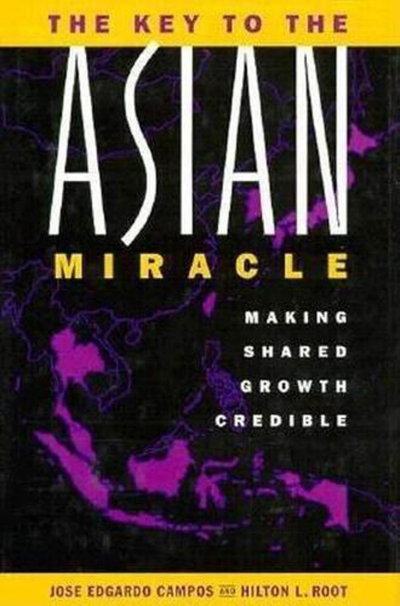
The Key to the Asian Miracle
Making Shared Growth Credible
Authors:
|
Publisher:
2001
Summary
"Easily the most informed and comprehensive analysis to date on how and why East Asian countries have achieved sustained high economic growth rates, [this book] substantially advances our understanding of the key interactions between the governors and governed in the development process. Students and practitioners alike will be referring to Campos and Root's series of excellent case studies for years to come." Richard L. Wilson, The Asia Foundation
Eight countries in East Asia--Japan, South Korea, Taiwan, Hong Kong, Singapore, Thailand, Malaysia, and Indonesia--have become known as the "East Asian miracle" because of their economies' dramatic growth. In these eight countries real per capita GDP rose twice as fast as in any other regional grouping between 1965 and 1990. Even more impressive is their simultaneous significant reduction in poverty and income inequality. Their success is frequently attributed to economic policies, but the authors of this book argue that those economic policies would not have worked unless the leaders of the countries made them credible to their business communities and citizens.
Jose Edgardo Campos and Hilton Root challenge the popular belief that East Asia's high performers grew rapidly because they were ruled by authoritarian leaders. They show that these leaders had to collaborate with various sectors of their population to create an environment that was conducive to sustained growth. This required them to persuade the business community that their investments would not be expropriated and to convince the broader population that their short-term sacrifices would be rewarded in the future. Many of the countries achieved business cooperation by creating consultative groups, which the authors call deliberation councils, to enhance accountability and stability. They also obtained popular support through a variety of wealth-sharing measures such as land reform, worker cooperatives, and wider access to education.
F
Search publication
Bibliographic data
Edition
1/2001
Copyright Year
2001
ISBN-Print
978-0-8157-1360-9
ISBN-Online
978-0-8157-2303-5
Publisher
Rowman & Littlefield, Lanham
Language
English
Pages
198
Product Type
Monograph
Table of contents
ChapterPages
Contents No access
Introduction No access
Rapid Growth, Reduced Poverty, and Improved Income Distribution No access
Political Contestability: The Communist Threat in East Asia No access
Wealth Sharing, Regime Stability, and Growth No access
Land Reform and Rural Development No access
Investing in Education and Promoting Labor-intensive Manufacturing No access
Promoting Small- and Medium-Sized Enterprises No access
Developing Rural Infrastructure No access
Allocating Corporate Equity No access
Sharing with Labor: Effective Tripartism No access
Worker Cooperatives No access
Public Housing Programs No access
Summary No access
The Deliberation Council No access
National Wages Council: Singapore No access
The Implications of Councils for Economic Performance No access
The Political Role of Councils No access
Summary No access
Taiwan No access
Indonesia No access
Expectations and Credibility No access
The Route to Competency No access
Balancing Independence and Accountability No access
Implications for Economic Growth No access
7. Conclusion: The Rise of East Asia in Comparative Perspective No access Pages 174 - 178