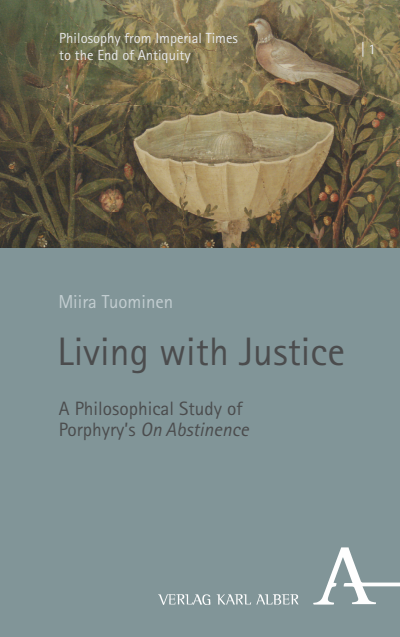
Living with Justice
A Philosophical Study of Porphyry’s ‘On Abstinence’- Authors:
- Series:
- Philosophy from Imperial Times to the End of Antiquity, Volume 1
- Publisher:
- 2025
Summary
The main objective of this book is to show that Porphyry extends moral concern to harmless living beings in his account of justice in On Abstinence. Miira Tuominen argues that while Porphyry shares some commonalities with the Platonists, Stoics and Theophrastus on the nature of justice, he develops an original notion of justice also attributing it to external actions. As an attribute of actions, justice consists in refraining from harming harmless animate creatures including animals and plants. Porphyry’s account is entangled with his polemic with opponents of vegetarianism and his quotations from other authors in that polemic. By unravelling these inner complexities of the treatise, this book shows the surprising modernity of his discussions.
Keywords
Search publication
Bibliographic data
- Edition
- 1/2025
- Copyright Year
- 2025
- ISBN-Print
- 978-3-495-99117-6
- ISBN-Online
- 978-3-495-99118-3
- Publisher
- Karl Alber, Baden-Baden
- Series
- Philosophy from Imperial Times to the End of Antiquity
- Volume
- 1
- Language
- English
- Pages
- 351
- Product Type
- Monograph
Table of contents
- Titelei/Inhaltsverzeichnis No access Pages 1 - 10
- 1.1.1 Porphyry’s dilemma No access
- 1.1.2 My main claims and approach No access
- 1.2.1 Porphyry and On abstinence No access
- 1.2.2 Solution in godlikeness No access
- 1.3.1 Being good, doing good No access
- 1.3.2 The Moral Status of Animals No access
- 1.4 The Structure of this Book No access
- 2.1.1 Outline of this chapter No access
- 2.1.2 Abstinence leads to a dilemma No access
- 2.1.3 Slippery slope objections No access
- 2.1.4 No injustice in our dealings with animals No access
- 2.1.5 Wisdom and piety do not require abstinence No access
- 2.2.1 The sleepers and the wakeful No access
- 2.2.2 Actions for the wakeful No access
- 2.2.3 Why are such actions needed? No access
- 2.2.4 Frugal diet: The Epicureans and Porphyry in (partial) agreement No access
- 2.3.1 Porphyry’s conclusions No access
- 2.3.2 Conclusions of this chapter No access
- 3.1.1 Central notions and claims No access
- 3.1.2 Outline of this chapter No access
- 3.2.1 The origins of sacrifice No access
- 3.2.2 It is unjust to take the life of a living creature No access
- 3.2.3 Gods delight in modest offerings, observing the person’s character No access
- 3.2.4 Justice, kinship and pleasure No access
- 3.2.5 Hiding from divinity No access
- 3.3.1 Enter Porphyry No access
- 3.3.2 Different offerings for different divinities No access
- 3.3.3 Daimones No access
- 3.4.1 Purity No access
- 3.4.2 Piety for philosophers No access
- 3.5.1 Theophrastean reforms No access
- 3.5.2 Porphyry’s reforms No access
- 4.1.1 Introduction to book 3 No access
- 4.1.2 Abstinence promotes virtues No access
- 4.1.3 The Stoic argument from (dis)similarity No access
- 4.2.1 Significant Utterance No access
- 4.2.2 Mutual understanding No access
- 4.2.3 Internal reason and affections of the body No access
- 4.2.4 Animal intelligence (φρόνησις) No access
- 4.3.1 Animal capacity to feel pain No access
- 4.3.2 Against the Stoic definition of justice No access
- 4.3.3 Justice and luxury No access
- 4.3.4 Principles of soul and body No access
- 4.3.5 Preparing for Porphyry’s account of justice No access
- 4.4 Concluding Remarks No access
- 5.1.1 Extending justice strengthens it No access
- 5.1.2 Justice lies in refraining from causing harm No access
- 5.2.1 Godlikeness No access
- 5.2.2 Porphyry’s hierarchy of godlikeness No access
- 5.2.3 Is abstinence for the sake of inner virtue alone? No access
- 5.2.4 Lack and resourcefulness No access
- 5.3.1 Porphyry’s conclusion of book 3 No access
- 5.3.2 Conclusions of this chapter No access
- 6.1 What is the Theme of Book 4? No access
- 6.2.1 Peripatetic histories of humanity No access
- 6.2.2 Spartan regulations No access
- 6.2.3 Egyptian priests No access
- 6.2.4 Jewish Sects: Essenes No access
- 6.2.5 Syrians and Persians No access
- 6.2.6 Indian naked sages and Bactrian Buddhists No access
- 6.2.7 Porphyry’s conclusions from his case studies No access
- 6.3.1 Purity and pollution No access
- 6.3.2 More cases No access
- 6.4.1 Ascetism and the assimilation to god No access
- 6.4.2 Porphyry’s argument in book 4 No access
- 7.1 Conclusions of On abstinence No access
- 7.2 Porphyry’s animal ethics? No access
- 8.1.1 Sources No access
- 8.1.2 Other Editions, Translations and Commentaries No access
- 8.2 Secondary literature No access
- 9.1 General Index No access
- 9.2 Index locorum No access