, to see if you have full access to this publication.
Book Titles No access
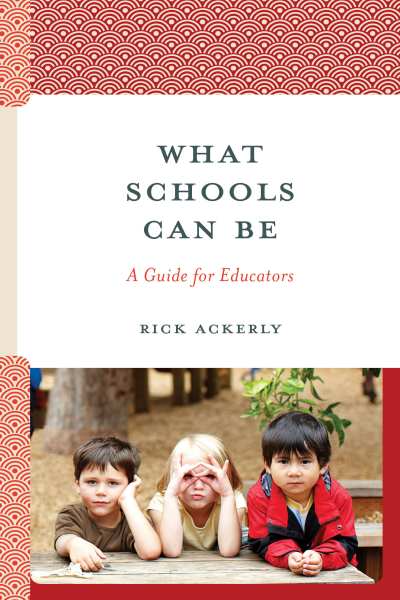
What Schools Can Be
A Guide for Educators- Authors:
- Publisher:
- 2023
Summary
In What School Can Be Ackerly shows the elements of school culture necessary for delivering good education. For more than a century, “blue ribbon” task forces have been formed to improve America’s public schools. Most of these efforts have failed because of mistaken notions about education and a failure to understand children. Education is not just curriculum, standards, and textbooks. It is the culture of the school, and the culture of American schools hasn’t changed much. Ackerly’s stories of teachers, students, and principals at work show what can be accomplished when good educational cultures are applied.
Keywords
Search publication
Bibliographic data
- Copyright year
- 2023
- ISBN-Print
- 978-1-4758-7346-7
- ISBN-Online
- 978-1-4758-7348-1
- Publisher
- Rowman & Littlefield, Lanham
- Language
- English
- Pages
- 174
- Product type
- Book Titles
Table of contents
ChapterPages
- Contents No access
- Foreword No access
- Preface No access
- Introduction No access Pages 1 - 4
- Chapter 1: Don’t Get Mad; Get Creative No access Pages 5 - 6
- Chapter 2: Thank You for Criticizing No access Pages 7 - 10
- Chapter 3: Arrogance Is a Learning Disability No access Pages 11 - 14
- Chapter 4: In Education, Failure Is an Option: New Myths for Successful Kids and Better Schools No access Pages 15 - 20
- Chapter 5: Measure What Matters No access Pages 21 - 26
- Chapter 6: The Culture We Create Is Visible in Everything We Do No access Pages 27 - 32
- Chapter 7: First-Grade Teacher Designs a Learning Organization No access Pages 33 - 36
- Chapter 8: A Leadership Culture Is Obvious to All No access Pages 37 - 40
- Chapter 9: Real Authority Brings out the Authority in Others No access Pages 41 - 44
- Chapter 10: Don’t Teach Empathy. Teach Thoughtfulness No access Pages 45 - 52
- Chapter 11: A Culture with the Soul of Creativity No access Pages 53 - 58
- Chapter 12: Conflict Aversion Is a Learning Disability No access Pages 59 - 64
- Chapter 13: Conflict Is the Crucible of Character No access Pages 65 - 66
- Chapter 14: Conflict Is Required for Creating Character No access Pages 67 - 72
- Chapter 15: Treat Kids As If Social Responsibility Is a Natural Act No access Pages 73 - 80
- Chapter 16: To Get Results, Schools Must Be in the Friendship Business No access Pages 81 - 84
- Chapter 17: Home Schooling Is an Oxymoron No access Pages 85 - 88
- Chapter 18: The “Soft,” “Non-cognitive Skills” are Hard, Cognitive, and Learned in Community No access Pages 89 - 92
- Chapter 19: Social Deprivation Causes Cognitive Deprivation No access Pages 93 - 98
- Chapter 20: Perfectionism Is Another Disability No access Pages 99 - 102
- Chapter 21: Staying out of Trouble Is Not a Worthy Mission No access Pages 103 - 108
- Chapter 22: The Need to Contribute Is a Childish Impulse No access Pages 109 - 114
- Chapter 23: Building an Organization on the Need to Contribute No access Pages 115 - 116
- Chapter 24: Diversity: The Solution, Not the Problem No access Pages 117 - 126
- Chapter 25: Authority that Brings out the Authority in Others No access Pages 127 - 130
- Chapter 26: Teacher Authority, Boundaries, and the Business of School No access Pages 131 - 136
- Chapter 27: Authority, Imperfection, and Behavior Problems No access Pages 137 - 138
- Chapter 28: True Authority Leaves Room for Others to Exercise Their Authority No access Pages 139 - 146
- Chapter 29: Integrity: Bringing Your Whole Self to the Table No access Pages 147 - 154
- Chapter 30: In Times of Crisis the Nomenclature Must Be Changed No access Pages 155 - 166
- Counter-Cultural Habits, Mores and Myths No access Pages 167 - 174