, to see if you have full access to this publication.
Monograph No access
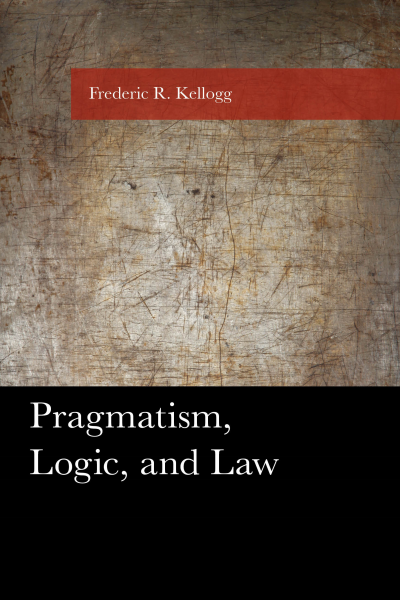
Pragmatism, Logic, and Law
Authors:
Publisher:
2020
Summary
Pragmatism, Logic and Law offers a view of legal pragmatism consistent with pragmatism writ large, tracing it from origins in late 19th century America to the present, covering various issues, legal cases, personalities, and relevant intellectual movements within and outside law. It addresses pragmatism’s relation to legal liberalism, legal positivism, natural law, critical legal studies (CLS), and post-Rorty “neopragmatism.” It views legal pragmatism as an exemplar of pragmatism’s general contribution to logical theory, which bears two connections to the western philosophical tradition: first, it extends Francis Bacon’s empiricism into contemporary aspects of scientific and legal experience, and second, it is an explicitly social reconstruction of logical induction. Both notions were articulated by John Dewey, and both emphasize the social or corporate element of human inquiry. Empiricism is informed by social as well as individual experience (which includes the problems of conflict and consensus). Rather than following the Aristotelian model of induction as immediate inference from particulars to generals, a model that assumes a consensual objective viewpoint, pragmatism explores the actual, and extended, process of corporate inference from particular experience to generalization, in law as in science. This includes the necessary process of resolving disagreement and finding similarity among relevant particulars.
Keywords
Search publication
Bibliographic data
Edition
1/2020
Copyright Year
2020
ISBN-Print
978-1-7936-1697-5
ISBN-Online
978-1-7936-1698-2
Publisher
Lexington, Lanham
Language
English
Pages
194
Product Type
Monograph
Table of contents
ChapterPages
Dedication Page No access
Contents No access
Chapter 1 The Early History No access
Chapter 2 Induction in Law and Science No access
Chapter 3 Pragmatism and the Problem of Order No access
Chapter 4 Hume, Logical Induction, and Legal Reasoning No access
Chapter 5 Positivism and the Myth of Legal Indeterminacy No access
Chapter 6 Pragmatism and Neopragmatism No access
Chapter 7 Liberalism and Critical Legal Theory No access
Chapter 8 Principles, Politics, and Legal Interpretation No access
Chapter 9 Legal Indeterminacy and the Hard Case No access
Chapter 10 The Abuse of Principle No access
Chapter 11 American Pragmatism and European Social Theory No access
Bibliography No access Pages 173 - 180
Index No access Pages 181 - 192
About the Author No access Pages 193 - 194
Similar publications
from the topics "Recht allgemein, Übergreifende Werke und Sammlungen"