, to see if you have full access to this publication.
Monograph No access
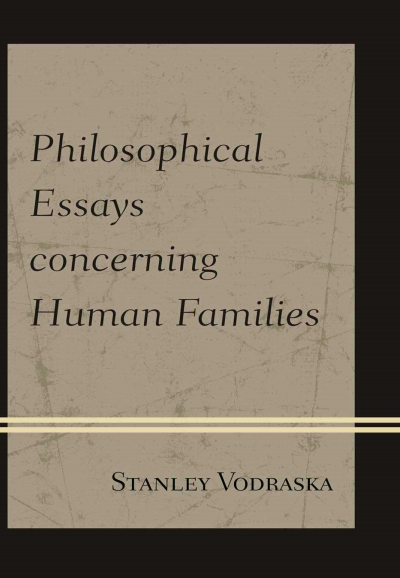
Philosophical Essays Concerning Human Families
- Authors:
- Publisher:
- 2014
Summary
In Philosophical Essays concerning Human Families, Stanley Vodraska describes a principle of moral practice that he calls “the principle of familial preference.” In ordinary circumstances, a moral agent should persistently provide preferential treatment to members of his or her family and should not pursue the good of extra-familial persons to such an extent as to disadvantage or neglect his or her family. The essays uncover this principle in human practices of love or charity, mercy, justice, and prudence, and measure its weight in religion, moral philosophy, and the political order.
Keywords
Search publication
Bibliographic data
- Edition
- 1/2014
- Copyright Year
- 2014
- ISBN-Print
- 978-0-7618-6424-0
- ISBN-Online
- 978-0-7618-6425-7
- Publisher
- Hamilton Books, Lanham
- Language
- English
- Pages
- 426
- Product Type
- Monograph
Table of contents
ChapterPages
- Contents No access
- Figures No access
- Tables No access
- References within the Essays No access
- Preface No access
- 1.1. One fragment of a history: Father Kolvenbach speaks at Santa Clara University No access
- 1.2. I gather some flowers from Father Kolvenbach’s Santa Clara speech No access
- 1.3. But in the first place Father Kolvenbach’s conclusion was a non sequitur No access
- 1.4. In the second place Father Kolvenbach’s teachings contravened the Gospel No access
- 1.5. In the third place Father Kolvenbach’s teachings contravened charity and justice No access
- 1.6. So Father Kolvenbach’s Santa Clara speech failed in at least three ways No access
- Notes No access
- 2.1. Familial preference conflicts with deontologism and utilitarianism No access
- 2.2. The principle of familial preference descends from charity to mercy No access
- 2.3. Works of mercy constitute a naturally familial practice No access
- 2.4. Works of mercy toward strangers are constrained by familial preference No access
- 2.5. Familial preference is compatible with the Parable of the Merciful Samaritan No access
- 2.6. “Catholic” social thought provides an attenuated principle of familial preference No access
- 2.7. Duties of familial preference give rise to rights of familial preference No access
- Notes No access
- 3.1. The Roman definition of justice suffers two defects; I’ll take up the second No access
- 3.2. Acts of justice aim at the right by adaptations to another according to equality No access
- 3.3. One object of acts of justice will be “the parental just” No access
- 3.4 Another object of acts of justice will be “the domestic just” No access
- 3.5. “The domestic just” is an object of acts of justice for heterosexual pairs No access
- 3.6. The acts of the kinds of justice conform to the principle of familial preference No access
- 3.7. “The parental just” and “the domestic just” give rise to natural rights No access
- 3.8. These analyses mitigate issues in modern understandings of “(what is) his right” No access
- Notes No access
- 4.1. Political life in city-states is not directly an object of natural human inclination No access
- 4.2. A political city-state is one of the civil societies produced by human art No access
- 4.3. The political city-state is not by nature superordinate to the familial household No access
- 4.4. Political life in city-states is not natural as familial life in households is No access
- 4.5. The political city-state is not necessarily or by nature prior to the household No access
- 4.6. I summarize and then suggest definitions of “family” and “human family” No access
- 4.7. I suggest a natural law version of the principle of familial preference No access
- 4.8. I suggest metaphysical priorities regarding familial life and political life No access
- Notes No access
- 5.1. In traditional moral philosophy prudence presents a distinctive set of features No access
- 5.2. In traditional moral philosophy prudence is of three distinct species No access
- 5.3. Diversity of sciences suggests diversity of prudences No access
- 5.4. Diversity of basic goods-as-ends determines diversity of prudences No access
- 5.5. Domestic prudence appears in familial flight, concealment, and migration No access
- 5.6. I describe three paradigm cases of domestic prudence No access
- 5.7. The aim of domestic prudence is “to live completely well” by domestic association No access
- 5.8. The orders within the moral virtues support a principle of familial preference No access
- Notes No access
- 6.1. Conditions for validity of contract and validity of oath seem to be the same No access
- 6.2. But contract and oath (or vow) are not the same No access
- 6.3. The marriage ceremony exhibits validity-features not of contract but of oath No access
- 6.4. There’s nothing contractual or comprehensible in an “exchange of promises” No access
- 6.5. Practices of contract performance differ from practices of oath performance No access
- 6.6. Marriage, although certainly not a contract, is certainly a social status No access
- 6.7. I offer brief tentative descriptions of some outward relations of marriage No access
- Notes No access
- Bibliography No access Pages 373 - 390
- Index No access Pages 391 - 424
- About the Author No access Pages 425 - 426