, to see if you have full access to this publication.
Monograph No access
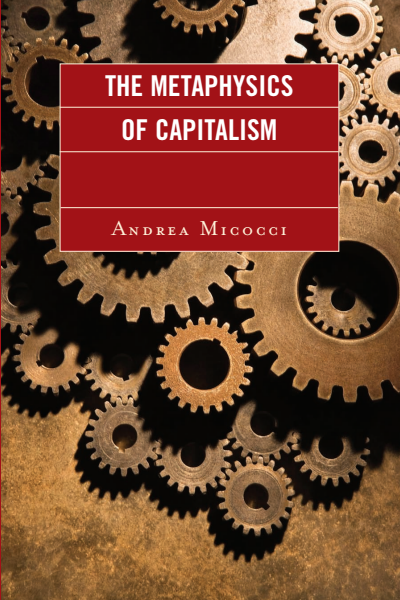
The Metaphysics of Capitalism
Authors:
Publisher:
2009
Summary
The objective of this book is to construct an individually emancipatory economic and political philosophy. This means a concrete-based, man-centered, non-hypostatizing, anti-dialectical approach to the apprehension of the material, i.e. nature in general. This constitutes an emancipation from culture-based understandings of reality, and in particular from the metaphysically biased type of culture represented by capitalism. The proposed philosophical emancipation means individual liberation from the logically flawed, massifying character of the dominant mode of thought of capitalist times. From these bases, the social sciences can also be reformulated. Micocci argues that capitalism can be conceptualized as a limited and limiting socialized mode of thought, an intellectuality whose dialectical features are effectively identified by using the proxy of political economy, both marxist and mainstream. Political economy in fact, being a most representative instance of dialectical thinking, mirrors the dialectical nature of capitalist economic and political relationships. According to Micocci, non-dialectical occurrences in capitalism are simply excluded from normal social, economic, and intellectual activities, which are performed in a metaphysical, intellectually isolated environment. In capitalism, therefore, the materials, the concrete, i.e. nature itself, is not considered as a whole but only as occasional instances. Micocci describes capitalism, in sum, as an intellectually constructed culture (a metaphysics) which preserves itself, and props itself up, by means of its iterative (market-like) functioning.
Search publication
Bibliographic data
Edition
1/2009
Copyright Year
2009
ISBN-Print
978-0-7391-2837-4
ISBN-Online
978-0-7391-3270-8
Publisher
Lexington, Lanham
Language
English
Pages
264
Product Type
Monograph
Table of contents
ChapterPages
Contents No access
Foreword No access
Preface No access
Acknowledgments No access
Ch01. Outline of an Intellectual Monster No access Pages 1 - 28
Ch02. The Anti-Hegelian Argument No access Pages 29 - 66
Ch03. Political Economy of Capitalism No access Pages 67 - 108
Ch04. The Iterative Nature of Capitalism No access Pages 109 - 148
Ch05. Capitalism’s Politeia No access Pages 149 - 190
Ch06. Capitalism versus Individuality No access Pages 191 - 226