, to see if you have full access to this publication.
Monograph No access
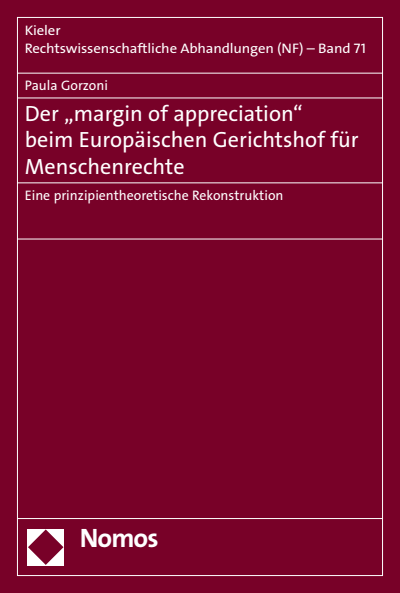
Der "margin of appreciation" beim Europäischen Gerichtshof für Menschenrechte
Eine prinzipientheoretische Rekonstruktion- Authors:
- Series:
- Kieler Rechtswissenschaftliche Abhandlungen (NF), Volume 71
- Publisher:
- 2019
Search publication
Bibliographic data
- Edition
- 1/2019
- Copyright Year
- 2019
- ISBN-Print
- 978-3-8487-5068-9
- ISBN-Online
- 978-3-8452-9273-1
- Publisher
- Nomos, Baden-Baden
- Series
- Kieler Rechtswissenschaftliche Abhandlungen (NF)
- Volume
- 71
- Language
- German
- Pages
- 300
- Product Type
- Monograph
Table of contents
ChapterPages
- Titelei/Inhaltsverzeichnis No access Pages 1 - 12
- I. Überblick und Problembeschreibung No access
- II. Kontextualisierung des »margin of appreciation«: Die EMRK und der EGMR No access
- III. Regeln, Prinzipien und der Begriff der Abwägung No access
- IV. Verhältnismäßigkeit No access
- V. Abwägung, Spielräume und formelle Prinzipien No access
- VI. These No access
- VII. Gang der Arbeit No access
- I. Bestimmung des Begriffs »margin of appreciation« No access
- II. Funktionen des »margin of appreciation« No access
- 1. Souveränität No access
- a) Subsidiarität im Völkerrecht No access
- b) Subsidiarität in der Rechtsprechung des EGMR und in der EMRK No access
- 3. Kulturelle, politische und soziale Vielfalt der Staaten No access
- 4. Das Vorhandensein unbestimmter Begriffe in der EMRK No access
- 5. Merkmale der allgemeinen gerichtlichen Funktion No access
- 1. Kriterien in Bezug auf das eingeschränkte Recht No access
- 2. Das Eingriffsziel No access
- 3. Gemeinsame europäische Standards (»common ground argument«) No access
- 4. Schwierigkeiten bei der Feststellung des Sachverhalts (»better placed argument«) No access
- 5. Politische Hintergründe (»policy grounds«) oder besondere Sachgebiete No access
- 6. Die Reichweite des »margin of appreciation« nach den Konventionsartikeln No access
- 7. Verhältnismäßigkeit und begründete Argumentationsentwicklung No access
- 1. Die Schwere des Grundrechtseingriffs und die Kontrollintensität No access
- 2. Die Wichtigkeit des betroffenen Grundrechts No access
- 3. Das Eingriffsziel und seine Objektivität No access
- 4. Europäischer Konsens und kulturelle Divergenz No access
- 5. Grundrechtsschutz innerhalb der nationalen juristischen Ordnungen und deren internationale Überprüfung No access
- 6. Umfang der Maßnahmenbewertung von der nationalen Autorität No access
- 7. Dringlichkeit der Maßnahme No access
- 8. Ungewissheit No access
- 9. Die Qualität der Begründung No access
- 10. Überblick über die Kriterien zur Bestimmung des »margin of appreciation« No access
- VI. Materielle und formelle Aspekte des »margin of appreciation« No access
- VII. Einwände gegen den »margin of appreciation« No access
- VIII. Ergebnisse No access
- I. Einleitung No access
- 1. Einwände gegen die Prinzipientheorie No access
- 2. Einwände gegen die Abwägung No access
- a) Der Begriff der Rationalität in der Rechtswissenschaft No access
- b) Modell der Abwägung No access
- c) Gewichtsformel No access
- a) Ausgangspunkt: Einwände gegen die Prinzipientheorie No access
- aa) Rahmenordnung No access
- bb) Grundordnung No access
- (1) Zwecksetzungsspielraum No access
- (2) Mittelwahlspielraum No access
- (a) Grundsatz der Geeignetheit No access
- (b) Grundsatz der Erforderlichkeit No access
- (c) Verhältnismäßigkeit im engeren Sinne No access
- (1) Empirischer epistemischer Spielraum No access
- (2) Die Erweiterung der Gewichtsformel No access
- (3) Normativer epistemischer Spielraum No access
- (4) Divergenzproblem und das Verbundgesetz No access
- d) Formelle Prinzipien und das epistemische Modell No access
- a) Gesetzgeber und Abwägung No access
- b) Drei Auffassungen zu formellen Prinzipien No access
- c) Akzessorische und nicht akzessorische formelle Prinzipien No access
- a) Einleitung No access
- b) Formelle Prinzipien: Begriff No access
- c) Differenzierungen No access
- d) Kontrollkompetenzen und das Modell konkurrierender Rechtskonzeptionen No access
- e) Kriterien No access
- f) Einwände No access
- 4. Raabe No access
- 5. Afonso da Silva No access
- a) Das Einstufungsproblem und die Einstufungsabwägung No access
- aa) Der Begriff und die Funktion formeller Prinzipien No access
- bb) Die Rolle formeller Prinzipien in der Abwägung und die Modelle formeller Prinzipien No access
- cc) Das Zweiebenenmodell No access
- dd) Gewichtungsregeln No access
- ee) Die Lösung der Kollisionen zwischen materiellen Prinzipien No access
- 7. Rivers No access
- 8. Portocarrero No access
- 9. Badenhop No access
- IV. Teilergebnisse des zweiten Teils – Abwägung und Spielräume No access
- I. Einleitung No access
- II. Die Prinzipientheorie im Völkerrecht No access
- III. Institutionalisierung der Menschenrechte im europäischen Schutzsystem, Rahmenordnung und Grundordnung No access
- 1. Einleitung No access
- 2. Die Grundlagen des »margin of appreciation« für eine prinzipientheoretische Rekonstruktion No access
- 3. Begründung des »margin of appreciation«: Das Spannungsverhältnis zwischen der Souveränität der Staaten und den Grundrechten im internationalen Kontext No access
- a) Struktureller Spielraum No access
- b) Epistemischer Spielraum No access
- 5. Fall Evans: Feststellung des »margin of appreciation« im konkreten Fall No access
- a) Die vier Hauptmodelle formeller Prinzipien No access
- b) Kombinationsmodell No access
- c) Indirekte Abwägung oder das epistemische Modell No access
- d) Das Zweiebenenmodell oder das Modell konkurrierender Rechtskonzeptionen No access
- e) Überblick zur Anwendung der Modelle No access
- V. Ergebnis No access
- Literaturverzeichnis No access Pages 289 - 296
- Rechtsprechungsverzeichnis No access Pages 297 - 300
Bibliography (119 entries)
No match found. Try another term.
- LiteraturverAarnio, Aulis: The rational as reasonable: a treatise on legal justification, 1987. Open Google Scholar DOI: 10.5771/9783845292731
- Afonso da Silva, Virgílio: Comparing the Incommensurable: Constitutional Principles, Balancing and Rational Decision, in: Oxford Journal of Legal Studies 31 (2) (2011), S. 273 ff. Open Google Scholar DOI: 10.5771/9783845292731
- Afonso da Silva, Virgílio: Der Vergleich des Inkommensurablen. Prinzipien, Abwägung und rationale Entscheidung, 2013, in: Klatt, Matthias (Hrsg.), Prinzipientheorie und Theorie der Abwägung, 2013, S. 236 ff. Open Google Scholar DOI: 10.5771/9783845292731
- Afonso da Silva, Virgílio: Grundrechte und gesetzgeberische Spielräume, Kieler rechtswissenschaftliche Abhandlungen, Bd. 41, 1. Auflage, 2003. Open Google Scholar DOI: 10.5771/9783845292731
- Afonso da Silva, Virgílio: O proporcional e o razoável, in: Revista dos Tribunais (798) (2002), S. 23 ff. Open Google Scholar DOI: 10.5771/9783845292731
- Ajevski, Marjan: Forced to Argue in Two World Views – the Margin of Appreciation and the Schismatic Identity of the European Court of Human Rights [Quelle: http://blogg.uio.no/jus/smr/multirights/content/forced-to-argue-in-two-world-views-%E2%80%93-the-margin-of-appreciation-and-the-schismatic-identity]. Open Google Scholar DOI: 10.5771/9783845292731
- Aleinikoff, T. A.: Constitutional Law in the Age of Balancing, in: Yale Law Journal (96) (1987), S. 943 ff. Open Google Scholar DOI: 10.5771/9783845292731
- Alexy, Robert: Comments and Responses, 2012, in: Klatt, Matthias (Hrsg.), Institutionalized Reason: The Jurisprudence of Robert Alexy, 2012, S. 319 ff. Open Google Scholar DOI: 10.5771/9783845292731
- Alexy, Robert: Constitutional Rights, Balancing and Rationality, in: Ratio Juris (2) (2003), S. 131 ff. Open Google Scholar DOI: 10.5771/9783845292731
- Alexy, Robert: Die Gewichtsformel, 2003, in: Jickeli, Joachim/Kreutz, Peter/Reuter, Dieter (Hrsg.), Gedächtnisschrift für Jürgen Sonnenschein, 2003, S. 771 ff. Open Google Scholar DOI: 10.5771/9783845292731
- Alexy, Robert: Die Konstruktion der Grundrechte, 2009, in: Clérico, Laura/Sieckmann, Jan-Reinard (Hrsg.), Grundrechte, Prinzipien und Argumentation: Studien zur Rechtstheorie Robert Alexys, 1. Auflage, 2009, S. 9 ff. Open Google Scholar DOI: 10.5771/9783845292731
- Alexy, Robert: Formal principles: Some replies to critics, in: International Journal of Constitutional Law 12 (3) (2014), S. 511 ff. Open Google Scholar DOI: 10.5771/9783845292731
- Alexy, Robert: Hauptelemente einer Theorie der Doppelnatur des Rechts, in: Archiv für Rechts- und Sozialphilosophie (95) (2009), S. 51 ff. Open Google Scholar DOI: 10.5771/9783845292731
- Alexy, Robert: Ideales Sollen, 2009, in: Clérico, Laura/Sieckmann, Jan-Reinard (Hrsg.), Grundrechte, Prinzipien und Argumentation: Studien zur Rechtstheorie Robert Alexys, 1. Auflage, 2009, S. 21 ff. Open Google Scholar DOI: 10.5771/9783845292731
- Alexy, Robert: Mauerschützen - Zum Verhältnis von Recht, Moral und Strafbarkeit. vorgelegt in der Sitzung vom 17. April 1993, in: Berichte aus den Sitzungen der Joachim-Jungius-Gesellschaft der Wissenschaften e.V. 11 (2) (1993), S. 3 ff. Open Google Scholar DOI: 10.5771/9783845292731
- Alexy, Robert: Postscript, 2010, in: Alexy, Robert (Hrsg.), A Theory of Constitutional Rights, 2010. Auflage, 2010, S. 388 ff. Open Google Scholar DOI: 10.5771/9783845292731
- Alexy, Robert: Rechtsregeln und Rechtsprinzipien, 2003, in: Alexy, Robert/Koch, Hans-Joachim/Kuhlen, Lothar/Rüßmann, Helmut (Hrsg.), Elemente einer juristischen Begründungslehre, 2003. Open Google Scholar DOI: 10.5771/9783845292731
- Alexy, Robert: Theorie der Grundrechte, Suhrkamp-Taschenbuch Wissenschaft, Bände 582, 1. Auflage, 1986. Open Google Scholar DOI: 10.5771/9783845292731
- Alexy, Robert: Verfassungsrecht und einfaches Recht. Verfassungsgerichtsbarkeit und Fachgerichtsbarkeit, in: Veröffentlichungen der Vereinigung der Deutschen (61) (2002). Open Google Scholar DOI: 10.5771/9783845292731
- Allan, T.R.S.: Constitutional Rights and the Rule of Law, 2012, in: Klatt, Matthias (Hrsg.), Institutionalized Reason: The Jurisprudence of Robert Alexy, 2012, S. 132 ff. Open Google Scholar DOI: 10.5771/9783845292731
- Arai-Takahashi, Yutaka: The Margin of Appreciation Doctrine and the Principle of Proportionality in the Jurisprudence of the European Court of Human Rights, 2002. Open Google Scholar DOI: 10.5771/9783845292731
- Badenhop, Johannes: Normtheoretische Grundlagen der Europäischen Menschenrechtskonvention, Kieler rechtswissenschaftliche Abhandlungen, 1. Auflage, 2010. Open Google Scholar DOI: 10.5771/9783845292731
- Bakircioglu, Onder: The Application of the Margin of Appreciation Doctrine in Freedom of Expression and Public Morality Cases, in: German Law Journal (7) (2007), S. 711 ff. Open Google Scholar DOI: 10.5771/9783845292731
- Beatty, David: The Ultimate Rule of Law, 2002. Open Google Scholar DOI: 10.5771/9783845292731
- Benvenisti, Eyal: Margin of appreciation, consensus, and universal standards, in: NYU Journal of International Law and Politics (31) (1998-1999). Open Google Scholar DOI: 10.5771/9783845292731
- Bernal Pulido, Carlos: Grundrechtsprinzipien in Spanien: Rationalität und Grenzen der Abwägung, 2007, in: Sieckmann, Jan-Reinard (Hrsg.), Die Prinzipientheorie der Grundrechte: Studien zur Grundrechtstheorie Robert Alexys, 1. Auflage, 2007. Open Google Scholar DOI: 10.5771/9783845292731
- Björnstern Baade/Sebastian Ehricht/Matthäus Fink/Robert Frau/Mirka Möldner/Isabella Risini/Torsten Stirner (Hrsg.): Verhältnismäßigkeit im Völkerrecht, 2015. Open Google Scholar DOI: 10.5771/9783845292731
- Bleckmann, Albert: Der Beurteilungsspielraum im Europa- und im Völkerrecht, in: EuGRZ (1979), S. 485 ff. Open Google Scholar DOI: 10.5771/9783845292731
- Böckenförde, Ernst-Wolfgang: Grundrechte als Grundsatznormen – zur gegenwärtigen Lage der Grundrechtsdogmatik, 1991, in: Böckenförde, Ernst-Wolfgang (Hrsg.), Staat, Verfassung, Demokratie, 1991, S. 159 ff. Open Google Scholar DOI: 10.5771/9783845292731
- Böckenförde, Ernst-Wolfgang: Grundrechtstheorie und Grundrechtsinterpretation, in: NJW (27) (1974), S. 1529 ff. Open Google Scholar DOI: 10.5771/9783845292731
- Bogdandy, A. von: Pluralism, direct effect, and the ultimate say. On the relationship between international and domestic constitutional law, in: International Journal of Constitutional Law 6 (3-4) (2008), S. 397 ff. Open Google Scholar DOI: 10.5771/9783845292731
- Bomhoff, Jacco: Balancing, the Global and the Local: Judicial Balancing as a Problematic Topic in Comparative (Constitutional) Law, in: Hastings International & Comparative Law Review (31) (2008), S. 555 ff. Open Google Scholar DOI: 10.5771/9783845292731
- Borowski, Martin/Paulson, Stanley L. (Hrsg.): Die Natur des Rechts bei Gustav Radbruch, Grundlagen der Rechtswissenschaft, Bände 24, 2015. Open Google Scholar DOI: 10.5771/9783845292731
- Borowski, Martin: Die Bindung an Festsetzungen des Gesetzgebers in der grundrechtlichen Abwägung, 2009, in: Clérico, Laura/Sieckmann, Jan-Reinard (Hrsg.), Grundrechte, Prinzipien und Argumentation: Studien zur Rechtstheorie Robert Alexys, 1. Auflage, 2009. Open Google Scholar DOI: 10.5771/9783845292731
- Borowski, Martin: Formelle Prinzipien und Gewichtsformel, 2013, in: Klatt, Matthias (Hrsg.), Prinzipientheorie und Theorie der Abwägung, 2013. Open Google Scholar DOI: 10.5771/9783845292731
- Borowski, Martin: The Structure of Formal Principles, in: Borowski, Martin (Hrsg.), On the Nature of Legal Principles: Proceedings of the Special Workshop “The Principles Theory” … Kraków, 2007, Archiv für Rechts- und Sozialphilosophie Beiheft, vol. 119, S. 19 ff. Open Google Scholar DOI: 10.5771/9783845292731
- Brauch, Jeffrey A.: The Margin of Appreciation and the Jurisprudence of the European Court of Human Rights: Threat to the Rule of Law, in: Columbia Journal of European Law (11) (2004-2005), S. 113 ff. Open Google Scholar DOI: 10.5771/9783845292731
- Brems, Eva: The Margin of Appreciation Doctrine in the Case-Law of European Court of Human Rights, in: Zeitschrift für ausländisches öffentliches Recht und Völkerrecht (56) (1996), S. 240 ff. Open Google Scholar DOI: 10.5771/9783845292731
- Brownlie, Ian: Principles of Public International Law, 6. Auflage, 2003. Open Google Scholar DOI: 10.5771/9783845292731
- Calliess, Christian: Zwischen staatlicher Souveränität und europäischer Effektivität: Zum Beurteilungsspielraum den Vertragsstaaten im Rahmen des Art. 10 EMRK, in: Europäische Grundrechte-Zeitschrift (1996), S. 293 ff. Open Google Scholar DOI: 10.5771/9783845292731
- Camilo De Oliveira, Renata: Zur Kritik der Abwägung in der Grundrechtsdogmatik. Beitrag zu einem liberalen Grundrechtsverständnis im demokratischen Rechtsstaat, Schriften zum öffentlichen Recht, Bände 1241, 2013. Open Google Scholar DOI: 10.5771/9783845292731
- Carozza, Paolo G.: Subsidiarity as a Structural Principle of International Human Rights Law, in: The American Journal of International Law (97) (2003), S. 38 ff. Open Google Scholar DOI: 10.5771/9783845292731
- Chang, Ruth: Introdution, 1997, in: Chang, Ruth (Hrsg.), Incommensurability, incomparability, and practical reason, 1997. Open Google Scholar DOI: 10.5771/9783845292731
- Chang, Ruth: The Possibility of Parity, in: Ethics (112) (2002), S. 659 ff. Open Google Scholar DOI: 10.5771/9783845292731
- Christensen, Ralph/Fischer-Lescano, Andreas: Das Ganze des Rechts: Vom hierarchischen zum reflexiven Verständnis deutscher und europäischer Grundrechte, 2007. Open Google Scholar DOI: 10.5771/9783845292731
- Christoffersen, Jonas: Fair Balance: Proportionality, Subsidiarity and Primarity in the European Convention on Human Rights, 2009. Open Google Scholar DOI: 10.5771/9783845292731
- Clérico, Laura: El examen de proporcionalidad em el derecho constitucional, 2009. Open Google Scholar DOI: 10.5771/9783845292731
- De La Rasilla del Moral, Ignacio: The Increasingly Marginal Appreciation of the Margin-of-Appreciation Doctrine, in: German Law Journal (7) (2006), S. 611 ff. Open Google Scholar DOI: 10.5771/9783845292731
- Dunoff, Jeffrey/Trachtman, Joel P.: A Functional Approach to International Constitutionalization, 2009, in: Dunoff, Jeffrey/Trachtman, Joel P. (Hrsg.), Ruling the world?: Constitutionalism, international law, and global governance, 1. Auflage, 2009, S. 3 ff. Open Google Scholar DOI: 10.5771/9783845292731
- Eissen, M.-A.: The Principle of Proportionality in the Case-Law of the European Court of Human Rights, 1993, in: MacDonald, R. S. J./Ronald J./Matscher, F./Petzold, H. (Hrsg.), The European System for the Protection of Human Rights, 1993. Open Google Scholar DOI: 10.5771/9783845292731
- Forsthoff, Ernst: Der Staat der Industriegesellschaft, 2. Auflage, 1971. Open Google Scholar DOI: 10.5771/9783845292731
- Gardbaum, Stephen: Human rights and International Constitutionalism, 2009, in: Dunoff, Jeffrey/Trachtman, Joel P. (Hrsg.), Ruling the world?: Constitutionalism, international law, and global governance, 1. Auflage, 2009, S. 233 ff. Open Google Scholar DOI: 10.5771/9783845292731
- Gerards, Janneke/Senden, Hanneke: The structure of fundamental rights and the European Court of Human Rights, in: International Journal of Constitutional Law (4) (2009), S. 619 ff. Open Google Scholar DOI: 10.5771/9783845292731
- Gerards, Janneke: Pluralism, Deference and the Margin of Appreciation Doctrine, in: European Law Journal (17) (2011), S. 80 ff. Open Google Scholar DOI: 10.5771/9783845292731
- Goldmann, Matthias: Turn to Principles, not to Values: Prinzipien als rationale Rekonstruktionen [Quelle: http://voelkerrechtsblog.com/2014/05/28/turn-to-principles-not-to-values-prinzipien-als-rationale-rekonstruktionen/]. Open Google Scholar DOI: 10.5771/9783845292731
- Greer, Steven: The Margin of Appreciation: Interpretation and Discretion under the European Convention on Human Rights, in: HR Files (17) (2000). Open Google Scholar DOI: 10.5771/9783845292731
- Grimm, Dieter: Proportionality in Canadian and German Constitutional Jurisprudence, in: University of Toronto Law Journal (57) (2007), S. 383 ff. Open Google Scholar DOI: 10.5771/9783845292731
- Gross, Oren/Ní Aoláin, Fionnuala: From Discretion to Scrutiny: Revisiting the Application of the Margin of Appreciation Doctrine in the Context of Article 15 of European Convention on Human Rights, in: Human Rights Quarterly (23) (2001), S. 625 ff. Open Google Scholar DOI: 10.5771/9783845292731
- Habermas, Jürgen: Between Facts and Norms, 1998. Open Google Scholar DOI: 10.5771/9783845292731
- Hutchinson, Michael R.: The Margin of Appreciation Doctrine in the European Court of Human Rights, in: International & Comparative Law Quarterly (48) (1999), S. 638 ff. Open Google Scholar DOI: 10.5771/9783845292731
- Jacobs, Francis G.: Recent Developments in the Principle of Proportionality in European Community Law, 1999, in: Ellis, Evelyn (Hrsg.), The principle of proportionality in the laws of Europe, 1999. Open Google Scholar DOI: 10.5771/9783845292731
- Jansen, Nils: Die Abwägung von Grundrechten, in: Der Staat (36) (1997). Open Google Scholar DOI: 10.5771/9783845292731
- Jestaedt, Matthias: Grundrechtsentfaltung im Gesetz. Studien zur Interdependenz von Grundrechtsdogmatik und Rechtsgewinnungstheorie, Ius publicum, Bände 50, 1999. Open Google Scholar DOI: 10.5771/9783845292731
- Kadelbach, Stefan/Kleinlein, Thomas: International Law – a Constitution for Mankind? An Attempt at a Re-appraisal with an Analysis of Constitutional Principles, in: German Yearbook of International Law (50) (2007). Open Google Scholar DOI: 10.5771/9783845292731
- Klabbers, Jan: Setting the Scene, 2009, in: Klabbers, Jan/Peters, Anne/Ulfstein, Geir (Hrsg.), The constitutionalization of international law, 1. Auflage, 2009, S. 1 ff. Open Google Scholar DOI: 10.5771/9783845292731
- Klatt, Matthias/Meister, Moritz: Verhältnismäßigkeit als universelles Verfassungsprinzip, in: Der Staat 51 (2) (2012), S. 159 ff. Open Google Scholar DOI: 10.5771/9783845292731
- Klatt, Matthias/Schmidt, Johannes: Spielräume im öffentlichen Recht. Zur Abwägungslehre der Prinzipientheorie, 2010. Open Google Scholar DOI: 10.5771/9783845292731
- Klatt, Matthias: Balancing competences. How institutional cosmopolitanism can manage jurisdictional conflicts, in: Global Constitutionalism 4 (02) (2015), S. 195 ff. Open Google Scholar DOI: 10.5771/9783845292731
- Klatt, Matthias: Die praktische Konkordanz von Kompetenzen. Entwickelt anhand der Jurisdiktionskonflikte im europäischen Grundrechtsschutz, Ius publicum, Bände 232, 2014. Open Google Scholar DOI: 10.5771/9783845292731
- Klatt, Matthias: Schutzpflichten in der Europäischen Konvention für Menschenrechte, 2013, in: Klatt, Matthias (Hrsg.), Prinzipientheorie und Theorie der Abwägung, 2013, S. 34 ff. Open Google Scholar DOI: 10.5771/9783845292731
- Koskenniemi, Martti: From Apology to Utopia: The Structure of International Legal Argument, 2005. Open Google Scholar DOI: 10.5771/9783845292731
- Kumm, Mattias: Alexy‘s Theory of Constitutional Rights and the Problem of Judicial Review, 2012, in: Klatt, Matthias (Hrsg.), Institutionalized Reason: The Jurisprudence of Robert Alexy, 2012, S. 201 ff. Open Google Scholar DOI: 10.5771/9783845292731
- Kumm, Mattias: The Cosmopolitan Turn in Constitutionalism: On the Relationship between Constitutionalism in and beyond the State, 2009, in: Dunoff, Jeffrey/Trachtman, Joel P. (Hrsg.), Ruling the world?: Constitutionalism, international law, and global governance, 1. Auflage, 2009, S. 258 ff. Open Google Scholar DOI: 10.5771/9783845292731
- Kumm, Mattias: The Jurisprudence of Constitutional Conflict: Constitutional Supremacy in Europe before and after the Constitutional Treaty, in: European Law Journal 11 (3) (2005), S. 262 ff. Open Google Scholar DOI: 10.5771/9783845292731
- Ladeur, Karl-Heinz: Kritik der Abwägung in der Grundrechtsdogmatik, 2004. Open Google Scholar DOI: 10.5771/9783845292731
- Leisner, Walter: Der Abwägungsstaat, 1997. Open Google Scholar DOI: 10.5771/9783845292731
- Letsas, George: Two Concepts of the Margin of Appreciation, in: Oxford Journal of Legal Studies (26) (2006), S. 705 ff. Open Google Scholar DOI: 10.5771/9783845292731
- MacDonald, R. S. J.: The Margin of Appreciation, 1993, in: MacDonald, R. S. J./Ronald J./Matscher, F./Petzold, H. (Hrsg.), The European System for the Protection of Human Rights, 1993. Open Google Scholar DOI: 10.5771/9783845292731
- Mahoney, Paul: Judicial activism and judicial self-restraint in the European Court of Human Rights: Two sides of the same coin, in: Human Rights Law Journal (1990), S. 57 ff. Open Google Scholar DOI: 10.5771/9783845292731
- Mahoney, Paul: Marvellous Richness of Diversity or Insidious Cultural Relativism? in: Human Rights Law Journal (19) (1998). Open Google Scholar DOI: 10.5771/9783845292731
- Matscher F.: Methods of Interpretation of the Convention, 1993, in: MacDonald, R. S. J./Ronald J./Matscher, F./Petzold, H. (Hrsg.), The European System for the Protection of Human Rights, 1993. Open Google Scholar DOI: 10.5771/9783845292731
- Ostrovsky, Aaron: What’s so funny about Peace, Love and Understanding? How the Margin of Appreciation Doctrine Preserves Core Human Rights within Cultural Diversity and Legitimizes International Human Rights Tribunals, in: Hanse Law Review (47) (2005), S. 47 ff. Open Google Scholar DOI: 10.5771/9783845292731
- Peters, Anne: Verhältnismäßigkeit als globales Verfassungsprinzip, 2015, in: Björnstern Baade/Sebastian Ehricht/Matthäus Fink/Robert Frau/Mirka Möldner/Isabella Risini/Torsten Stirner (Hrsg.), Verhältnismäßigkeit im Völkerrecht, 2015. Open Google Scholar DOI: 10.5771/9783845292731
- Petzold, Herbert: The Convention and the Principle of Subsidiarity, 1993, in: MacDonald, R. S. J./Ronald J./Matscher, F./Petzold, H. (Hrsg.), The European System for the Protection of Human Rights, 1993. Open Google Scholar DOI: 10.5771/9783845292731
- Poiares Maduro, Miguel: Courts and Pluralism: Essay on a Theory of Judicial Adjudication in the Context of Legal and Constitutional Pluralism, 2009, in: Dunoff, Jeffrey/Trachtman, Joel P. (Hrsg.), Ruling the world?: Constitutionalism, international law, and global governance, 1. Auflage, 2009, S. 356 ff. Open Google Scholar DOI: 10.5771/9783845292731
- Portocarrero Quispe, Jorge A.: Der autoritative Charakter der Grundrechtsabwägung. Eine Untersuchung über die Rolle der formellen Prinzipien in der Grundrechtsinterpretation, Studien zur Rechtsphilosophie und Rechtstheorie, Bände 62, 1. Auflage, 2014. Open Google Scholar DOI: 10.5771/9783845292731
- Poscher, Ralf: Insights, Errors and Self-Misconceptions of the Theory of Principles, in: Ratio Juris 22 (4) (2009), S. 425 ff. Open Google Scholar DOI: 10.5771/9783845292731
- Prepeluh, Urska: Die Entwicklung der Margin of Appreciation-Doktrin im Hinblick auf die Pressefreiheit, in: Zeitschrift für ausländisches öffentliches Recht und Völkerrecht (61) (2001), S. 771 ff. Open Google Scholar DOI: 10.5771/9783845292731
- Raabe, Marius: Grundrechte und Erkenntnis. Der Einschätzungsspielraum des Gesetzgebers, Kieler rechtswissenschaftliche Abhandlungen, N.F., 15, 1. Auflage, 1998. Open Google Scholar DOI: 10.5771/9783845292731
- Rauber, Jochen: Der „Turn to Principles“ im Völkerrecht: Theoretische und methodische Perspektiven auf die Zukunft von Völkerrecht und Völkerrechtswissenschaft [Quelle: http://voelkerrechtsblog.org/der-turn-to-principles-im-volkerrecht-theoretische-und-methodische-perspektiven-auf-die-zukunft-von-volkerrecht-und-volkerrechtswissenschaft/]. Open Google Scholar DOI: 10.5771/9783845292731
- Rauber, Jochen: Verhältnismäßigkeit und völkerrechtliche Systembildung, in: ZaöRV (2015), S. 259 ff. Open Google Scholar DOI: 10.5771/9783845292731
- Reimer, Philipp: „… und machet zu Jüngern alle Völker?“ Von „universellen Verfassungsprinzipien“ und der Weltmission der Prinzipientheorie der Grundrechte, in: Der Staat (52) (2013), S. 27 ff. Open Google Scholar DOI: 10.5771/9783845292731
- Riehm, Thomas: Abwägungsentscheidungen in der praktischen Rechtsanwendung, 2006. Open Google Scholar DOI: 10.5771/9783845292731
- Rivers, Julian: Constitutional Rights and Statutory Limitations, 2012, in: Klatt, Matthias (Hrsg.), Institutionalized Reason: The Jurisprudence of Robert Alexy, 2012. Open Google Scholar DOI: 10.5771/9783845292731
- Rivers, Julian: Proportionality and discretion in international and European law, 2010, in: Tsagourias, Nikolaos K. (Hrsg.), Transnational constitutionalism: International and European perspectives, 2010. Open Google Scholar DOI: 10.5771/9783845292731
- Rivers, Julian: Proportionality and Variable Intensity Review, in: The Cambridge Law Journal 65 (01) (2006), S. 174. Open Google Scholar DOI: 10.5771/9783845292731
- Rivers, Julian: Proportionality, Discretion and the second law of balancing, 2007, in: Pavlakos, Georg (Hrsg.), Law, rights and discourse: The legal philosophy of Robert Alexy, 2007. Open Google Scholar DOI: 10.5771/9783845292731
- Rubel, Jörgen: Entscheidungsfreiräume in der Rechtsprechung des Europäischen Gerichtshofes für Menschenrechte und des Europäischen Gerichtshofes. ein Beitrag zur Beantwortung der Kontrolldichtefrage, 2005. Open Google Scholar DOI: 10.5771/9783845292731
- Rupp-Swienty, Annette: Die Doktrin von der margin of appreciation in der Rechtsprechung des Europäischen Gerichtshofs für Menschenrechte, Europarecht, Völkerrecht, 1999. Open Google Scholar DOI: 10.5771/9783845292731
- Schlink, Bernhard: Abwägung im Verfassungsrecht, Schriften zum öffentlichen Recht, Bände 299, 1976. Open Google Scholar DOI: 10.5771/9783845292731
- Schlink, Bernhard: Der Grundsatz der Verhältnismäßigkeit, 2001, Festschrift 50 Jahre Bundesverfassungsgericht, 2001, S. 445 ff. Open Google Scholar DOI: 10.5771/9783845292731
- Schlink, Bernhard: Freiheit durch Eingriffsabwehr - Rekonstruktion der klassischen Grundrechtsfunktion, in: Europäische Grundrechte-Zeitschrift (11) (1984), S. 457 ff. Open Google Scholar DOI: 10.5771/9783845292731
- Schlink, Bernhard: German Constitutional Culture in Transition, in: Cardozo Law Review (14) (1992-1993), S. 711 ff. Open Google Scholar DOI: 10.5771/9783845292731
- Schlink, Bernhard: The Dynamics of Constitutional Adjudication, in: Cardozo Law Review (17) (1995-1996), S. 1231 ff. Open Google Scholar DOI: 10.5771/9783845292731
- Schokkenbroek, Jeroen: The basis, nature and application of the margin-of-appreciation doctrine in the case-law of the European Court of Human Rights, in: Human Rights Law Journal (19) (1998), S. 30 ff. Open Google Scholar DOI: 10.5771/9783845292731
- Shany, Yuval: Regulating jurisdictional relations between national and international courts, International courts and tribunals series, 2009. Open Google Scholar DOI: 10.5771/9783845292731
- Shany, Yuval: Toward a General Margin of Appreciation Doctrine in International Law? in: The European Journal of International Law (5) (2006), S. 907 ff. Open Google Scholar DOI: 10.5771/9783845292731
- Shaw, Malcolm N.: International Law, 5. Auflage, 2006. Open Google Scholar DOI: 10.5771/9783845292731
- Sieckmann, Jan-Reinard: Das System richterlicher Bindung und Kontrollkompetenzen, 1988, in: Mellinghoff, Rudolf (Hrsg.), Die Leistungsfähigkeit des Rechts: Methodik, Gentechnologie, internationales Verwaltungsrecht ; [27. Tagung der wissenschaftlichen Mitarbeiter der Fachrichtung Öffentliches Recht vom 10.- 13. März 1987 in Heidelberg], Heidelberger Forum, vol. 53, 1988, S. 39 ff. Open Google Scholar DOI: 10.5771/9783845292731
- Sieckmann, Jan-Reinard: Grundrechtliche Abwägung als Rechtsanwendung. das Problem der Begrenzung der Besteuerung / von Jan-Reinard Sieckmann, in: Der Staat Bd. 41 (2002), S. 385 ff. Open Google Scholar DOI: 10.5771/9783845292731
- Sieckmann, Jan-Reinard: Recht als normatives System. Die Prinzipientheorie des Rechts, Studien zur Rechtsphilosophie und Rechtstheorie, Bd. 51, 1. Auflage, 2009. Open Google Scholar DOI: 10.5771/9783845292731
- Sieckmann, Jan-Reinard: Regelmodelle und Prinzipienmodelle des Rechtssystems, Studien zur Rechtsphilosophie und Rechtstheorie, Bd. 1, 1. Auflage, 1990. Open Google Scholar DOI: 10.5771/9783845292731
- Stone Sweet, Alec/Mathews, Jud: Proportionality Balancing and Global Constitutionalism, in: Columbia Journal of Transnational Law (47.1) (2008). Open Google Scholar DOI: 10.5771/9783845292731
- Tridimas, Takis: Proportionality in community law: searching for the appropriate standard of scrutiny, 1999, in: Ellis, Evelyn (Hrsg.), The principle of proportionality in the laws of Europe, 1999. Open Google Scholar DOI: 10.5771/9783845292731
- Tsakyrakis, Stravros: Proportionality: An assault on human rights? in: International Journal of Constitutional Law (3) (2009), S. 468 ff. Open Google Scholar DOI: 10.5771/9783845292731
- van Aaken, Anne: Defragmentation of Public International Law Through Interpretation: A Methodological Proposal, in: Indiana Journal of Global Legal Studies (16) (2009), S. 483 ff. Open Google Scholar DOI: 10.5771/9783845292731
- Vedross, Alfred/Simma, Bruno: Universelles Völkerrecht, 3. Auflage, 1984. Open Google Scholar DOI: 10.5771/9783845292731
- Waldock, Claud H. M.: The Effectiveness of the System set up by the European Convention on Human Rights, in: Human Rights Law Journal (1) (1980), S. 1 ff. Open Google Scholar DOI: 10.5771/9783845292731
- Yourow, Howard C.: The Margin of Appreciation Doctrine in the Dynamics of European Human Rights Jurisprudence, 1996. Open Google Scholar DOI: 10.5771/9783845292731