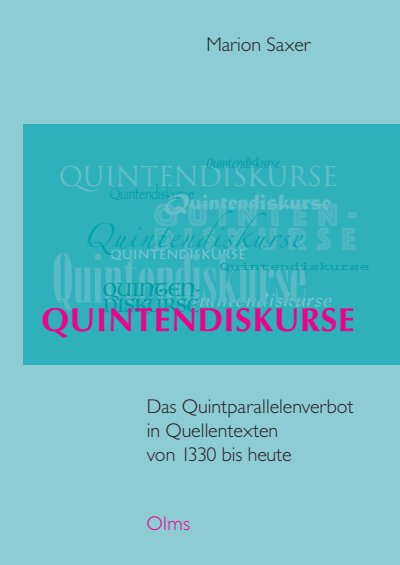
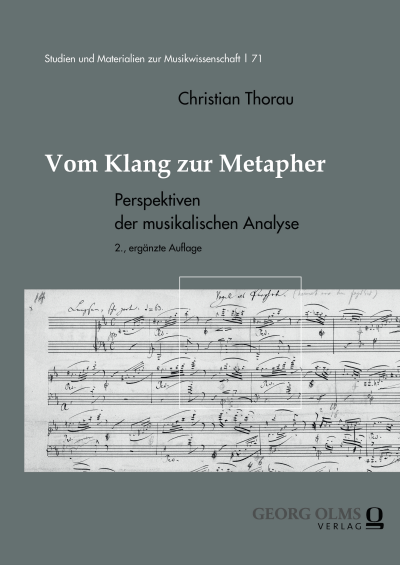
The prohibition of fifth parallels is a counterpoint rule that every professional music student learns today. Less well known is the fact that the rule was first formulated as early as 1330 in the context of an oral practice of contrapuntal singing. Its historical emergence was not anchored in the cultural memory of European music. This volume fills this memory gap by presenting the almost seven-hundred-year history of the prohibition on the basis of sixteen source texts and detailed commentaries focussing on musicology, cultural studies and media studies. Among other things, this provides surprising insights into the listening and media history of European music.
Keywords
Search publication
Bibliographic data
Copyright Year
2021
ISBN-Print
978-3-487-15859-4
ISBN-Online
978-3-487-42467-5
Publisher
Georg Olms Verlag, Baden-Baden
Series
Studien und Materialien zur Musikwissenschaft
Volume
106
Language
German
Pages
444
Product Type
Monograph
Table of contents
ChapterPages
Titelei/Inhaltsverzeichnis No access Pages 1 - 6
Inhalt Kommentartexte No access Pages 7 - 10
Vorbemerkung No access Pages 11 - 12
Einleitung No access Pages 13 - 28
Die frühste Quelle im Kontext mündlich geprägter mittelalterlicher Musikpraxis Anonymus, Quilibet affectans (um 1330) No access Pages 29 - 64
Die erste Begründung Prosdocimus de Beldemandis, Contrapunctus (1412) No access Pages 65 - 90
Neue Klausel – neues Klangbild Guillaume Dufay, Nuper Rosarum Flores (1436) und Ave Regina Celorum (um 1464) No access Pages 91 - 108
Balance zweier Praxisformen: Cantare super librum und res facta Johannes Tinctoris, Liber de Arte Contrapuncti (1477) No access Pages 109 - 134
Zitatklitterung und das Auswendigsingen Franchinus Gaffurius, Practica Musicae (1496) No access Pages 135 - 146
Die süßen Quinten I Pietro Aron, Libri tres de institutione harmonica (1516) No access Pages 147 - 154
Dynamischer Medienwandel und die Neuerfindung einer Begründung Gioseffo Zarlino, Le Istitutioni harmoniche (1558) No access Pages 155 - 206
Die süßen Quinten II und die Idee der musikalischen Fasslichkeit René Descartes, Musicae Compendium (1618) No access Pages 207 - 218
Forcierte Schriftlichkeit und Regelbruch im Dienst des Affektausdrucks Athanasius Kircher, Musurgia universalis (1650) No access Pages 219 - 248
Soziale Distinktionen Wolfgang Caspar Printz, Phrynis Mitilenaeus oder Satyrischer Komponist (1696) No access Pages 249 - 274
Außerirdisch: Die harmonische Begründung Christiaan Huygens, Cosmotheoros sive de Terris Coelestibus, earumque ornata, conjecturae ad Constantinum Hugenium fratrem (1698) No access Pages 275 - 288
Die sündigen Quinten Andreas Werckmeister, Cribrum musicum (1700) No access Pages 289 - 300
Wider die Quintenfuchserei und die nicht mehr süßen Quinten Johann Mattheson, Das Neu-- Eröffnete Orchestre (1713), Das Forschende Orchestre (1721), Der vollkommene Kapellmeister (1739) No access Pages 301 - 342
Musikwissenschaftliche Korrekturen einer diffusen Genieästhetik August Wilhelm Ambros, Zur Lehre vom Quinten-Verbote (1859) No access Pages 343 - 390
Kultur- und naturwissenschaftliche Perspektiven Hermann Helmholtz, Die Lehre von den Tonempfindungen als physiologische Grundlage für die Theorie der Musik (1863) No access Pages 391 - 402
Das Quintparallelenverbot wird historisch oder Harmonie- und Kontrapunktlehre als Propädeutika Arnold Schönberg, Harmonielehre (1922) No access Pages 403 - 428
Literaturverzeichnis No access Pages 429 - 444
Similar publications
from the series "Studien und Materialien zur Musikwissenschaft"