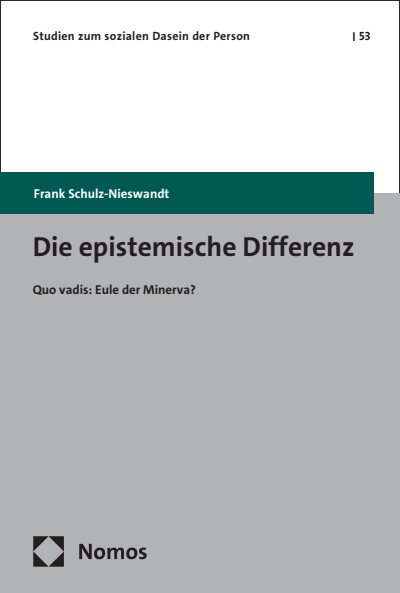
Building on the idea of ontological difference (being and existence and the mode of existential being as the mode of historical reality of life), the essay is reflecting about the epistemic difference of two truths (empirical correctness and ontological truth of form). Critical theory of alienation must measure the world of experience against the ideal-typical standard of the true form of the human being in the light of the bipolar potential (progression - regression, cosmopolitan love - narcissistic destructiveness, homo donans - homo abyssus) of the conditio humana. The true form of man is conceived in his personhood as selfhood in solidaric togetherness which morphologically takes the form of a cooperative grammar in in oikos, polis, cosmos.
Keywords
Search publication
Bibliographic data
Copyright Year
2024
ISBN-Print
978-3-7560-0748-6
ISBN-Online
978-3-7489-1906-3
Publisher
Nomos, Baden-Baden
Series
Studien zum sozialen Dasein der Person
Volume
53
Language
German
Pages
132
Product Type
Monograph
Table of contents
ChapterPages
Titelei/Inhaltsverzeichnis No access Pages 1 - 8
Vorwort No access Pages 9 - 12
Einleitende Vorbemerkungen No access Pages 13 - 44
1. Erkenntnisinteresse und Werkzusammenhang No access Pages 45 - 50
2. Die conditio humana: Dependenzgrammatik der Freiheit No access Pages 51 - 58
3. Polarität als Strukturgesetz No access Pages 59 - 64
4. Dynamische Prozessontologie No access Pages 65 - 72
5. Ästhetik der Lebensform No access Pages 73 - 76