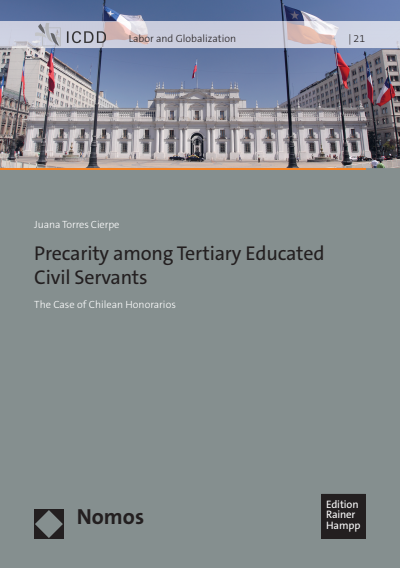
Precarious working conditions are spreading among highly qualified workers. The Chilean civil service employs many university graduates, the honorarios, on a temporary basis. Torres explores the question of what follows objectively and subjectively from this special status of non-recognition of the honorarios’ de facto dependent employment relationship for these workers, and whether commonalities in experiences and self-understanding arise on this basis, which in turn form the starting point for a conscious stance as a collective actor. Her answers are guided by Honneth's recognition theory and Paugam's theory on strategies for dealing with precarity. In this way, Torres enriches insights into possible identity constructions among precarious workers.
Keywords
Search publication
Bibliographic data
Edition
1/2021
Copyright Year
2021
ISBN-Print
978-3-98542-003-2
ISBN-Online
978-3-95710-290-4
Publisher
Hampp, Baden-Baden
Series
Labor and Globalization
Volume
21
Language
English
Pages
183
Product Type
Monograph
Table of contents
ChapterPages
Titelei/Inhaltsverzeichnis No access Pages I - X
Methodology No access
Problematisation and research question No access
Hypotheses No access
Objectives No access
INTRODUCTION No access
1.1. Classical approaches to identity: towards the relevance of this concept in the world of labour No access
1.2. Process of identity construction: from the individual to the collective No access
1.3. The Chilean discourse to describe the experience of non-recognition based on the ideal of rights No access
2.1. Strategy based on the lineal (family) bond. No access
2.2. The development of trade unions as a strategy based on the organic bond No access
2.3. Factors of common identity and collective identity: a brief debate No access
Introduction No access
1.1. The historical roots of the dismantling process of the Chilean state and its public sector No access
1.2. Democracy arrival and its continuities with the dictatorship No access
2.1. The different methods of hiring employees in the public sector No access
2.2. Regulation of the Honorarios agreement and its consequences No access
3.1. Honorarios public employees and Honorarios private workers No access
3.2. Public Honorarios employees compared to civil servants in the central Administration No access
3.3. Honorarios employees in Municipalities No access
4.1. Individual characterisation of Honorarios employees in the public sector No access
4.2. The working conditions of Honorarios employees in the public sector: A comparison to civil servants No access
Introduction No access
1.1. Brief review of the Chilean higher education system as a reproducer of social inequality No access
1.2. Distribution of respondents in the social division of labour according to their socioeducational background No access
2.1. Meanings of having gone through higher education No access
2.2. Meanings of being professional No access
2.3. Meanings of labour in the lives of Honorarios employees No access
Introduction No access
1.1. The lack of labour rights: perceptions around it No access
1.2. The relationship between Honorarios employees and their fellow civil servants. The construction of them and us No access
2.1. The recognition as a public employee No access
2.2. Is there a willingness on the Chilean state to recognise Honorarios as public employees? No access
2.3. Meanings associated with having a formal employment contract No access
2.4. The labour circle of Honorarios: the social-esteem promoters No access
3. Honorarios and precariousness: their fears and uncertainties No access
Introduction No access
1.1. Strategies based on the self No access
1.2. Strategies linked to lineal bonds No access
2.1. Honorarios trade unions panorama No access
2.2. The Honorarios unionisation strategy on the shop floor No access
2.3. The boss role in the provision of rights No access
Conclusion No access Pages 166 - 170
Bibliography No access Pages 171 - 176
Annexe N°1: The methodological techniques to address the study subject No access